The bedside bookstack – November 2020

What I’m reading and what’s gathering dust on the bedside bookstack this month.

Sisters by Daisy Johnson, Jonathon Cape 2020

By some random literary luck, I picked up three novels this month that could be loosely described as modern gothic. This one definitely felt like it was a firm fit for the genre. It was as compelling as it was unsettling and at times it felt like I was caught in the pages of a Henry James novel.

July and September are sisters. They’re a slim 9 months apart but their connection is more like twins. After an undisclosed event at school, their mother moves them away to a remote house owned by her ex-husband’s sister. The house has history for all of them but there is a sense of things closing in metaphorically rather than the freedom and release of being remote.

September, the older sister, has a ravenous love and control over July. And the mother, in her own fog of grief and depression fears September as a version of the violent husband who fathered her.

I read it a bit franticly, trying to keep up with the action and get to the final reveal. I read so fast that I was sure I was missing something important and wasn’t quite putting all the pieces together but I didn’t want to slow down and in the end it all comes out.

A warning that it’s always raining – everyone is always wet and muddy and cold. There’s a lot of stumbling around in the dark and I longed for some warm waterproof clothes and a few sunny days to dry everything out. Not very gothic of me, I know.

The Bass Rock by Evie Wyld, Vintage 2020

I think this book would have to be in my top five for 2020. I just loved it. It’s the second of my accidental gothic novels this month with parallel narratives about three women all linked by family, location and a haunting. The bristling and elemental Scottish coastline is very much a character too.

Violence and aggression against women is a common thread through these narratives from the extremes of stabbed bodies to the attrition of emotional manipulation and insistence.

There is the idea that these women aren’t to be trusted and so they doubt themselves when really, it’s the men in their lives who should be viewed suspiciously.

They’re often frozen by their own doubts about what’s going on and revert to the shamefully familiar thought -‘I shouldn’t make a big deal about it.”

This was a real ‘wow’ read for me.

Kim Jiyoung, Born 1982 by Cho Nam-Joo, Scribner 2020

Kim Jiyoung is the Korean every-woman. She’s named for the most popular girl’s name in that year. She is a normal girl with a normal family who follows the ‘normal’ path. Normal starts to unravel for her after having a baby when she briefly takes on the persona of other women in her life.

This book reads like a diary or catalogue. It lists, in a very understated way, the norms of Jiyoung’s life as a woman, especially a young one.

The preferential treatment of male siblings, classmates and colleagues made my blood boil. And the endemic misogyny in workplaces was a sobering reminder that things have only changed very recently and the fact that I tutted with recognition when I read it makes me wonder how much has actually changed.

Thank god this book was written and that a million copies have been bought breaking the code of ‘keeping quiet like a good girl’.

Sweetness and Light by Liam Pieper, Hamish Hamilton, 2020

I stayed up late last night to finish this one. It was a real page turner for me and should replace ‘The Beach’ as the definitive backpacker book. I liked the premise of an Australian expat in India who scams tourists in a beach town who then gets himself in too deep. Worlds collide when he runs into an American woman looking for a spiritual experience and a way to move on with her life.  

Anyone who has done any travel, especially backpacking, through south-east Asia, will love the familiarity of it all. Overnight trains, touts and tea stalls, seekers and surfers are all brought to life in a familiar but sometimes uncomfortable light.

I didn’t know how or where this one was going to end – which is a great thing and I recommend it as a perfect summer read.

Flyaway by Kathleen Jennings, Picado, 2020

This was the last of my accidental gothic trio of books this month and is by the very talented Kathleen Jennings whose gorgeous and other-worldly cut-paper silhouettes deserve their own mention.

But I digress…Bettina lives in the quiet rural town of Runagate with her mum. Her brothers and father have disappeared and there are rumours about strange creatures that have been sighted nearby.

I have to confess, I was very tired when I read this and was kind of unmoored from the start. I was never clear on when and where we were exactly and what was going on. It was described as part folk tale, part mystery, so there’s an intention for the reader to be unsettled and uncertain. They sure were for me.

The love of a good woman by Alice Munro, Vintage 1998

I picked this up at a garage sale and I love finds like this because they seem to arrive so serendipitously. I’d just been thinking I needed another Alice Munro on my shelf. I only have Dear Life thus far.

Haven’t read a word of it yet but am always happy for the bedside bookstack to have a few anthologies when I’m between books or just want a little slice of something. I’m sure I’ll get some in over the summer break.

Tools of Titans by Tim Ferriss, Vermilion 2016

This tome of a thing is sitting at the bottom of my bookstack. Not at all the kind of book I usually get, I bought it because of the eloquent recommendation that Katherine Colette gave it on the First Time Podcast.

The subtitle is: the tactics, routine and habits of billionaires, icons and world-class performers. So, there’s obviously going to be some interesting stuff in there but how and when to find it?

I already have another couple of writing/business books sitting around unread. The problem is that I do most of my reading at night and this is a ‘work’ book, so when am I going to choose that over the pleasure of a narrative?

Being realistic, it’s only going to get opened if I put it in as part of my working day.

If you enjoyed reading this and want blog updates, subscribe to my monthly newsletter below.

Processing…
Success! You're on the list.

Do books belong out in the world or on your bookshelf?

For something that is really just printed words on paper, we have some very strong feelings and ideas about our books as possessions. Seeing a full bookshelf calms me and holding a book is always a comfort. But my passion in their power also means that I think they need to be read, so I’m happy to lend out my books.

A book is meant to be read, hopefully by as many people as possible. I love it when someone asks me if I have anything good to read. I have a look on my shelves and pick out what I think is the right pick for them at the time.

I’d like to get the book back eventually but it’s a bit of an honesty system (I am lending to family and friends after all) and not every book comes back to the shelf.

There are a few books which I keep lending out and then rebuying. One is Annie Proulx’s That Old Ace in the Hole and the other is Elizabeth Gilbert’s celebration of creativity, Big Magic. Which reminds me, I don’t have a copy of either of them at the moment. Short story anthologies are something else I’m always lending out too.

Some people use Ex Libris bookplates in the front of their books but anecdotally, they don’t guarantee that a book will ever return.

I always know if someone else’s book is on my shelves though. I’m very aware of possessions that aren’t mine. For me, a borrowed book feels a bit like an unpaid debt until it’s been returned.

Books have sentimental value and financial value. Some are out of print and can’t be replaced. Others I just want on my shelves but any copy will do. My general hope is that I remember both that they’re gone and who they went to. And when it doesn’t work out that way, when I have an inkling that I used to own a book which is no longer there, there is a consolation in thinking of it making its way in the world onto other bookshelves and into other hands.

If you enjoyed reading this and want blog updates, subscribe to my monthly newsletter below.

Processing…
Success! You're on the list.

The bedside bookstack – October 2020

What I’m reading and what’s gathering dust on the bedside bookstack this month.

Stone Sky Gold Mountain by Mirandi Riwoe, University of Queensland Press, 2020

Set in the Australian gold fields, this story is told by Chinese gold miners, Mei Ying and her brother Lai as well as Merri, the Irish housekeeper of a local prostitute.

Everyone is holding secrets, Ying is disguised as a boy, her brother chats with his dead fiancé and Merri has been forced to leave home and give up her child because she’s unmarried.

There’s sweat and dirt and hunger. These characters are here because of other people’s choices. Ying finds liberation in her ability to work and wander freely. Merri’s social standing is equal to her employer’s. But they’re both still women in a man’s world.

There’s debt and decency at stake and as their lives overlap and run parallel, even friendship and connection isn’t enough to dilute the separation of white miners, Chinese miners and local Indigenous people.

Act of Grace by Anna Krien, Black Inc., 2019

In the early parts of reading this book I would put it down and think, why bother trying to write when other people just do it so much better?

I know Anna Krien from her non-fiction. She’s thorough and eloquent and her recent piece The screens that ate school in The Monthly, had me in tears. As I said, the writing in this is sometimes so beautiful it feels like it’s about as good as writing can get.

There are multiple narrative strands that link the lives of a war veteran and his son, an Iraqi refugee and a young girl trying to square her identity and the fate of her father. They didn’t ultimately tie together for me, but why stop reading when the writing is so good?

The Shadow Year by Hannah Richell, Hachette, 2013

This started as a slow burn for me and I nearly left it a few pages in. But I was curious enough about some of the set up to keep reading and I’m glad I did. There’s an element of Lord of the Flies to it with five recent uni graduates trying to live off the land for a year in a rundown cottage in the remote Peak District.

When the sister of one of them arrives, the dynamic shifts and in close proximity sex, jealousy and power plays change everything.

There’s a parallel narration in the present day which was necessary for the plot reveals but I skipped through some of those parts. My fascination was with the blinkered love, sibling rivalry and desperation and how it can make us protect perpetrators and cast out victims.

The Remains of the Day by Kazuo Ishiguro, Faber, 1989

This was a tricky read for me. I read it because it won a Booker many moons ago and I’ve loved reading other Ishiguro books.

For those who don’t know the premise or haven’t watched the movie (Emma Thompson and Anthony Hopkins) it’s basically a butler, Stevens, from a once distinguished household narrating his younger years through the memory of a housekeeper, Miss Kenton.

Theirs is a close working relationship and for Stevens there is no separation between work and life.

This is what I struggled with, the loyalty to a boss and a position at the expense of his personal life. I know it’s making comments about pride, reserve, controlled emotions and the expectations of the hired help but that’s what made it hard to read for me. Anyone else need more emotion in a main character to keep on going?

Sweetness and Light by Liam Pieper, Hamish Hamilton, 2020

This one just joined the pile yesterday, borrowed from a friend. I like the premise of an Australian expat in India who scams tourists in a beach town then getting himself in too deep. Worlds collide when he runs into an American woman looking for a spiritual experience and a way to move on with her life.  

Haven’t started it yet but apparently the ending is quite ‘shocking’, so obviously I want to know what and why. That’ll probably move it to the top of the pile.

Letters of note: Mothers compiled by Shaun Usher, Canongate, 2020

Published letters satisfy the inner stickybeak in me who wants to know what everyone else is and has been saying in private. I’m not sure about letter collections and if the writers have authorised their publication or how letters come to be sold in the public sphere. Probably something to look into if I want a clear conscience about reading someone’s else’s mail.

These look good to pick up every now and again but haven’t made a start just yet.

What we talk about when we talk about love by Raymond Carver, Vintage, 2009

It’s never a bad time to read some Raymond Carver. Five-page average length and clean prose mean you can fit at least one story in before bed, even if you’re tired.

How can you compress whole lives within a few pages? That’s why we keep reading, to see where and how the magic is done.

If you enjoyed reading this and want blog updates, subscribe to my monthly newsletter below.

Processing…
Success! You're on the list.

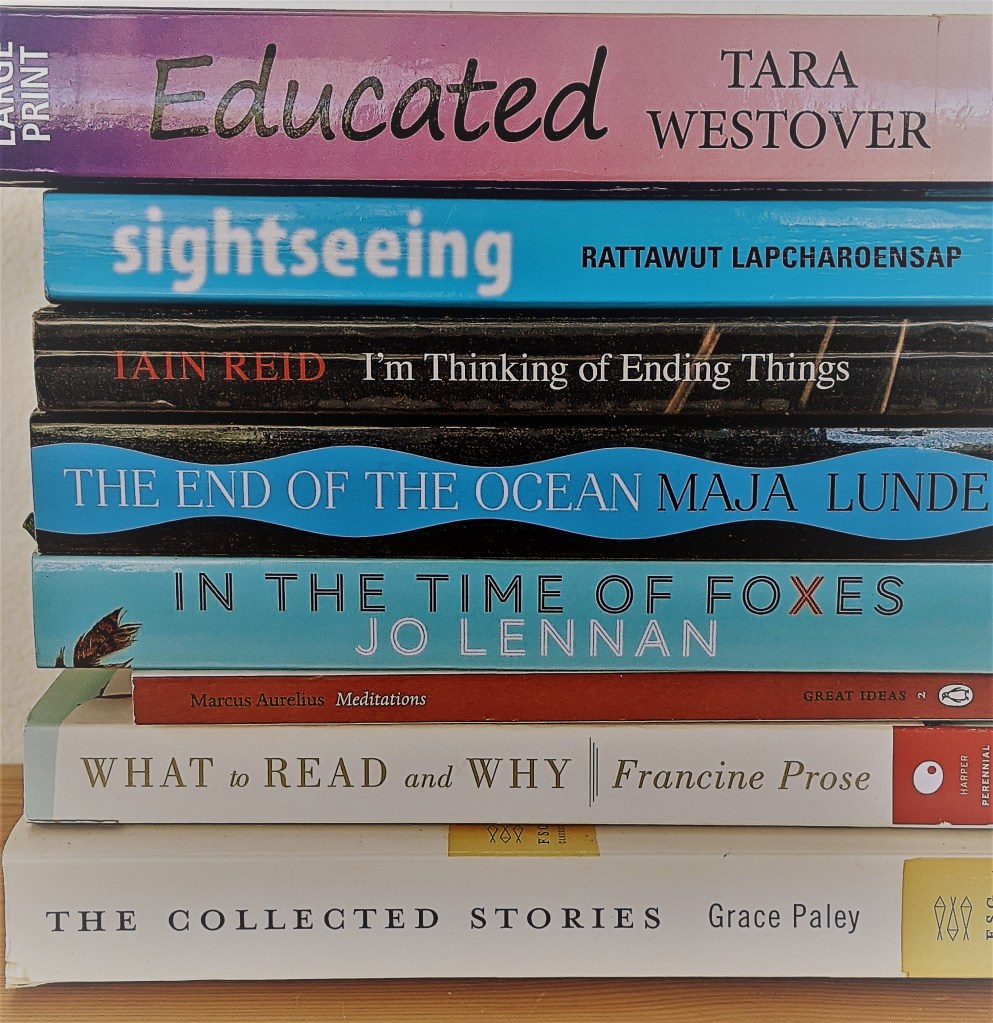
The bedside bookstack – September 2020

What I’m reading and what’s gathering dust on the bedside bookstack this month.

Educated by Tara Westover, Penguin, 2018

I couldn’t put this book down. It was me at the height of my voyeurism, gob-smacked at a glimpse into lives I can’t even imagine living. And that’s what books are for right, to take us somewhere else completely and allow us exposure into other pockets and corners of the world?

This is a memoir about growing up with a radical survivalist father, a violent brother and no formal education. It made me furious about these men who hold their family to ransom with their ideology and convictions and the social system that allows them to have that hold and sway over the people they love.

I’m so glad she wrote this so I could read it. But I always wonder about these translators, what is the cost in the end? She constantly weighs up the cost of splitting from her family which is huge enough but to then make that story public and for it to become a bestseller, I worry about the personal fall out.

Richard Fidler has a great chat with her on this Conversations episode.

In the Time of Foxes by Jo Lennan, Scribner, 2020

It wouldn’t be a bookstack without an anthology of short stories. These stories move from London to Wollongong to Moscow and even Mars. They follow people who are close but growing apart and strangers whose lives overlap even if it’s only for short time.

And always there’s the fox loosely linking one story to the next – as a painting on a wall, a personal characteristic or a real live animal digging up a backyard.

The End of the Ocean by Maja Lunde, Scribner, 2019

This is the first climate fiction book I’ve read and I didn’t even know that’s what it was when I borrowed it. What to say about this genre? It’s important but uncomfortable to read because the facts aren’t good and the future scenarios are even worse. I hate to admit but after reading the news and working all day, eternal drought and water shortage are a tough bedtime read.

However, once I got into it, I found that that characters and the story distracted me from the doom of their surroundings.

This is two concurrent stories, one in 2017 and the other in 2041. The present follows Norwegian activist Signe as she takes part in her final protest which is both personal and environmental. She sails on her boat – the same boat that David and his daughter find in 2041 as they search for family and a future in a dry landscape where anyone who is left is searching for the same things too.

I’m thinking of ending things by Iain Reid, Text Publishing, 2016

I don’t usually read books that are scary but I read a good review of this one and also saw that Charlie Kaufman had made a version of it for Netflix. It’s the insanely tense story of an unnamed narrator and her boyfriend, Jake, as they go to visit his parents in a remote rural town.

In between the chapters there is dialogue from locals alluding to a gruesome crime. The build up is creepy and everything is just a bit off. The visit to the parent’s farm is weird and then they get caught in a snowstorm on the way home.

I didn’t finish reading it. I do most of my reading at night and I got genuinely spooked. I did skip to the end though…in the daytime and I was confused. Reviewers of the Netflix series said a similar thing.

I’ll leave you to read it in full, piece it together and get back to me.

Upstream by Mary Oliver, Penguin Press, 2016

Who doesn’t need Mary Oliver and her words by their side at the moment?

This one’s still on my pile from the June bookstack, the July bookstack, the August bookstack and will likely remain there into the future. There are some books that stay on the stack not because they’ve been forgotten and are a ‘should’, but because their presence is a reassurance.

Upstream is a book of essays rather than her usual poetry and they are perfect to dip in and out of. Her poetic reflections always slow things down to a pace we’re probably meant to be moving at anyway.

Meditations by Marcus Aurelius, Penguin Books, 2004 (written sometime AD 121 – 180)

Will I ever read this book? This has been sitting at the bottom of the pile for a long time now. Even though I feel like I could and should be someone who reads Roman philosophy, it hasn’t happened thus far when I’m tired and have an o-so-finite reading window before I fall asleep.

I can’t quite give up on it yet though. I feel like there’s something in there for me, if I could just stay awake.

What to read and why by Francine Prose, Harper Perennial, 2018

Still haven’t read it, though my intentions from last month and the months before are the same:

When I read Francine Prose’s Reading like a writer, I fell even more in love with reading and writing. I walked away with a new list of recommended writers that I can’t believe I’d lived without, including Grace Paley and the Canadian short story writer Mavis Gallant.

I haven’t started this yet, but I’m hoping for the same sublime experience.

If you enjoyed reading this and want blog updates, subscribe to my monthly newsletter below.
Processing…
Success! You're on the list.

10 Essay Collections for Can’t-Concentrate Readers

Rescue Reading for Troubled Times Part 5

This week’s rescue reading is suggested essay collections. Don’t worry, none of them will feel like homework. I’ve cast a wide net and there’s something for everyone with travel writers, food writers, ground-breakers, satirists, novelists and quiet observers.

If this doesn’t sound right for you try last week’s Men’s Mixed Bag of Male Short Story Writers, 10 female Australian short story writers you should read or 20th Century female short story writers.

The Details – On love, death and reading by Tegan Bennett Daylight, Scribner, 2020

And that’s exactly what this beautiful book of essays is about. She’s writing as a woman, a mother, a daughter, a reader and a writer and she’s so generous with us in what she shares whether it’s her mother’s last days, her love of Helen Garner or George Saunders or childbirth-related vaginal issues.

Her eloquence and intelligence are such a pleasure to read. There was no snacking on these essays. I devoured them in two nights. This one was also on my August bedside bookstack.

True Stories by Helen Garner, Text Publishing, 1996

This collection gathers together pieces she has written from over 25 years. The subject matter jumps from giving birth to visiting a morgue, to a school dance. But it doesn’t really matter what she writes about, it all turns to gold in her hands. I think this is her true gift, the ability to find moments we all recognise and hold them still for long enough to take in the complete picture.

She’s a joy to read and these pieces are short and thus perfect for rescue reading. I also love the inscription in my second-hand copy of this book: Christina, surround yourself with good friends, good music and good books!! Love Julie.

Her collection Everywhere I Look would be another good rescue reading recommendation.

The New Journalism edited by Tom Wolfe and E.W. Johnson, Picador, 1975

This collection is for anyone interested in how the essays and non-fiction we read today came to be such a varied bunch. New journalism was a step in the direction of creative non-fiction, using literary techniques to capture real events. There’s an extract from Truman Capote’s In Cold Blood as well as seminal pieces by Hunter S. Thompson, Joan Didion and Tom Wolfe.

Kitchen Confidential by Anthony Bourdain, Bloomsbury, 2000

It doesn’t matter how you feel about his food shows, the late Anthony Bourdain could write. These essays are a great read – pacy and perfect if you’re looking for something speedy but satisfying.

This book was like the New Journalism moment for food writing. Here was a chef-written page turner about sex, drugs and haute cuisine. He was unconventional and an insider and I’m glad I now know not to order the seafood special on a Sunday.

The Global Soul by Pico Iyer, Bloomsbury, 2000

I’m a big Pico Iyer fan. He’s my favourite travel writer. I think he has such gentle, generous and intelligent observations of the world and his restlessness and desire to seek out corners of the world is very satisfying for one’s own global curiosity.

This collection is subtitled jetlag, shopping malls and the search for home. It’s an accurate one-liner for what you’ll get in this collection.

Me Talk Pretty One Day by David Sedaris, Abacus, 2000

Actually, I could just as easily list any of his other collections. These are perfect if you’re looking for something lighter. They’re ridiculous, funny and short.

David Sedaris is a humourist who works his comic magic on ordinary moments. His observations and wit will be a welcome relief from the pandemic plod.

Known and Strange Things by Teju Cole, Faber, 2016

I’ve been dipping in and out of these pieces and get something completely different every time. Politics, photography, travel, history and literature are just some of the topics Teju Cole covers.

So far, I’ve gone from Kenyan coastal folklore to the poetry of Derek Walcott, portrait photography and drones. His curiosity and knowledge blend seemingly disparate ideas so that you’re never quite sure where he’ll lead you until you’re there.

This is the story of a happy marriage by Ann Patchett, Bloomsbury, 2013

It seems Ann Patchett can write non-fiction with just as much talent and flair as she does her fiction. This collection is definitely one for writers and readers who like to get the personal behind-the-scenes tour of a writer’s ideas and life. There are essays on how she wrote her first novel, book tours, opening an independent book shop and her obsession with opera which led to her novel Bel Canto.

Columbus’ Blindness and Other Essays edited by Cassandra Pybus, University of Queensland Press, 1994

This collection was my introduction to essays as a form to be read and enjoyed. As a writer, this was my first taste of essays beyond the high school classroom.

The titular essay has stayed with me all these years. It is written by that master of sentence-level perfection; Delia Falconer. It lays a period of unexplained illness that Christopher Columbus had on the return of his second journey against her father’s Alzheimer’s disease. Both are treated with her usual eloquence and it just blew my mind that such beauty was possible in an essay.

Best Australian Essays, Black Inc, 1998 – 2018

Obviously, a collection that has already curated the best of a bunch over a year should be added to the rescue reading list. The variety of topic, style and tone will keep things interesting and the choice of twenty years’ worth of back catalogue means you’ll always be covering new ground.

Some of these may be out of print or hard to find. You can find the closest library copy of a book, anywhere in the world, through world cat.

If you enjoyed this, keep an eye out on Twitter @ninakcullen and Facebook or subscribe to my newsletter below for blog updates.  

Processing…
Success! You're on the list.

Men’s mixed bag – 5 male short story writers to read

Rescue Reading for troubled times Part 4

A lot of us are feeling distracted and unable to concentrate at the moment. My Rescue Reading series has lists of suggested short works and collections. Previous posts have included 10 female Australian short story writers you should read and 20th Century female short story writers. This week it’s a mixed bag of male short story writers.

Of course, most people would start with Chandler or Cheever. But I’m going to start with Chekhov. 

Anton Chekhov – Lady with a Lap Dog and Other Stories, 1885-1899

Let’s start the list with a classic. What can you say about Chekhov? Doctor, writer, master observer. His characters feel as real now in their hopes, jealousies and betrayals as they were when he wrote them over a hundred years ago.

His ability to create comedy and tragedy within the same space is just one of the reasons his stories are worth reading. Apparently, after reading one of these stories, Gorky wrote to him that his own work seemed ‘coarse and written not with a pen but with a log.’ So, we’re all in agreement that he’s great at what he does!

Read, re-read and then read anything Francine Prose has to say about him in Reading like a writer and read them all again.

Rattawut Lapcharoensap – Sightseeing, Atlantic Books, 2004

It’s more than elephants, tourists and the sex industry. Some of these stories answer questions you may have had about what Thai locals think of the tourist influx to their islands and mainland. Others are universal in their subject but specific to Thailand in their setting. There’s a lot here about family and the bonds that bind them, both antagonistic and loving. Brothers growing apart, a father begrudgingly accepting his son’s help and a mother and son on holiday are just a few.

Junot Diaz – Drown, Faber and Faber 1996

These stories sling you straight into the jostle and vibe of Dominican communities from urban New Jersey to Santo Domingo barrios. They’re about family and friendship, love and territory, growing up and moving on.

Nothing flat or spare here. It’s all noise and colour and life. I promise that even the most distracted reader will be helpless to the pull of perpetual motion at work in these tales.

James Joyce – Dubliners, 1914

I’ve already mentioned in an earlier post that I attempted to read Ulysses and put it down in defeat. I’ve avoided Joyce since then. No need. This collection of short stories needs no more attention or concentration than any other on this list. It allows you a glimpse into what all the Joyce fuss is about. A few easy words and he’s created a character complete with their inadequacies.

There’s a lot about money and hardly anything about religion or politics. Make sure you’re warm when you read it, because it’s often wet and cold and no one has any money.

George Saunders – Pastoralia, Bloomsbury, 2000

Read Saunders for social realism in a parallel universe where people work fulltime as exhibits in a theme park, bodies come back from the dead and managerial-speak is the new vernacular. His stories seem to bring together the worst of the 20th and 21st Centuries in the best way. He’s clever, creative and always surprising.

Some of these may be out of print or hard to find. You can find the closest library copy of a book, anywhere in the world (I know, amazing right?), through world cat.

I’ll be posting more suggested anthologies and collections for short reading. Keep an eye out on Twitter @ninakcullen and Facebook or subscribe to my newsletter below for blog updates.  

Processing…
Success! You're on the list.

The bedside bookstack – August 2020

What I’m reading and what’s gathering dust on the bedside bookstack this month.

Metal Fish, Falling Snow by Cath Moore, Text, 2020

Full Disclosure, Cath Moore is my cousin and I’m so proud of her and her debut YA novel. It’s a magical-realist road trip and the ideas and themes sprawl the dusty distance that Dylan, the main character, has to travel. Identity and race, grief and loss, and family and connection are all part of her journey.

Moving words by someone who has experienced her own variations on these ideas. If you don’t trust me to be objective, have a look at what Kill Your Darlings, The Saturday Paper, and the Big Issue have to say.

Station Eleven by Emily St. John Mandel, Picador, 2014

Phwoar!!!!! What a read!! How do you mix a post pandemic civilisation storyline with tabloid lives and Shakespeare? And, how had I never heard anything about this book in the middle of a pandemic?

Current situation aside, this is a great book about how everything can change and some things stay exactly the same when humans are involved. Now I need to check her back-catalogue and see what else I’ve been missing.

The Details – On love, death and reading by Tegan Bennett Daylight, Scribner, 2020

And that’s exactly what the beautiful book of essays is about. She’s writing as a woman, a mother, a daughter, a reader and a writer and she’s so generous with us in what she shares whether it’s her mother’s last days, her love of Helen Garner or George Saunders (I bought the book below after reading her essay on him) or childbirth-related vaginal issues.

Her eloquence and intelligence are such a pleasure to read. There was no snacking on these essays. I devoured them in two nights.

Pastoralia by George Sanders, Bloomsbury, 2000

There’s certainly nothing I can say about George Saunders that hasn’t been said better in Tegan Bennett Daylight’s essay The worst that could happen.

Read Saunders for social realism in a parallel universe where people work fulltime as exhibits in a theme park, bodies come back from the dead and managerial-speak is a scary new vernacular. His stories seem to bring together the worst of the 20th and 21st Centuries in the best way. He’s clever, creative and always surprising.

Dyschronia by Jennifer Mills, Picador 2018

This is another story that takes our world and tilts what we know to be true. The sea recedes from a small coastal town and one of the residents has visions which have included an occurrence like this.

Jennifer Mills comes highly recommended and I haven’t read anything by her before but my copy of this one is pretty big and to be honest I probably should’ve started with her short story collection The Rest is Weight. I just need to get my hands on it.

The Dickens Boy by Thomas Keneally, Vintage Books, 2020

Charles Dickens had 10 children. He sent two of his sons to Australia to become gentleman farmers. Who knew? I didn’t but obviously Thomas Keneally knew something about it.

This book is about the youngest son, Plorn. He feels the fame and achievements of his father in stark contrast to his own inability to pass any exam or ‘apply himself’. His secret is that he’s never read one of his father’s books. 

Plorn tries to make something of himself in Australia, outside of his father’s shadow, but the colony is almost as obsessed with Dickens as the Mother Country and even boundary riders in solitary huts quote his father from books he pretends to know. 

A great read on its own but even better for the salient facts I learned about Dickens without having to read a biography.

Upstream by Mary Oliver, Penguin Press, 2016

Who doesn’t need Mary Oliver and her words by their side at the moment?

This one’s still on my pile from the June bookstack and the July bookstack and will likely remain there into the future. There are some books that stay on the stack not because they’ve been forgotten and are a ‘should’, but because their presence is a reassurance.

Upstream is a book of essays rather than her usual poetry and they are perfect to dip in and out of. Her poetic reflections always slow things down to a pace we’re probably meant to be moving at anyway.

Meditations by Marcus Aurelius, Penguin Books, 2004 (written sometime AD 121 – 180)

This has been sitting at the bottom of the pile for a long time now. Even though I feel like I could and should be someone who reads Roman philosophy, it hasn’t happened thus far when I’m tired and have an o-so-finite reading window before I fall asleep.

I recently came across a Brain Pickings piece on Zadie Smith’s new essays which were inspired by her encounters with Meditations. Is this a sign? Will knowing that Zadie made it through this book spur/shame me into action? We shall see.

What to read and why by Francine Prose, Harper Perennial, 2018

Still haven’t read it, though my intentions from last month are the same:

When I read Francine Prose’s Reading like a writer, I fell even more in love with reading and writing. I walked away with a new list of recommended writers that I can’t believe I’d lived without, including Grace Paley and the Canadian short story writer Mavis Gallant.

I haven’t started this yet, but I’m hoping for the same sublime experience.

If you enjoyed reading this and want blog updates, subscribe to my monthly newsletter below.

Processing…
Success! You're on the list.

20th Century female short story writers you should read

Rescue Reading for troubled times Part 3

My Rescue Reading series is suggested short reads for people who want the bliss and escapism of words but can’t concentrate on anything beyond a few pages.

Rescue Reading Part 2 was 10 female Australian short story writers you should read.

Part 3 is a list of 20th Century female short stories writers. Some of them are pioneers of the form. All of them are interesting to read and if we read them enough, we might replace the tendency to think of the big-names of the genre as male.

Mavis Gallant – Collected Stories

Mavis Gallant is a Canadian writer. I went all in and have a giant doorstopper of collected works that I slowly worked through over a year. She spans such varied eras and landscapes but really settles in with post-war Europe.

My brief sentences don’t do her range and sympathies any justice, so I’ll let the eloquence of Francine Prose do the talking. “There’s a light voice on the surface that you can very easily slip beneath, and it’s so deep and where she’s going is so profound.”

Zora Neale Hurston – Hitting a Straight Lick with a Crooked Stick

Zora Neale Hurston wrote from the 1920s. She was the only African American student at a New York university and during that time became part of the Harlem Renaissance. 8 of the stories here are ‘lost’ from that time.

She also worked as an anthropologist and the story is that she packed a pistol together with her notepads, so she sounds as feisty and no-nonsense as her female characters who take on race and relationships and try to even their odds. Some of the stories are written in a vernacular that adds a cadence to their narrative.

Lucia Berlin – A Manual for Cleaning Women

She’s a new addition to the canon of female short story writers. She wrote for years, but this collection, which was published a couple of years ago, has brought her to a wider audience. I’m one of those grateful recent readers.

Read. This. Collection. She has a vast range and is bold with style and brave with content. Could definitely be categorised as ‘before her time’ writing, among many other things, about single parenthood, addiction and the taboo of female desire and seduction.

Elizabeth Bowen – Collected Stories

I have a brick of a book that is her collected stories. They can feel almost genteel to read (she was born in Ireland and lived in England) but then you get to one like The Working Party where a hostess desperately tries to hide the dead body of one of her staff because it’s finally her turn to have the local ladies over for tea.

She liked to peek under the lid of all that etiquette and respectability. A lot of her stories are set in London during the Second World War.

Grace Paley – Collected Stories

Grace Paley is another feisty one. She was a writer, teacher and activist and that intensity and passion is there in her stories. She’s at home with the ordinary lives, loves and losses of the common people. Her stories span the 1950s to the 1980s, definitely interesting for the modern reader considering the eras of social change.

This is a current constant in my bedside bookstack and I work through it slowly one story at a time. Check out my earlier bookstack post for some of my favourite quotes.

Alice Munro

Does she sneak in as a 20th Century writer? She crosses into the 21st Century but I think she’s been so influential on the form that I’m including her on this list. She won a Nobel for her short stories for crying out loud!

What can I say about Alice Munro that hasn’t been said before? She’s been at it for years, charting our small lives in just-enough words. We skate along with the narrative of her economical prose and there it is all along, what lies beneath.

Lithub has put together a list of 25 of her stories that you can read online.

Katherine Mansfield – In a German Pension

Katherine Mansfield was a New Zealand writer and another one who straddles two centuries (this time 19th and 20th) – even more reason to include her because she was writing as a woman and across topics that weren’t usual for the time. Her writing has also influenced what we think of a modern short story, so take that Hemingway.

Her stories and characters sometimes feel like psychological studies where characters are so tightly wound that the smallest vibration will set everything off. Some people feel her stories read a bit cool or stilted. I think it’s always interesting to see what people have been doing with the form over time. In a German Pension is a good place to start, but probably has a lighter touch than her later work.

Dorothy Parker – Collected Stories

Dorothy Parker is famous for her wit and wisecracks. She was a staff writer at The New Yorker and no one was safe in her reviews and essays.

Her stories are clever but where a one-liner is a quick hit, these carry bruises and have a sadder tone. For all the new freedoms of the age, women were still at the mercy of the men around them; for money, acknowledgement, access to power. If you’re looking for a light read, don’t start here. This is an honest take on mental health in the jazz era.

Shirley Jackson – The Lottery and Other Stories

I’ll fess up that I haven’t read any of her collections. I’ve read her novels and I’ve read her still-gives-me-goosebumps short story The Lottery. It’s her most famous story and I won’t say much for fear of spoiling it.

Shirley Jackson is way ahead of her time. Everything should be normal in her stories but it’s all just a bit off. She leaves an eerie and haunted residue on her pages that is part unnerving and part thrilling. Read The Lottery at the very least. You can read it or hear A.M. Homes reading it for the New Yorker.

Do you love your 20th Century shorts? Let me know any other suggestions you have for collections by 20th Century female short story writers.

I’ll be posting more suggested anthologies and collections for short reading over the next few weeks. Keep an eye out on Twitter @ninakcullen and Facebook or subscribe to my newsletter below for updates.  

Processing…
Success! You're on the list.

10 female Australian short story writers you should read

Rescue reading for troubled times Part 2

Last week’s post was all about rescue reading, my suggestions for short reading to keep you in a world of words when your concentration is shot and you’re too distracted to stick around for long. Here are my Rescue Reading suggestions for female Australian short story writers that would be perfect for this.

Josephine Rowe – Here until August

Beautiful stories scattered across the globe. It’s an art to be able to furnish your characters and narrative so fully while using such spare prose. She places you as firmly in Western Australia as she does in a Montreal winter. A collection that will definitely take you away if you need to not be here right now.

Melanie Cheng – Australia Day

All these doctors who also write (Vincent Lam, Chekov, Peter Goldsworthy), how do they do it? Melanie Cheng is one of them as well.

These stories capture that rare cross-section of Australia in its more realistic diversity. A place where everyone is trying to find how and where they can belong. More recently, not a short story but well worth a read, she’s written an essay on her experiences of the COVID-19 pandemic as a doctor for the Guardian.

Cate Kennedy – Dark Roots & Like a House on Fire

For a while in the noughties Cate Kennedy was constantly referred to as Australia’s ‘Queen of Short Stories’. She’s been off the radar in recent years and is writing poetry now instead. But when you go back to her two collections, you’ll realise that human dynamics are timeless in her hands.

Listen to her on Conversations with Richard Fidler. It’s a great interview about the time she and her family spent living and working in Vanuatu. If you’re time-poor though, skip right to the end and listen to her reading one of her poems. The Midas touch with all forms it seems.

Julie Koh – Portable Curiosities

These stories are the wild love-child of satire and surrealism. As a taster, in the story Sight, our narrator, China Doll, has regular conversations with the enigmatic Tattoo Man. China Doll has a third eye located in her stomach (her sister used to have one on her left shoulder). Her mum arranges for it to be surgically removed but not before China Doll has a chance to meet the brother who never came home from hospital…in lizard form.

Emily Paull – Well-behaved women

This collection is perfect if you want to dip into a little nostalgia for adolescence and its sense of longing or feel the heat of endless summers, fractured friendships and family ties both tight and loose. A good read for sand between your toes in the middle of winter.

Alice Bishop – A Constant Hum

This collection of stories is written in the aftermath of the Victorian Black Saturday fires of 2009. So, this is what happens when big news moves from the front page. People live with it, the loss of it, the trauma of it and the seedlings of hope that sometimes still grow. Stories from one paragraph to many pages to suit your current abilities of concentration.

Maxine Beneba Clarke – Foreign Soil

This debut collection won quite a few literary prizes back in 2015. It was definitely a win for readers who got to hear from voices and read about lives that don’t always make their way onto the shelves from Sudanese migrants to asylum seekers and Chinese students. She was a performance poet first and the rhythm and cadence of language and speech is also something that’s noticeable in these voices.

Tegan Bennet Daylight – 6 Bedrooms

I love a good collection of inter-linked short stories like Tim Winton’s The Turning or Elizabeth Strout’s Olive Kitteridge books. This isn’t a whole collection of linked stories but there are enough for you to chart the lives of a few characters. This is another collection to go to for coming-of-age first times and the longing, humiliation and triumph of youth.

She writes beautifully and if you’re more in the mood for non-fiction, The Details, her recently released book of essays, is another excellent option to dip in and out of.

Margo Lanagan – Singing My sister Down and Other stories

Margo Lanagan has that Margaret Atwood sense of disquiet to her stories where frightening things happen in a world that is similar but not-quite ours. The title story Singing my sister down has stayed with me like no other story since Shirley Jackson’s The Lottery.

I get goose bumps just reading the first line. We all went down to the tar-pit, with mats to spread our weight. Read it. I think it might be one of the best short stories I’ve ever read.

Fiona McFarlane – The High Places

Fiona MacFarlane is best known for her novel The night guest but for me, this book of shorts was a much better read. There’s something very classic in the style of these stories that made them feel more like a 20th Century read, and I mean that in a good way. The subjects suit the style.

You can also read her story Demolition from the May 2020 New Yorker.

Do you love your Australian shorts? Let me know any other suggestions you have for collections by female Australian short story writers.

Over the coming weeks I’ll be posting more suggested anthologies and collections for short reading. Keep an eye out on Twitter @ninakcullen or subscribe to my newsletter below for updates.  

Processing…
Success! You're on the list.

Rescue reading for troubled times

Suggested reading for when you can’t concentrate on anything.

Who can read a book right now? It’s so hard to concentrate on anything or get anything done. It’s hard to scan beyond restrictions and stats of infections, hospitalisations and deaths, a daily loop with minor variations.

And reading, which used to be a joy, seems like hard work for a concentration span which has been whittled by anxiety and circumstance. Also, hard work for tired eyes that stare at screens too many hours a day.

But there is still comfort, solace and reassurance to be found in the written word. There’s a quietness there for your mind to melt into that you won’t get from streaming a series or trawling a feed. There’s food for your soul.

So here are my reading rescue suggestions. Firstly, I’m suggesting paper as something tactile and familiar and to delineate it from the screens of our working days. Secondly, I’m suggesting short forms. The idea is to replenish those ravaged inner reserves any way we can.

Short stories

The right short story can take you away and deliver you back, (perhaps even slightly changed) in the time it takes to drink a cup of tea. Feel the satisfaction of starting and finishing something. Feel the relief of genuine distraction and the space to make your own connection with what’s on the page. I’ll be posting a series of suggested anthologies to read over the next weeks.

Poetry

Something else which can be enjoyed in short bursts and picked up and put down again for intervals. Don’t make it hard for yourself. Pick up what you have on the shelf, what you know from studying at school, or something that’s been recommended.

An old favourite

Take a favourite book from your shelf, one that feels like a best friend and is therefore no effort at all, despite the time between sittings. Read it at whatever pace you want because you know what’s coming anyway. Abandon without any hard feelings. Sometimes it’s just nice to re-connect with familiar words.

Old diaries and letters

Pick out an entry/letterl at random. You probably won’t remember anything that’s mentioned. You may be impressed by your turn of phrase or kind of mortified. If you’re like me, you’ll often be left feeling sad about the passing of time and for your former self without knowing exactly why. But look at that, half an hour just passed and you were somewhere else altogether.

Collections

Collections of letters, diaries or essays are all great for their pick-up and put-downability. They also offer diversity in subjects and styles, so you get the feeling of reading widely even though it’s all from the same source.

Over the coming weeks I’ll be posting suggested anthologies and collections for short reading. Keep an eye out on Twitter @ninakcullen or subscribe to my newsletter below for updates.  

Processing…
Success! You're on the list.