The bedside bookstack – November 2023

What’s sitting on the bedside bookstack this month.
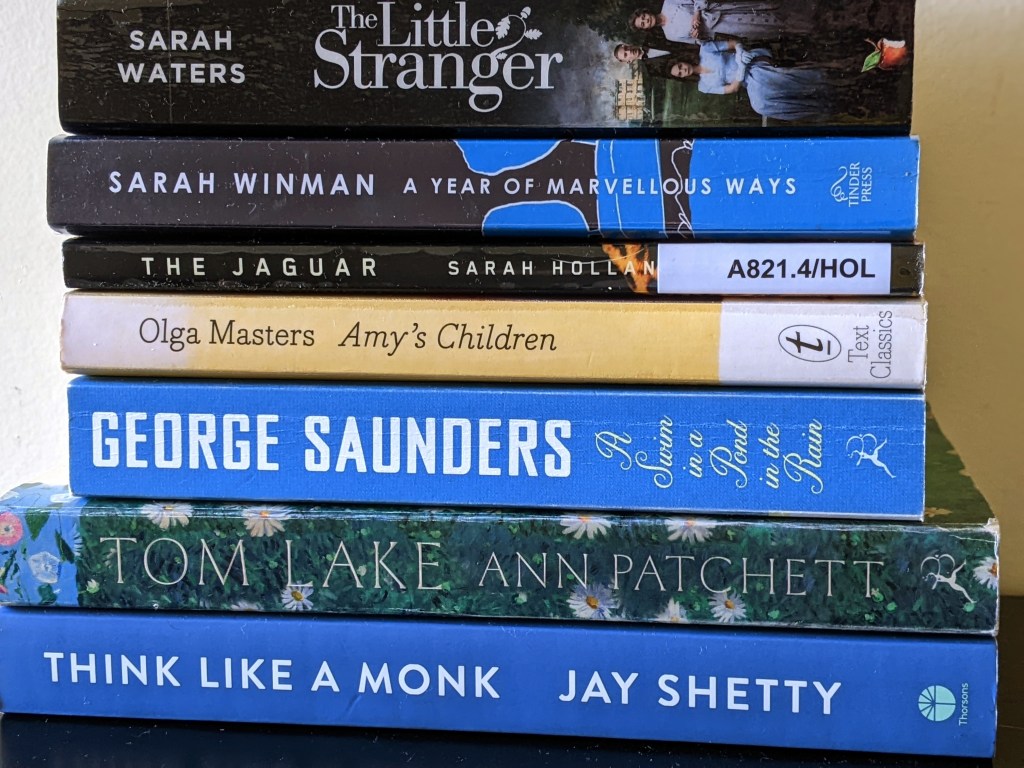
Tom Lake By Ann Patchett, Bloomsbury Publishing, 2023

It’s lockdown and Lara’s three daughters have come back home to their cherry farm to help with the harvest. In between the picking they demand that it’s time to hear the full story about their mother’s life as an actress and the summer she spent with Peter Duke who is now a famous actor but was just starting out like the rest of them back then.

This is Ann Patchett. She knows what she’s doing and a dual narrative comes off just fine in her hands. She also knows how to get in there a play around with personal dynamics and ideas about loyalty, love, creative ability, ambition and ageing. I loved the present sibling and family narrative as much as the summer at Tom Lake. This’ll be a great summer read, settle in for some seasonal nostalgia.

The Jaguar by Sarah Holland-Blatt, UQP, 2022

Sometimes poetry makes me feel stupid. I read it and just can’t find a way in. I don’t like feeling stupid, so I don’t read a lot of poetry. But that’s a shame, because it isn’t all like that and I’m so glad that this won the 2023 Stella Prize and was on the radar enough for me to pick it up.

It doesn’t make me feel stupid. It makes me see the world with fresh eyes. It makes me even more curious about words, sounds, rhythm and pace and how I could use it to better effect in my own writing. She has a lovely way of dusting some words off as well, that have been sitting on the shelf for a long time and deserve to find themselves on a page again.

For me, this collection is at its best when she recalls her father and his 20-year deterioration with Parkinson’s Disease and subsequent death. There isn’t anywhere for poets to hide with the omnipresent ‘I’ and she’s so generous with what she shares.

A Year of Marvellous Ways by Sarah Winman, Tinder Press 2015

Sarah Winman is one of my literary heroes. I just love her to bits and pieces for bringing Still Life into the world. She has so much heart and humanity in her writing and that’s present not just in a masterpiece like Still Life but also in a quieter novel like A Year of Marvellous Ways.

Marvellous Ways is a 90-year-old woman who lives in a caravan on the sea. Francis Drake is a 28-year-old soldier who had nothing to come back to in England after the war. When their paths cross Marvellous gets a chance to relive the past and Drake finally looks to the future. If you didn’t like Still Life or you need total realism in your narrative then give this one a miss. Otherwise, savour as it’s another Sarah Winman delight.

For any Winman fangirls like me, this interview she did on The First Time Podcast confirms she’s just as warm and wonderful a human as you’d think she would be.

Amy’s Children by Olga Masters, Text Publishing, 1987

I’m ashamed to say that this is the first Olga Masters I’ve read. I feel like I owe more to an Australian female writer publishing at a time when the scene was so male. Ne’er mind. I’ll be looking up her backlist now.

Amy’s husband leaves her and her three young daughters during the Depression. Living on the family farm in rural NSW, she then leaves her daughters to try and find work in Sydney. Work is scarce but no one will hire a married woman, so she makes herself slightly younger and unmarried on any applications.

This is a fascinating insight into Depression and war-time Australia, especially society’s ideas of women and the paths open to them. It’s also a nuanced offering of a mother leaving her children and atypical mother-daughter relationships. People will come down on all sides about Amy leaving her children and pretending when her eldest daughter arrives in Sydney, that she’s actually her sister. Definitely an Australian classic!

The Little Stranger by Sarah Waters, Virago, 2009

This book opens post World War One in rural Warwickshire. You’ve got the landed gentry in their slowly crumbling Georgian manor, the two house staff they can afford, a local doctor and a family of new money just moved from London.

This is beautifully written. I feel like I’m in an episode of Downton Abbey and so obviously in good hands. However, I’m 136 pages in (of 500) and it’s starting to get creepy. There are unexplained incidents in the house and a few people are starting to admit to feeling a malevolent presence. And it’s around about now that I think I’m going to put it down. I do most of my reading at night and I still haven’t totally squared myself with the dark. I don’t love scary, so I’ve called time on it. All those who like a bit of Henry James’ spooky house spirit vibe, read on.

Think Like a Monk by Jay Shetty, Thorsons, 2020

Like many of us, I’m on a journey to get a bit more calm in my life and improve the way I deal with stress. I heard Jay Shetty on the Dear Therapist podcast (my version of voyeurism which also happen to have good life advice) and they talked about this book.

After working in finance in London, he ends up moving to India and being a monk for three years. It isn’t out of the blue – he’d been spending his summers in an ashram throughout uni but it was still a huge life change. He shares his experiences of that time and teachings mixed in with modern examples to offer suggestions to ‘train your mind for peace and purpose every day’. If you’re already interested and open to these ideas, you’ll enjoy it.

If you enjoyed reading this and want to hear about the next bookstack, subscribe to my bi-monthly newsletter below.
Processing…
Success! You're on the list.

The bedside bookstack – October 2023

What’s sitting on the bedside bookstack this October.

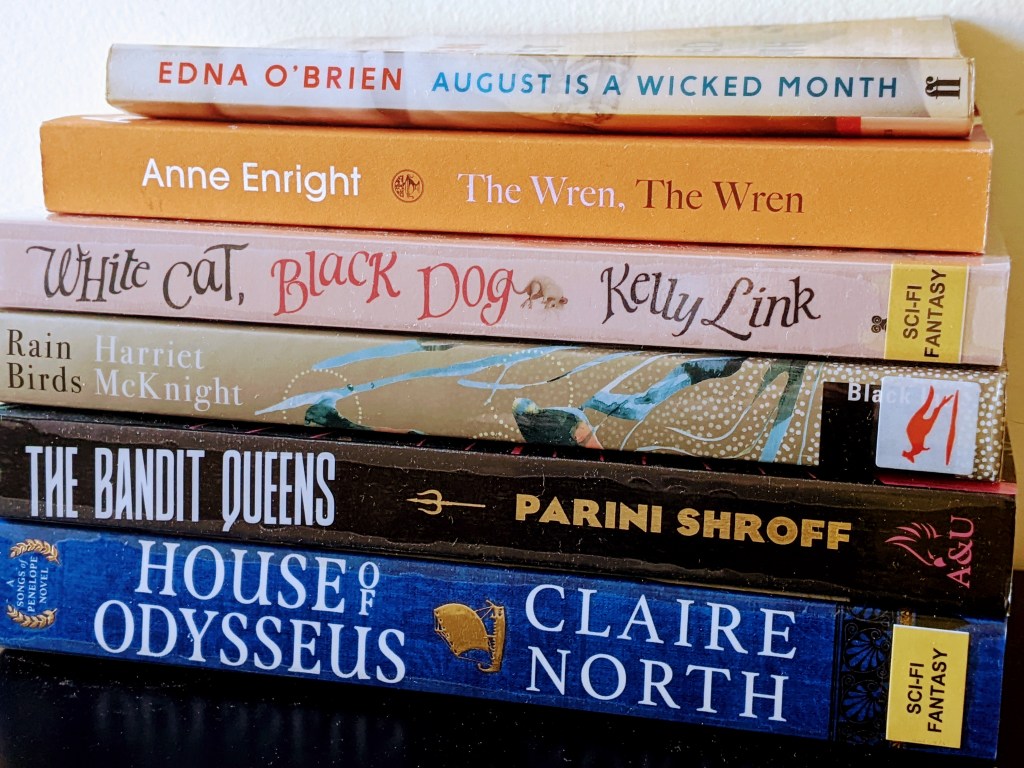
The Wren, the Wren by Anne Enright, Jonathan Cape, 2023

Anyone who’s been reading a few recent Bookstacks will notice I’m partial to Irish literature. My grandparents were Irish immigrants. Even transplanted to Australia, there’s a lot that is familiar in the cultural legacy; the Catholicism, the big families, the lack of money and knowing your place in the pecking order. So, no surprises that I’m an Anne Enright fan. Loved the Gathering, the Green Road and Actress and thus headed straight to this one when I saw she had something new out.

Carmel McDaragh’s father is a well-known fictional Irish poet, Phil McDraagh. She grows up in reaction to his dramatic leaving of the family. Her daughter Nell grows up in reaction to Carmel and so a generational pattern is set. The push and pull of love, loyalty and disappointment plays out in a destructive loop.

I wanted to love, love, love this one but it came in at like. There was something that always had me a bit wrong-footed. I don’t know if it was a lack of balance in the narration or frustration with the characters. It just never seemed to settle for me. It’s Anne Enright though, so the writing is still a joy.

The Bandit Queens by Parini Shroff, Allen & Unwin, 2023

This absolute page-turner of a book has me wondering how exactly she got me to laugh so much while at the same time covering domestic violence, sexual abuse, caste discrimination and the general all-round subjugation of women.

Geeta is part of a microloan group in rural India. Everyone in her village, and the group, think she murdered her husband because he disappeared one night five years ago. As a single woman, it’s not terrible to have a dangerous reputation but life gets chaotic when she starts to get further job requests.

It’s described as ‘a feminist revenge thriller’ and I think it takes skill to pull that off successfully, which it definitely does.

White Cat Black Cat by Kelly Link, Head of Zeus, 2023

This is a collection of seven modern fairy tales. There is something reminiscent yet foreign in these stories. You think you know where they’re going but you’re wrong. There’s a character you recognise from childhood, heading in a familiar direction but then it all tilts and you’re in a completely different world.

The blurb on the back saying  ‘poised on the edges between magic, modernity and mundanity’ is bang on.

August is a Wicked Month by Edna O’Brien, Faber & Faber, 1965

This is Edna O’Brien (incidentally more Irish literature – though she lived in England for a long time). It’s going to be gorgeously written. It’s going to get into uncomfortable interior territory. She throws her first paragraph down with the ease of someone who has 20 books to her name.

What should be a sexual awakening and liberation for young divorcee Ellen, is something sad and sullied. Wow, to be a woman in the sixties!? The humiliation and shame that was attached to desire, the vulnerability and harassment of being a woman alone. This book was initially banned in several countries.

I’m not going to lie. This book is a downer. It well-written and it’s interesting but unless you like pressing at a bruise, I wouldn’t read it when you’re feeling fragile.

Rain Birds by Harriet McKnight, Black Inc.2017

I borrowed this from the library after reading Remember This a beautiful personal essay on friendship and grief by Susie Thatcher. She and the author Harriet McKnight were friends. They met at Canary Press, bonded over writing and played a big role in the development of each other’s writing. She wrote so lovingly about Harriet and Rain Birds that I had to read it too.

Pina is feeling isolated and over-it as she looks after her husband who has Alzheimer’s. Arianna is taking part in a project reintroducing black cockatoos into the local national park but she’s dubious about their donor organisation. I’m only two chapters in so far but the portent is that their paths will cross and changing things for both of them.

If you enjoyed reading this and want to hear about the next bookstack, subscribe to my bi-monthly newsletter below.

Processing…
Success! You're on the list.

The bedside bookstack – September 2023

What’s sitting on the bedside bookstack this September.

A Swim in a Pond in the Rain by George Saunders, Vintage, 2021

What’s the next best thing to being one of the 5 or 6 students every year who nab a spot in George Saunders’ writing class at Syracuse University? Reading this book because it absolutely feels like you’re one of the 5 or 6 students in George Saunders’ nineteenth-century Russian short story in translation class!!

This one is for the readers as well as the writers. He takes 7 short stories from Chekhov, Turgenev, Tolstoy and Gogol, includes them in the book and then discusses each one. For anyone who misses the close-reading of high school or university English, this is for you. He fossicks around and asks questions and delicately takes the story apart. Then he polishes each part and by the time you finish your reading, it’s been put back together as something better and brighter. I’m loving the meticulousness of this!

Fifty-Two Stories by Anton Chekhov, Bloomsbury Publishing, 2021

I mean really, what can you say about Chekhov? That he’s timeless. That he’s nailed it. Nailed us – our dynamics and foibles and joys. He can tell a tale about an aristocrat or a farmer and it can seem like it’s about nothing but then ta-da it reveals itself to be about everything.

I feel like he’s a bit of a Helen Garner where all of life’s small moments somehow turn up on the page to be much more than the sum of their parts. This is a gem to have on the bedside table. Dip in and out. I guess the 52 is neatly suggesting a year of Chekhov. The temptation with good short stories though, is to gobble them all up.

(Incidentally, not inspired by a Swim in a Pond in the Rain. I was already reading this one)

Tell me who I am by Una Mannion, Faber, 2023

Deena Garvey has gone missing. She’s a loving mother to Ruby and a dedicated NICU nurse but a history of mental illness allows people to think that she’s done a runner. Her sister Nessa knows this isn’t the case. She thinks that Lucas, Deena’s ex-partner had something to do with it. When Lucas moves back to his childhood farm in Vermont with Ruby, he creates a new story about what happened.

Narrated over 20 years by Ruby and Nessa, this is a compelling read about family, control, loyalty and lies.

Brutus and Other Heroines by Harriet Walter, Nick Hern Books, 2016

This book was brilliant! Every so often I think it’s time I read some Shakespeare and that I really should read one of his plays I haven’t studied or seen. But time marches on and it seems too much like hard work.

Harriet Walter (who a lot of people will recognise from Succession and Ted Lasso) has appeared in productions for the Royal Shakespear Company for over 30 years. She has played every major female and male Shakespeare character and this book is a fascinating insight into the approach an individual actor and the cast as a collective take with each new production.

It’s also a great way to catch up on your unknown Shakespear’s. Instead of a plot summary, you get the close-reading and analysis of someone who needs to understand the characters well enough to embody them.

For me it was a great three-for-one. It was a refresher on plays I knew, an introduction to those I’d never read or seen and research for my novel.

Getting into Character – 7 Secrets a Novelist Can Learn From Actors by Brandilyn Collins, John Wiley & Sons, 2002

Notice the dramatic flavour that’s turning up on the pile? If you’re not interested in acting or writing, then skip to the next book. I’m doing research for my main character who is an actor and this book was a great two-for-one reading about acting as well as applying it to characterisation in your writing.

The premise is to take the seven characterisation techniques of method acting and suggest how they can be used by writers to create believable characters with depth who are able to create drama and tension.

I’ve never been much of a craft reader. I think I read a few duds early on and was arrogant enough to think there wasn’t much to learn (excuse me while I roll my eyes at youthful ego and a wasted decade or two) but I’ve just joined a Hunter Writer’s Centre Book club which only reads books on the craft of writing. Anyway, this was a crash course in method acting and tips on how to make better characters, so tick and tick.

The Pearl by John Steinbeck, Penguin, 2011

I love Steinbeck. In fact one of the few craft books I have read and loved was his Journal of a Novel.  But this was a DNF for me. It’s set up as a fable and reads as a fable with an exaggerated tone to the characters and events and I’m just expecting something way more detailed and nuanced from him.

Kino finds a pearl which he wants to sell, so his son Coyotito can go to school and have a better life than his father. But having something precious makes you a target and reveals the potential we all have for greed and violence.

For a modern reader, there’s also a white American writing about a peasant Mexican family. There is context. Steinbeck has a lot of lived experience growing up in Southern America and living for a while in Mexico. It was 1947 and he was deliberately writing about people who were invisible to his big city readership but I’m reading it in 2023 and that has context too.

If you enjoyed reading this and want to hear about the next bookstack, subscribe to my bi-monthly newsletter below.
Processing…
Success! You're on the list.

The Bedside Bookstack – August 2023

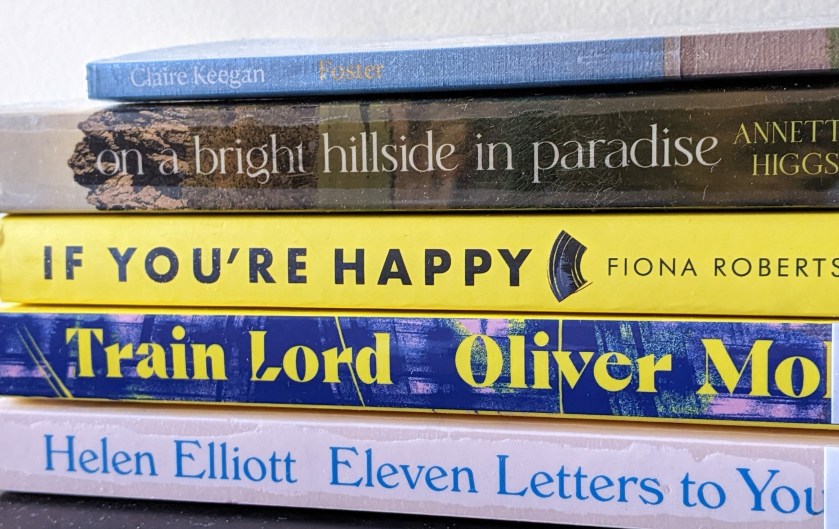
If You’re Happy by Fiona Robertson, University of Queensland Press, 2022

The wonderful Fiona Robertson has created an equally wonderful collection of stories that take you from regional Australia to Morman America. Divorcees, widowers, war vets and comfy couples find themselves questioning the decisions they’ve made or are forced to make as life changes around them. It doesn’t matter if they find themselves in the middle of a natural disaster or daily domestics, there are human instincts which connect us all. Binge read or savour and set aside.

on a bright hillside in paradise by Annette Higgs, Penguin, 2023

This manuscript was the winner of last year’s Penguin Literary Prize and I can see how it was picked. I was completely absorbed by the sense of character and place as we follow five members of the Hatton family who live on Paradise, a farm in settler Tasmania.

There are births, deaths and marriages, but strangers also arrive during this time, evangelist preachers. Their arrival charts changed paths for each of the characters as ‘life in paradise’ begins to mean something different for each character.

Train lord by Oliver Mol, Penguin, 2022

Oliver Mol gets a 10-month migraine which he can’t shake. He can’t read, write or look at screens but he does need work. Typing ‘Sydney’ and ‘no experience’ into Google he puts in an application to work with Sydney trains.

This memoir is one part observation of his time working on the trains (I would’ve guessed about the vomit and poo but I had no idea there were so many snakes to deal with!!) and many parts the honest reconciling of his journey with severe pain, depression, heartbreak and the creative life.

Foster by Claire Keegan, Faber, 2022

Reading Claire Keegan, I enter a quiet place. There is a stillness to her stories, where small things are given time and attention. Foster follows the summer that our narrator is sent to live on a farm with an older couple who are distant relatives of her mother’s.

She comes from a farm with many children, an exhausted mother and a father who likes to gamble. Just like the narrator, I read at first unable to trust that good could happen but the long days of summer and attention and affection can slowly change all of us. Another quiet beauty from Claire Keegan. Read Small Things Like These for some more Claire Keegan.

Eleven Letters to You by Helen Elliott, Text, 2023

This memoir is a beautiful tribute to some of the people who had a profound influence on Helen Elliott’s life and character, whether they realise it or not. Written exactly as the title suggests, it’s 11 letters to neighbours, teachers and mentors. As we learn about them and their backstories, more of her story emerges too.

I liked the originality of revealing the memories of a life this way and growing up in Melbourne in the 50s, it’s a completely different world which is evoked.

If you enjoyed reading this and want to hear about the next bookstack, subscribe to my bi-monthly newsletter below.

Processing…
Success! You're on the list.

The bedside bookstack – July 2023

What’s sitting on the bedside bookstack this July.

Daughters of Sparta by Claire Heywood, Hodder & Stoughton

I love a classical myth retelling, especially those putting sidelined female characters into the centre of their stories – Circe, the Silence of the Girls, the Penelopiad, the Mere Wife. I only found this one by accident, after reading this great lithub article which I book marked (but never read until now) years ago.

Daughters of Sparta follows Helen and her older sister Klytemnestra from childhood through their marriages and the Trojan war. I always love reading the expanded story of those who were just bit players in some of the other retellings I’ve read. Obviously Helen is hardly a bit player, but it was great to see her as more than just ‘the face who launched a thousand ships’ and Klytemnestra as more than a wronged wife. Agamemnon is still a complete tyrant, Menelaos is dutiful but distant and Paris a narcissist, so even though this is the women’s story, you can’t get away from the fact that the men around them still decide how it goes.

As you Were by Elaine Feeney, Harvill Secker, 2020

This is a cancer story. So if you can’t do that right now, then move on because it’s set on a hospital ward and every page is sickness and mortality. But, every page is also the ridiculousness and wonder of life and there’s a brilliant dark humour that carries it all along.

This book absolutely deserves the ‘Thrilling’, ‘Superb’ and ‘Brilliant’ endorsements on its front cover. Elaine Feeney uses Sinead and the four patients who share her room to examine family relationships, human instincts, the state of Ireland’s health system and its recent cultural past. I absolutely loved it.

Small Things Like These by Claire Keegan, Faber, 2021

Another recent Irish hit, this title gives a clear preview of the story to come. It comes in at a very generously double-spaced 114 pages and it isn’t a big story in that it’s about a handful of people in a small area and the little actions they take. At the same time, these actions can change lives and a lot can be said in 114 pages.

Claire Keegan comes with Irish It-girl status and so it’s no surprise that in the seemingly quiet and compressed prose we have a sober take on the Catholic church’s legacy in everyday Irish lives. A beautiful book.

Stone Blind by Natalie Haynes, Pan Macmillan, 2022

Here are a few things you probably don’t know about Medusa. She was a mortal. Although she was a gorgon, she looked human and her only point of difference was a pair of wings. She is raped by Poseidon in Athena’s temple and she ends up with snakes on her head and a look that turns any living thing to stone because Athena was insulted by the desecration. Certainly no sisterhood there. 

This is Medusa’s story with the age-old question of who the monster really is and as for heroes, it turns out the Perseus is a bit of a prick. If you’re currently on the Greek-myth train like I am, add this to your list.

The Shadow of Perseus by Claire Heywood, Hodder & Stoughton, 2023

It was interesting to read this straight after Stone Blind because it’s the same story of Medusa and Perseus with a lot more focus also given to his mother Danae and wife Andromeda. However, Claire Heywood puts her stories in a realist’s realm. In the endnotes, she says, “I want to reimagine this myth within a historically authentic setting, without the intervention of gods or supernatural forces, and so create a story driven primarily by human decision.”

So, no son of Zeus or winged sandals. No gazes that turn people to stone or rescuing from sea beasts but a fascinating story and a great read. And Perseus, still more of a prick than a hero. Some things don’t change when women are at the centre of this story.

The Long View by Elizabeth Jane Howard, Picador Classic, 2016

Elizabeth Jane Howard (EJH) has only recently come onto my radar and she’s as good as everyone says she is. This edition had a beautiful introduction by Hilary Mantel whose writing about the story matches that of the story.

EJH is so smart and intuitive about human relationships, family dynamics and social expectations. It all comes together in a rich (but seemingly effortless) narrative for the reader. But I had to put this one down. It felt like watching Mad Men where the costumes are amazing and the acting is spot on but everyone is just so repressed and unhappy and nursing their wounds in isolation. I know all of that is saying something very specific about the time and class and especially women’s suffocated place in it but I just needed more kindness to keep me going this month.

Victory by Joseph Conrad, Oxford University Press, 2004

This is one of those editions which comes with a hefty academic introduction and pages and pages on the detail of editorial changes between editions as well as a timeline of Conrad’s life and bibliography charted next to global events from 1857 -1928 (pretty interesting to see in parallel actually).

I say all this because a book that comes with all the trappings, arrives with a bit of status and expectation. It’s a classic. I thought I should give it a go. I haven’t read any of Conrad apart from Heart of Darkness decades ago when I was ploughing through the classics and not really understanding any of what I read.

Victory opens with the story of Axel Heyst, a Swede who drifts through the Asia/Pacific colonies of the early 20th Century. I lived and worked in Dili, Timor-Leste for two years, so it was interesting to see it appear in the opening pages. Heyst is an interesting character and cause for a lot of expat gossip. I stayed with it for 100 pages, diligently reading long after some of the players became more caricature than character. This was a classic, right? It was Joseph Conrad? Well, probably 50 pages later than I should’ve, I decided to ditch it – which I wrote about in Quitting on Conrad. Life’s too short and the TBR pile way too big to soldier on in misery.

If you enjoyed reading this and want to hear about the next bookstack, subscribe to my bi-monthly newsletter below.
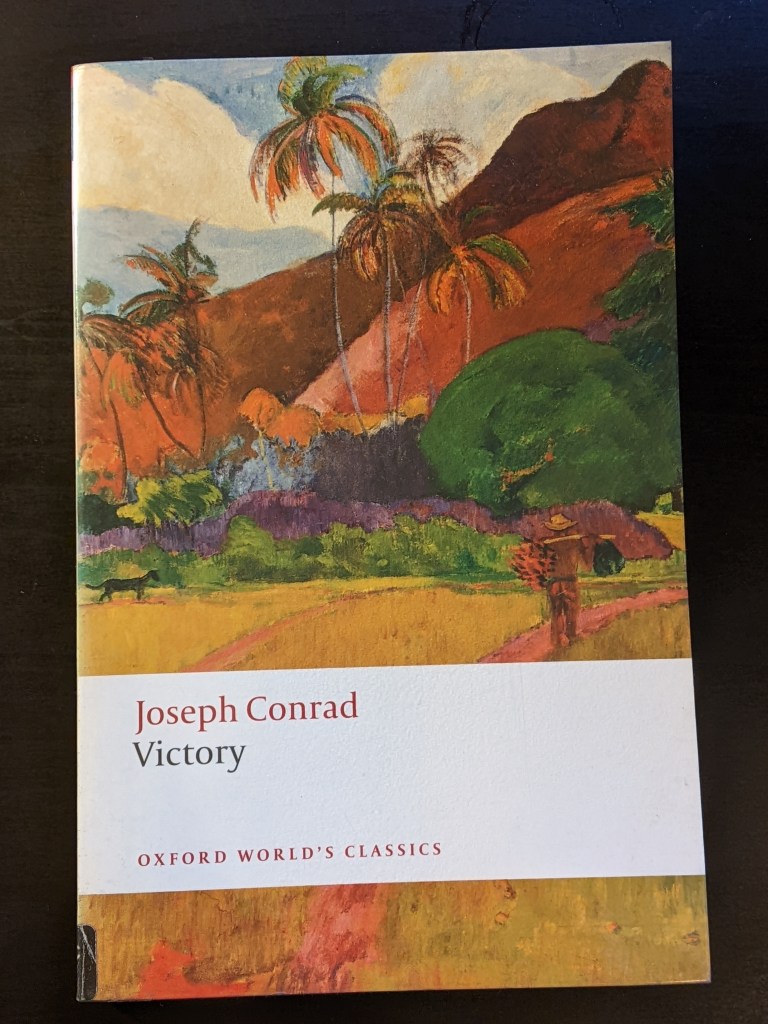
Quitting on Conrad

Sometimes you just gotta put a book down

I recently borrowed Joseph Conrad’s Victory. I read Heart of Darkness years ago when I was making my way through the cannon but didn’t have nearly enough life experience to understand what any of them were saying. So, I thought it was time to read another Conrad. The edition came with a lengthy introduction from an Oxford academic, pages and pages about editorial changes between editions and even a timeline of world events mapped again Conrad’s written work. Thus the book arrived with plenty of status and expectation.

I struggled on for 100 pages before putting it down. I put a call out on Twitter to see I should keep going. Was it going to come good like I hoped it would? John Purcell (The Lessons) said that he always felt the failing was his when he couldn’t finish a classic. It was reassuring to be in good company. Classic or not, personal taste and opinion should still matter. In every other area of life, I would say that you shouldn’t like something just because everyone else does. But it makes me feel vulnerable and stupid to be out of step with a book or author that is perceived as brilliant. How embarrassing, to not see or enjoy the mastery in a book which everyone lauds. ‘The failing is mine’ is the usual line.

Conrad is obviously good at what he does. It got off to a great start and some of the writing was such a joy to read. Here he is on the sounds of a squeaky orchestra playing in a tropical backwater:

 “The Zangiacomo band was not making music; it was simply murdering silence with a vulgar, ferocious energy. One felt as if witnessing a deed of violence; and that impression was so strong that it seemed marvellous to see people sitting so quietly on their chairs, drinking so calmly out of their glasses, and giving no signs of distress, anger or fear. Heyst averted his gaze from the unnatural spectacle of their indifference.”

 I mean really, this is great! But something happened as the story went on and it all turned a bit melodramatic and the character making these observations disappeared and was replaced by a few guys who were closer to caricature.

I thought I’d already picked a position on all this but it seems that if the book is a ‘classic’ it’s not so easy for me to call time on it. In my blog How Heavy is a Half Read Book I decided that life was too short, time too scarce and my TBR pile way too big to just slog on.

But the sunk-costs habit of investing time in a book and hoping that something will eventually come out of it is obviously not so easily ditched. I blame Middlemarch. I struggled on for 400 (of the odd 900) pages and then something changed and I was so glad that I’d stuck with it. So, for years, I applied the same hope to books and movies and kept going with the belief that things could change and all would be worth it. It says startling things about my ability to endure what I don’t enjoy, or my thoughts that I should have to.

I don’t mind a challenging read but who needs it to feel like homework. When I finally put Victory down, it was such a relief and the next book didn’t feel like a chore at all.

In future, I’ll try and remember John Irving’s advice, “Grown-ups shouldn’t finish books they’re not enjoying. When you’re no longer a child, and you no longer live at home, you don’t have to finish everything on your plate. One reward of leaving school is that you don’t have to finish books you don’t like.”

Processing…
Success! You're on the list.

The bedside bookstack – June 2023

What’s teetering on the bedside bookstack this June.

Salt and Skin by Eliza Henry-Jones, Ultimo Press, 2022

I need to take a big breath in just thinking about this book. It was all consuming, in the best of ways. Remote island. Wary locals. Myths and stories of selkies and witches. A mother and her children steeped in their own grief and secrets but looking for a fresh start. Wind and water, endless amounts of both, shaping the people and the place. 

There’s such vitality in this book. I felt buffeted around and truly exhausted by the end but also elated by human connection, history, family, sisterhood and survival. Read it. Read it now!!

There was still love by Favel Parrett, Hachette, 2019

This is the story of a Czech family, sliced in half by history. Eva and Máňa are identical twins. In 1938, their father only has enough money to buy false papers and get one girl out of the country. So, we start in 1980s Melbourne where Eva now lives with her husband and granddaughter ‘Little Red Fox’ then cross to Prague where Luděk lives with his grandmother, Máňa.

It’s Luděk and Little Red Fox who observe the family in their separate worlds and we loop back in time to London and to Prague in the 60s to give us the past and fill in what children can’t know from living in a perpetual state of the present. This is a beautiful story of family, culture, love and loss.

Romantic Comedy by Curtis Sittenfeld, doubleday, 2023

Well, this was a lot of fun and I demand that someone turn into a movie immediately. Sally Milz is a comedy writer for a long-running late night tv skit show. The pace is fast and the vibe is cynical and platonic. She writes a piece called the Danny Horst effect about the trend of her male co-writers getting together with famous women out of their league. When Noah Brewster, a famous singer, comes on the show, it looks like the rule might not only apply to men. It’s true, Noah is a bit one-dimensional, but this book definitely delivers on its title. Also, incidentally, a fascinating insight into the process of comedy writing, pitching, edits and the making of a weekly tv show.

A little give – the unsung, unseen, undone work of women by Marina Benjamin, Scribe, 2023

This gorgeous book is part memoir, part essay, part feminist meditation on women’s work. She shares the fascinating story of her Iraqi-Jewish émigré parents, how they came to settle in London and how that equalled another sort of settling, of not really being able to stretch and fulfill their potential. Then there is caring for these parents as they age and her experience of child-rearing, menopause and an empty nest. It’s written so beautifully and personally and is full of food for thought about what the philosopher Ivan Illich calls ‘shadow work’.

If you enjoyed reading this and want to hear about the next bookstack, subscribe to my bi-monthly newsletter below.

Processing…
Success! You're on the list.

The bedside bookstack – May 2023

What’s teetering on the bedside bookstack this May.

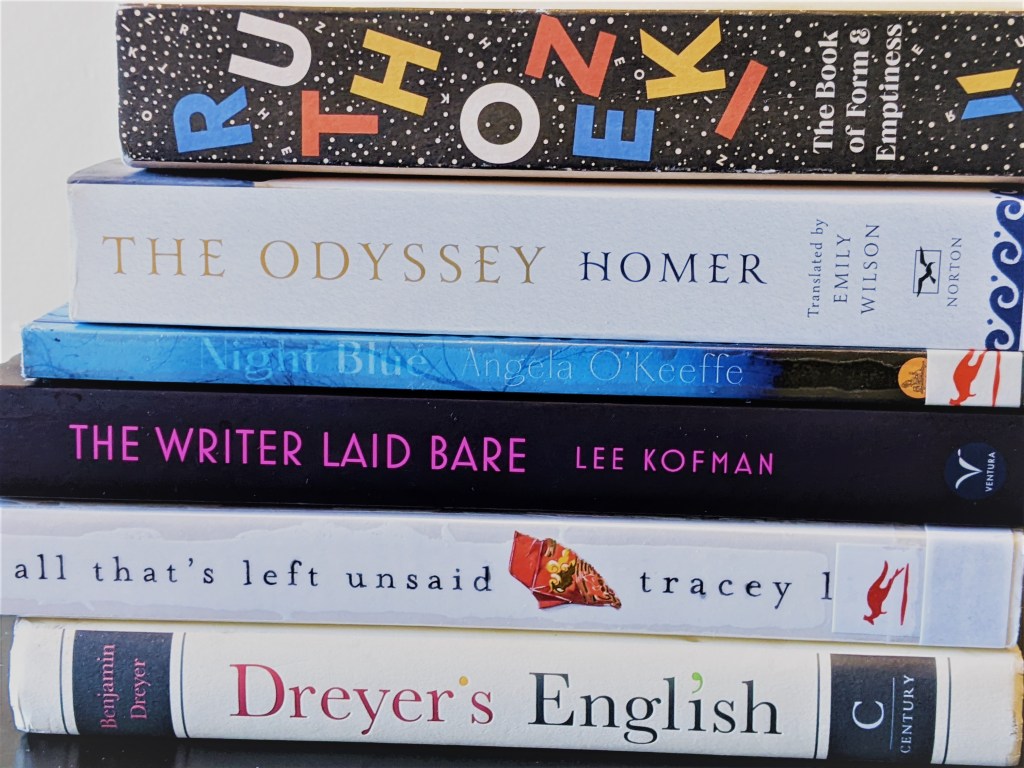
The Writer Laid Bare by Lee Kofman, Ventura, 2022

Yes, another writing book. No, you can’t have too many of them because they all serve different purposes. This one is practical and personal. It’s warm and honest and generous in its detailing of the various blocks and the emotional evolution she has been on with her writing, which she believes writers need to go through to a certain extent to reach emotional honesty in their writing.

It’s full of her own experiences as well as other writers untangling the knot of art and life – life and art. We’re all just muddling through.

There’s also an excellent bibliography, a 100 Books list and suggestions of more writers on writing to read. My best take-away was the writing teacher who asked about a piece of writing, “What’s it about?” Then, “What’s is really about?” And finally, “What’s it really, really, really about?” Sometimes we need extra digging to excavate our intentions.

The Odyssey by Homer, translated by Emily Wilson, W. W. Norton & Company, Inc. 2018

If you’ve been reading the bookstack you’ll know from last year that I went on a bit of a classics binge, particularly retellings like The Song of Achilles, Circe, The Silence of the Girls, and The Mere Wife. I thought it was time to give an original a go, one of the biggies. And thank you to whoever recommended the Emily Wilson translation.

It is beautiful, poetic and of course epic. What surprised me though was how we were washing hands and making up beds as often as we were fighting creatures or enemies. And in Book 6, teenage Nausicaa, gets scolded for leaving her dirty clothes lying around the room and not having anything clean to wear. Ha!

But I’ve had to put this one down for a bit. I get unstuck with the sexual violence, casual misogyny and general oppression of females in the myths. There’s a scene where Aphrodite is humiliated for having Ares as a lover. They get trapped in a spider’s web and held there entwined while all the gods come down to laugh and gawk. As a scene, it was just too similar to ‘the lads’ having a laugh at a sex tape.

But then there’s poetry and wisdom like how to smooth a slight “If something rude was said, let the winds take it. May the gods allow you to reach your home and see your wife again.” And the longing for home and loved ones which is eternal and universal.

Dreyer’s English – An Utterly Correct Guide to Clarity and Style by Benjamin Dreyer, Century, 2019

Obviously as a style guide this is a dip-in-and-out number but he’s so witty that I’ve been in more in than out. Benjamin Dreyer has been Copy Chief at Random House for over 20 years. He’s got plenty so say about punctuation and grammar (OMG, his suggestion for dealing with the clunkiness of past perfect has rocked my world p.110) but it’s what else arrives with it that is just as informative and entertaining like when he copyedited unpublished works by Shirley Jackson. I know, right?

Anyone who’s into language and its intricacies as well as a peep into the sausage making of books and publishing will love this.

Night Blue by Angela O’Keeffe, Transit Lounge, 2021

This one’s got a quiet contemplative feel to it. You get that when it’s narrated by a painting which spends time either in basement storage or on gallery walls. The painting is Jackson Pollack’s Blue Poles. From a technical angle, I wondered how an inanimate object could hold a novel-length narration but as a reader, if you have a narrator with enough consistency and authority, you stop thinking about it.

It is a love letter to art and how it matters in people’s lives moving from America with the artist and his wife Lee Krasner, to the wall of a New York family and then on to Australia where it sits in a basement but feels the reverberations of Whitlam’s dismissal before hanging in the National Gallery where its presence affects both staff and visitors.

all that’s left unsaid by Tracey Lien, HQ, 2022

Ky is called home by her father after her brother is brutally murdered while eating out with friends. Home is Cabramatta in the 90s, known as much for its pho as for its heroin. Ky can’t imagine any world where her straight-A brother could get mixed up in anything that would lead to this. But she moved to Melbourne two years ago to become a reporter, so what would she know about his life.

Intergenerational trauma, family, culture and identity play out on the streets of Cabramatta as Ky tries to piece together what actually happened that night.

The Book of Form and Emptiness by Ruth Ozeki, Canongate, 2021

Skip this if you’re looking for a straight narrative because Ruth Ozeki is having a great time playing around with all kinds of stuff in this. Be prepared for a dual narration from the main character Benny Oh as well as books – the book you’re reading as well as books talking to books.

Not long after Benny’s Dad dies, he starts to hear voices, lots of them, everywhere. He can hear objects talking. He hears the contrition of a window that kills a bird, the sadness of the toys children cuddle at the psychologist’s office, the pain of glass being broken. He hears the natural world and made objects as a constant cacophony.

I’ve still got a while to go on this one and the objects are making Benny’s life a mess at the moment but Ruth Ozeki is also a Zen Buddhist priest, so I feel she’s going to get us through in one piece.

If you enjoyed reading this and want to hear about the next bookstack, subscribe to my bi-monthly newsletter below.
Processing…
Success! You're on the list.

The Bedside Bookstack – April 2023

What’s teetering on the bedside bookstack this April.

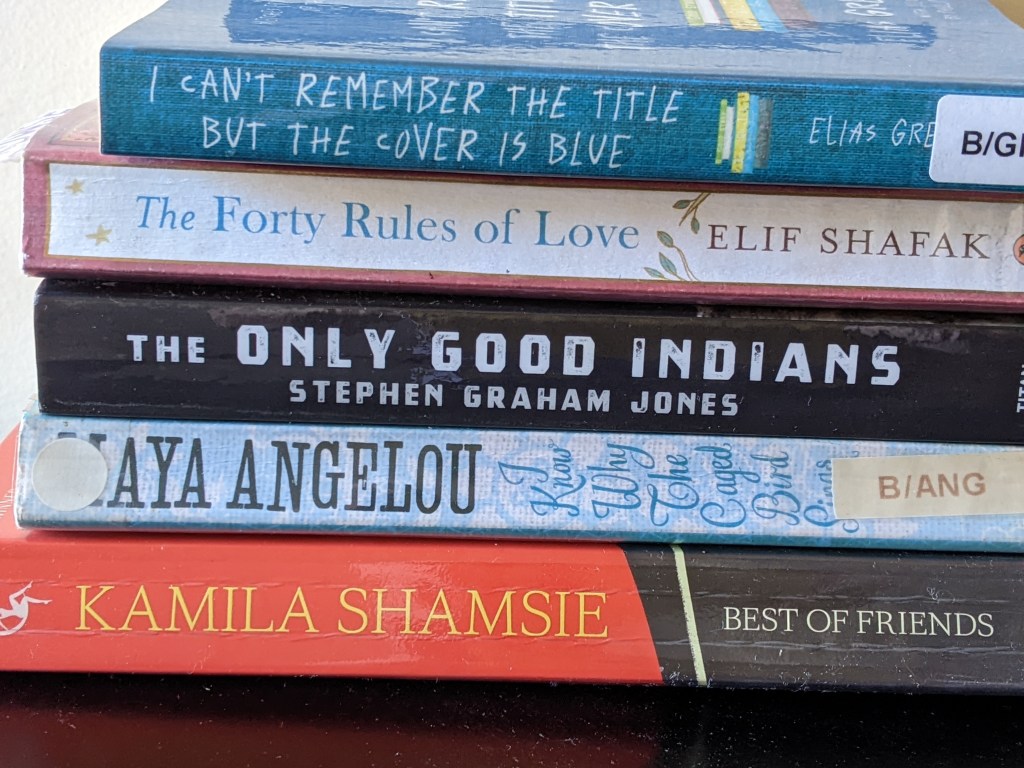
Best of Friends by Kamila Shamsie, 2022, Bloomsbury

Maryam and Zahra are best friends. They go to a good Karachi High School. Zahra is bright and ambitious but even with her grades, only a scholarship will get her to a British University. Maryam doesn’t worry too much about any of it. She comes from a wealthy family and is going to inherit and run the family business. But one night and two men change the neat trajectory of those plans.

Fast-forward 20 years and both women are successful professionals living in London. They’re still best friends but their politics pull in different directions. This is a great examination of loyalty, ethics, lifelong friendships and what keeps people together as they grow into very different people.

I Know Why the Caged Bird Sings by Maya Angelou, 1969, Virago Press

Maya Angelou’s autobiography reads with the rhythm and sound you’d expect from a poet. It covers childhood to late teens as she and her brother live with their grandma and uncle, then move in with her mother, spend time with her father, move back to her grandma and then back again with her mother. She writes of the small girl she was, trying to get on with life as she knew it despite rape, trauma, separation and the endemic racism of growing up as an African American female in the South.

I Can’t Remember The Title But The Cover Is Blue by Elias Greig, Allen & Unwin, 2018

This witty little number is the perfect pick up, put down and leave around the house book. The sub-title, Sketches from the other side of the bookshop counter, cleverly captures its essence as a collection of pictures and encounters from Elias Greig’s time as a book seller in a Sydney book shop.

It’s written as a script and you get to laugh along at how outrageous the general public is until you see yourself standing at the counter too (there’s a definite theme of tired mothers) and are momentarily chastened and reminded of how little it takes to have good retail behaviour and decent manners. I’d say a great gift for booklovers and bookshop champions.

Also check out A Circle Married to a Straight Line, his glorious commuter essay in the Sydney Review of Books, if you want a sample of his style and a reminder of all the things that an essay can be.

The Only Good Indians by Stephen Graham Jones, Titan Books, 2020

10 years ago, Lewis and 3 friends shot some elk. As Blackfoot men, they’d all hunted before but this trip was different. Now, strange things are happening and Lewis starts thinking about that day again and it feels like he’s the one being hunted.

This is a visceral and pacy read but all the blurbs talk about Stephen Graham Jones as a horror writer. I’m not great with scary stuff, so I’m reading on because it’s such a good read but I’m going slowly and almost with my hands over my eyes because I want to get out if it gets too scary.

The Forty Rules of Love by Elif Shafak, Penguin Books, 2010

This book is the dual narrative of Ella, an unhappy American housewife, and the 13th Century Sufi poet Rumi and his companion Shams of Tabriz. It’s a tricky balance trying to hold the 21st and 13th Centuries in parallel and it didn’t work for me. Unfortunately, I was interested in reading about Rumi but not Ella, and I was on holiday, so I ended up putting it down and reading about neither.

If you’re curious though, give it a go. I might even have another peek. ‘International Bestseller’ doesn’t usually come from nothing and I’ve enjoyed her other books.

If you enjoyed reading this and want to hear about the next bookstack, subscribe to my bi-monthly newsletter below.
Processing…
Success! You're on the list.

The Bedside Bookstack – March 2023

What’s teetering on the bedside bookstack this March.

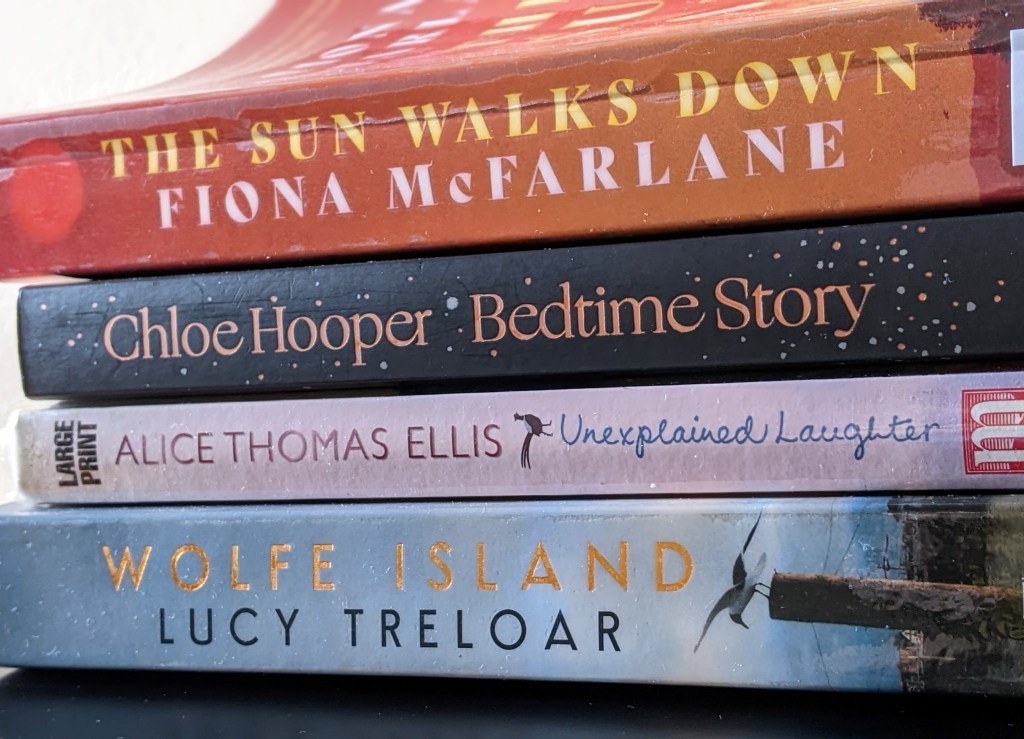
Wolfe Island by Lucy Treloar, Picador, 2019

Kitty Hawke is the last person living on Wolfe Island. Everyone else left when the water started to rise. One day her estranged granddaughter arrives bringing a boyfriend and a brother and sister who are looking for their mother and trying to get north.

This brilliant book is so rich and immerses you completely in Kitty’s natural and internal world. It’s epic and timely, daring to take on the biggies of climate change, migration and borders, family and the idea of home when the one you knew is no longer an option – all don so skilfully.

Unexplained Laughter by Alice Thomas Ellis, Corsair, 2012

I’d never heard of Alice Thomas Ellis until Charlotte Wood mentioned her in The Luminous Solution. So glad she did. This book was such a hoot.

Lydia’s relationship has just ended. Her partner left her for someone else and she’s gone to a cottage in the Welsh countryside for some time out. Her colleague Betty comes with her. They don’t actually know each other very well, which isn’t too awkward for Betty but it rubs at Lydia initially.

Lydia is one of the most unique characters I’ve read. She’s a total original. She’s clever, witty, judgemental, flippant, eccentric but also completely aware of her foibles. It’s her monologues (internal and external) as they meet and get tangled up with the locals and their business that provide the clever humour here.

It got me wondering why literary fiction is usually so un-funny. And I put it out there for suggestions of more books like this one, but haven’t heard any yet. Please pass them on if you have them.

Bedtime Story by Chloe Hooper, Illustrated by Anna Waler, Scribner, 2022

Chloe Hooper writes so beautifully. She burst onto the scene back in 2002 with The Child’s Book of True Crime. Since then, she’s written more non-fiction than fiction (The Tall Man, The Arsonist) and incredibly well but seems to fly under the radar a bit.

This is a memoir about her husband, Don Watson (of Weasel Words and Paul-Keating’s-speech-writer fame) getting a rare type of blood cancer. She wonders how to tell her young boys aged seven and four. She tries to find the perfect book to do the job for her and in doing so contemplates children’s stories, the authors who write them and the stories we tell ourselves. This is a sobering and contemplative read about sickness, mortality, love and words. Beautiful. And I can’t wait to see her this weekend at the Newcastle Writer’s Festival!!

The Sun Walks Down by Fiona McFarlane, Allen & Unwin, 2022

Another Australian writer who you know you’re in good hands with and who also seems to not get the readership, or is it air-play that her words deserve. Fiona McFarlane also had a big-deal debut with The Night Guest. After that came her beautiful short story collection The High Places and now we have The Sun Walks Down.

Six-year-old Denny Wallace goes missing in a dust storm in 1883. The locals of Fairly, South Australia, (both newly arrived and first nations) are unsettled by the event and their complex relationship with the land. This is a roving POV which moves seamlessly between the immediate family, neighbouring farms, domestic staff, police search party and trackers.

I haven’t finished it yet and am dying to know what has happened to Denny.

If you enjoyed reading this and want to hear about the next bookstack, subscribe to my bi-monthly newsletter below.
Processing…
Success! You're on the list.