The bedside bookstack – November 2023

What’s sitting on the bedside bookstack this month.
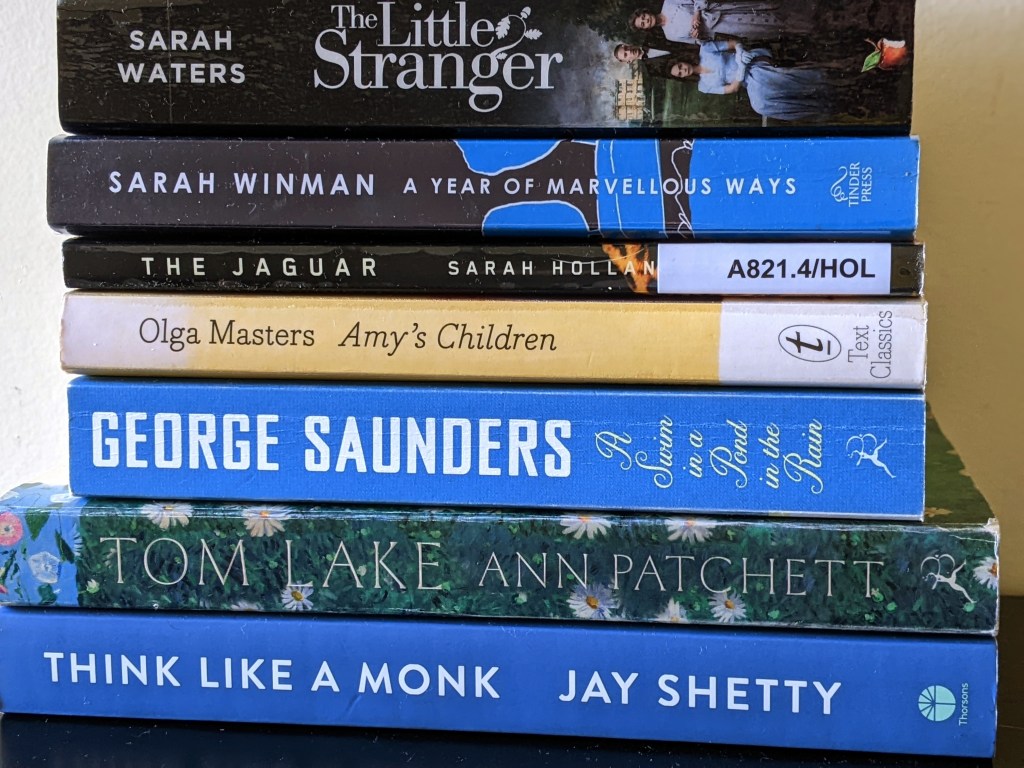
Tom Lake By Ann Patchett, Bloomsbury Publishing, 2023

It’s lockdown and Lara’s three daughters have come back home to their cherry farm to help with the harvest. In between the picking they demand that it’s time to hear the full story about their mother’s life as an actress and the summer she spent with Peter Duke who is now a famous actor but was just starting out like the rest of them back then.

This is Ann Patchett. She knows what she’s doing and a dual narrative comes off just fine in her hands. She also knows how to get in there a play around with personal dynamics and ideas about loyalty, love, creative ability, ambition and ageing. I loved the present sibling and family narrative as much as the summer at Tom Lake. This’ll be a great summer read, settle in for some seasonal nostalgia.

The Jaguar by Sarah Holland-Blatt, UQP, 2022

Sometimes poetry makes me feel stupid. I read it and just can’t find a way in. I don’t like feeling stupid, so I don’t read a lot of poetry. But that’s a shame, because it isn’t all like that and I’m so glad that this won the 2023 Stella Prize and was on the radar enough for me to pick it up.

It doesn’t make me feel stupid. It makes me see the world with fresh eyes. It makes me even more curious about words, sounds, rhythm and pace and how I could use it to better effect in my own writing. She has a lovely way of dusting some words off as well, that have been sitting on the shelf for a long time and deserve to find themselves on a page again.

For me, this collection is at its best when she recalls her father and his 20-year deterioration with Parkinson’s Disease and subsequent death. There isn’t anywhere for poets to hide with the omnipresent ‘I’ and she’s so generous with what she shares.

A Year of Marvellous Ways by Sarah Winman, Tinder Press 2015

Sarah Winman is one of my literary heroes. I just love her to bits and pieces for bringing Still Life into the world. She has so much heart and humanity in her writing and that’s present not just in a masterpiece like Still Life but also in a quieter novel like A Year of Marvellous Ways.

Marvellous Ways is a 90-year-old woman who lives in a caravan on the sea. Francis Drake is a 28-year-old soldier who had nothing to come back to in England after the war. When their paths cross Marvellous gets a chance to relive the past and Drake finally looks to the future. If you didn’t like Still Life or you need total realism in your narrative then give this one a miss. Otherwise, savour as it’s another Sarah Winman delight.

For any Winman fangirls like me, this interview she did on The First Time Podcast confirms she’s just as warm and wonderful a human as you’d think she would be.

Amy’s Children by Olga Masters, Text Publishing, 1987

I’m ashamed to say that this is the first Olga Masters I’ve read. I feel like I owe more to an Australian female writer publishing at a time when the scene was so male. Ne’er mind. I’ll be looking up her backlist now.

Amy’s husband leaves her and her three young daughters during the Depression. Living on the family farm in rural NSW, she then leaves her daughters to try and find work in Sydney. Work is scarce but no one will hire a married woman, so she makes herself slightly younger and unmarried on any applications.

This is a fascinating insight into Depression and war-time Australia, especially society’s ideas of women and the paths open to them. It’s also a nuanced offering of a mother leaving her children and atypical mother-daughter relationships. People will come down on all sides about Amy leaving her children and pretending when her eldest daughter arrives in Sydney, that she’s actually her sister. Definitely an Australian classic!

The Little Stranger by Sarah Waters, Virago, 2009

This book opens post World War One in rural Warwickshire. You’ve got the landed gentry in their slowly crumbling Georgian manor, the two house staff they can afford, a local doctor and a family of new money just moved from London.

This is beautifully written. I feel like I’m in an episode of Downton Abbey and so obviously in good hands. However, I’m 136 pages in (of 500) and it’s starting to get creepy. There are unexplained incidents in the house and a few people are starting to admit to feeling a malevolent presence. And it’s around about now that I think I’m going to put it down. I do most of my reading at night and I still haven’t totally squared myself with the dark. I don’t love scary, so I’ve called time on it. All those who like a bit of Henry James’ spooky house spirit vibe, read on.

Think Like a Monk by Jay Shetty, Thorsons, 2020

Like many of us, I’m on a journey to get a bit more calm in my life and improve the way I deal with stress. I heard Jay Shetty on the Dear Therapist podcast (my version of voyeurism which also happen to have good life advice) and they talked about this book.

After working in finance in London, he ends up moving to India and being a monk for three years. It isn’t out of the blue – he’d been spending his summers in an ashram throughout uni but it was still a huge life change. He shares his experiences of that time and teachings mixed in with modern examples to offer suggestions to ‘train your mind for peace and purpose every day’. If you’re already interested and open to these ideas, you’ll enjoy it.

If you enjoyed reading this and want to hear about the next bookstack, subscribe to my bi-monthly newsletter below.

Processing…
Success! You're on the list.

Do books belong out in the world or on your bookshelf?

For something that is really just printed words on paper, we have some very strong feelings and ideas about our books as possessions. Seeing a full bookshelf calms me and holding a book is always a comfort. But my passion in their power also means that I think they need to be read, so I’m happy to lend out my books.

A book is meant to be read, hopefully by as many people as possible. I love it when someone asks me if I have anything good to read. I have a look on my shelves and pick out what I think is the right pick for them at the time.

I’d like to get the book back eventually but it’s a bit of an honesty system (I am lending to family and friends after all) and not every book comes back to the shelf.

There are a few books which I keep lending out and then rebuying. One is Annie Proulx’s That Old Ace in the Hole and the other is Elizabeth Gilbert’s celebration of creativity, Big Magic. Which reminds me, I don’t have a copy of either of them at the moment. Short story anthologies are something else I’m always lending out too.

Some people use Ex Libris bookplates in the front of their books but anecdotally, they don’t guarantee that a book will ever return.

I always know if someone else’s book is on my shelves though. I’m very aware of possessions that aren’t mine. For me, a borrowed book feels a bit like an unpaid debt until it’s been returned.

Books have sentimental value and financial value. Some are out of print and can’t be replaced. Others I just want on my shelves but any copy will do. My general hope is that I remember both that they’re gone and who they went to. And when it doesn’t work out that way, when I have an inkling that I used to own a book which is no longer there, there is a consolation in thinking of it making its way in the world onto other bookshelves and into other hands.

If you enjoyed reading this and want blog updates, subscribe to my monthly newsletter below.

Processing…
Success! You're on the list.

The bedside bookstack – August 2020

What I’m reading and what’s gathering dust on the bedside bookstack this month.

Metal Fish, Falling Snow by Cath Moore, Text, 2020

Full Disclosure, Cath Moore is my cousin and I’m so proud of her and her debut YA novel. It’s a magical-realist road trip and the ideas and themes sprawl the dusty distance that Dylan, the main character, has to travel. Identity and race, grief and loss, and family and connection are all part of her journey.

Moving words by someone who has experienced her own variations on these ideas. If you don’t trust me to be objective, have a look at what Kill Your Darlings, The Saturday Paper, and the Big Issue have to say.

Station Eleven by Emily St. John Mandel, Picador, 2014

Phwoar!!!!! What a read!! How do you mix a post pandemic civilisation storyline with tabloid lives and Shakespeare? And, how had I never heard anything about this book in the middle of a pandemic?

Current situation aside, this is a great book about how everything can change and some things stay exactly the same when humans are involved. Now I need to check her back-catalogue and see what else I’ve been missing.

The Details – On love, death and reading by Tegan Bennett Daylight, Scribner, 2020

And that’s exactly what the beautiful book of essays is about. She’s writing as a woman, a mother, a daughter, a reader and a writer and she’s so generous with us in what she shares whether it’s her mother’s last days, her love of Helen Garner or George Saunders (I bought the book below after reading her essay on him) or childbirth-related vaginal issues.

Her eloquence and intelligence are such a pleasure to read. There was no snacking on these essays. I devoured them in two nights.

Pastoralia by George Sanders, Bloomsbury, 2000

There’s certainly nothing I can say about George Saunders that hasn’t been said better in Tegan Bennett Daylight’s essay The worst that could happen.

Read Saunders for social realism in a parallel universe where people work fulltime as exhibits in a theme park, bodies come back from the dead and managerial-speak is a scary new vernacular. His stories seem to bring together the worst of the 20th and 21st Centuries in the best way. He’s clever, creative and always surprising.

Dyschronia by Jennifer Mills, Picador 2018

This is another story that takes our world and tilts what we know to be true. The sea recedes from a small coastal town and one of the residents has visions which have included an occurrence like this.

Jennifer Mills comes highly recommended and I haven’t read anything by her before but my copy of this one is pretty big and to be honest I probably should’ve started with her short story collection The Rest is Weight. I just need to get my hands on it.

The Dickens Boy by Thomas Keneally, Vintage Books, 2020

Charles Dickens had 10 children. He sent two of his sons to Australia to become gentleman farmers. Who knew? I didn’t but obviously Thomas Keneally knew something about it.

This book is about the youngest son, Plorn. He feels the fame and achievements of his father in stark contrast to his own inability to pass any exam or ‘apply himself’. His secret is that he’s never read one of his father’s books. 

Plorn tries to make something of himself in Australia, outside of his father’s shadow, but the colony is almost as obsessed with Dickens as the Mother Country and even boundary riders in solitary huts quote his father from books he pretends to know. 

A great read on its own but even better for the salient facts I learned about Dickens without having to read a biography.

Upstream by Mary Oliver, Penguin Press, 2016

Who doesn’t need Mary Oliver and her words by their side at the moment?

This one’s still on my pile from the June bookstack and the July bookstack and will likely remain there into the future. There are some books that stay on the stack not because they’ve been forgotten and are a ‘should’, but because their presence is a reassurance.

Upstream is a book of essays rather than her usual poetry and they are perfect to dip in and out of. Her poetic reflections always slow things down to a pace we’re probably meant to be moving at anyway.

Meditations by Marcus Aurelius, Penguin Books, 2004 (written sometime AD 121 – 180)

This has been sitting at the bottom of the pile for a long time now. Even though I feel like I could and should be someone who reads Roman philosophy, it hasn’t happened thus far when I’m tired and have an o-so-finite reading window before I fall asleep.

I recently came across a Brain Pickings piece on Zadie Smith’s new essays which were inspired by her encounters with Meditations. Is this a sign? Will knowing that Zadie made it through this book spur/shame me into action? We shall see.

What to read and why by Francine Prose, Harper Perennial, 2018

Still haven’t read it, though my intentions from last month are the same:

When I read Francine Prose’s Reading like a writer, I fell even more in love with reading and writing. I walked away with a new list of recommended writers that I can’t believe I’d lived without, including Grace Paley and the Canadian short story writer Mavis Gallant.

I haven’t started this yet, but I’m hoping for the same sublime experience.

If you enjoyed reading this and want blog updates, subscribe to my monthly newsletter below.

Processing…
Success! You're on the list.

The bedside book stack – June 2020

What I’m reading and what’s gathering dust on my bedside book stack this month.

Well-behaved women by Emily Paull, Margaret River Press, 2019

I’ve just finished reading this debut short story collection by Perth writer Emily Paull. I loved the heat in these pages, the feeling of sand between my toes, the nostalgia and longing of adolescence and the family ties both close and distant. Always refreshing to have strong female characters in all their varied glory.

A constant hum by Alice Bishop, Text Publishing, 2019

Another debut short story collection by a female Australian writer. This collection focuses on the fallout after the 2009 Black Saturday fires in Victoria – especially prescient given the summer we just had.

There are brief flash fiction pieces against longer stories. A great read and a sobering reminder of life continuing, though forever altered, long after the fires leave the front pages.

You think it, I’ll say it by Curtis Sittenfeld, Doubleday books, 2018

Another collection of short stories. I’ve only read Curtis Sittenfeld’s novels and it’s always fun to see an author write in another form. What was even more interesting, given the recent release of her novel Rodham, was reading the Hilary Clinton short story. I’m wondering if that story was the starting point for what eventually became Rodham. It’s quite nice to chart a narrative trajectory.

Upstream by Mary Oliver, Penguin Press, 2016

Anyone who read my post about the late poet Mary Oliver will know how much I love and respect her writing. There is usually one of her books permanently on my pile. They’re perfect to just dip in and out of. But this is a book of essays rather than poetry.

True to her loves, there is a focus on the natural world, also on writers, her past and of course poetry. These reflections, just like her poetry, slow down the world around you until it’s only her words that exist.

The Collected Stories by Grace Paley, Farrar, Strauss and Giroux, 2007

Grace Paley is an American writer who I only recently discovered, via the recommendations of Francine Prose (who appears below in my pile). She was a writer, activist and teacher and you can feel her passion and intent crackle through these stories.

A lot of these stories were written in the 70s and 80s and as a woman reading in the 21st Century there’s a marvel at how things have changed….and stayed the same.

I read these on a slow drip feed, in-between novels and whatever else I have on the go, so that she’ll be with me for the long haul.

My husband gave me a broom one Christmas. This wasn’t right. No one can tell me it was meant kindly.   

An interest in life, Grace Paley

She sure knows how to start a story!

The Business of being a writer by Jane Friedman, The University of Chicago Press, 2018

I’m subscribed to Jane’s Electric Speed newsletter which is full of excellent advice and links for writers. This book had lots of great reviews and she is a practical lady with years of experience in publishing and writing (in the US). She presents the book as a reality check for those wanting to make writing their living, not in a mean way, but suggesting what you could do to make it sustainable.

I confess, I haven’t got past the introduction cos I’m just not feeling it at bedtime. It’s a ‘work’ book for me. I think it’ll be a good public transport or lunch break book. And even in the introduction I got out the highlighter and made some annotations.

What to read and why by Francine Prose, Harper Perennial, 2018

When I read Francine Prose’s Reading like a writer, I fell even more in love with reading and writing. I walked away with a new list of recommended writers that I can’t believe I’d lived without, including Grace Paley and the Canadian short story writer Mavis Gallant.

I haven’t started this yet, but I’m hoping for the same sublime experience.

Meditations by Marcus Aurelius, Penguin Books, 2004 (written sometime AD 121 – 180)

Every now and then I think it’s time to grow up and give an ancient classic a go. I haven’t yet, but Maria Popova wrote a beautiful piece on this in brainpickings and I ordered it instantly. Sorry to say it’s a thin little thing and has been sitting forlornly at the penultimate bottom of my pile. Roman philosophy, no matter how beautiful in reflection, feels too heavy for me at the moment.

The memoirs of a survivor by Doris Lessing, Picador, 1974

I love a bit of Doris Lessing but I just didn’t feel it when I started reading this one. It’s supposed to be amazing, which always makes me soldier on a bit longer and give it more of a go. The bookmark shows I got to page 38 but I couldn’t tell you anything about it. Looks like I either have to start again or pull the plug.

Bookshelf bliss

A shelf full of books will always be a comfort and delight.

I recently watched a movie and at different times a son and a father moved into new places and had to find things to put on their empty shelves. Empty shelves? The idea just doesn’t compute.

I don’t think our place will ever have enough shelf space. We have books lying horizontal across vertical rows. I think there are one or two shelves which even have double rows. I know, not fair at all to the inside titles who never get to see the light of the lounge room. There are book piles by our bedsides and piles that have collected where children left them.

I know people love their negative space but for me the joy of a bookshelf is to see it full. There is something so comforting about a full bookshelf in all its proud coloured glory. I love walking past houses where people don’t shut their curtains, especially at dusk. I’m a bit nosy anyway but seeing into rooms with a bookshelf at capacity is just a delight.

I read an article by a writer who had dumped all her books in favour of a digital library. She wrote of how bereft she then felt, looking around and suddenly being a person without books. Marie Kondo copped it when she said people shouldn’t have more than 30 books. I think it got taken out of context. Her philosophy is about keeping what you love and she’s obviously not that big on books. I’m happy to thin the ranks and pass on what doesn’t mean anything to me anymore but the physical presence of books on a shelf is what sparks joy for me.

I am also prone to bookshelf envy. But it’s a light envy, because really, it’s love. Pinterest sends me the most dazzling shots of bookshelves and I love reading library features with their angled shots of tiered shelves. My friend recently had bookshelves built into her study, two wonderful stacks that reach the ceiling. Bliss. Her sister has a reading room. I wasn’t sure they even existed outside Austen novels. Swoon.

Even drawings of bookshelves will do. Julia Donaldson’s wonderful picture book The Detective Dog follows the mystery of some stolen school books. There’s a page near the end when the book thief is introduced to the local library. We’ve read it hundreds of times and I still love turning the page for the big reveal – a double page covered in bookshelves.

Thousands of books from the floor to the ceiling. The books gave the thief the most heavenly feeling.

The Detective Dog, Julia Donaldson

That’s exactly how it feels.