The bedside bookstack – June 2024

What’s sitting on the bedside bookstack this month.
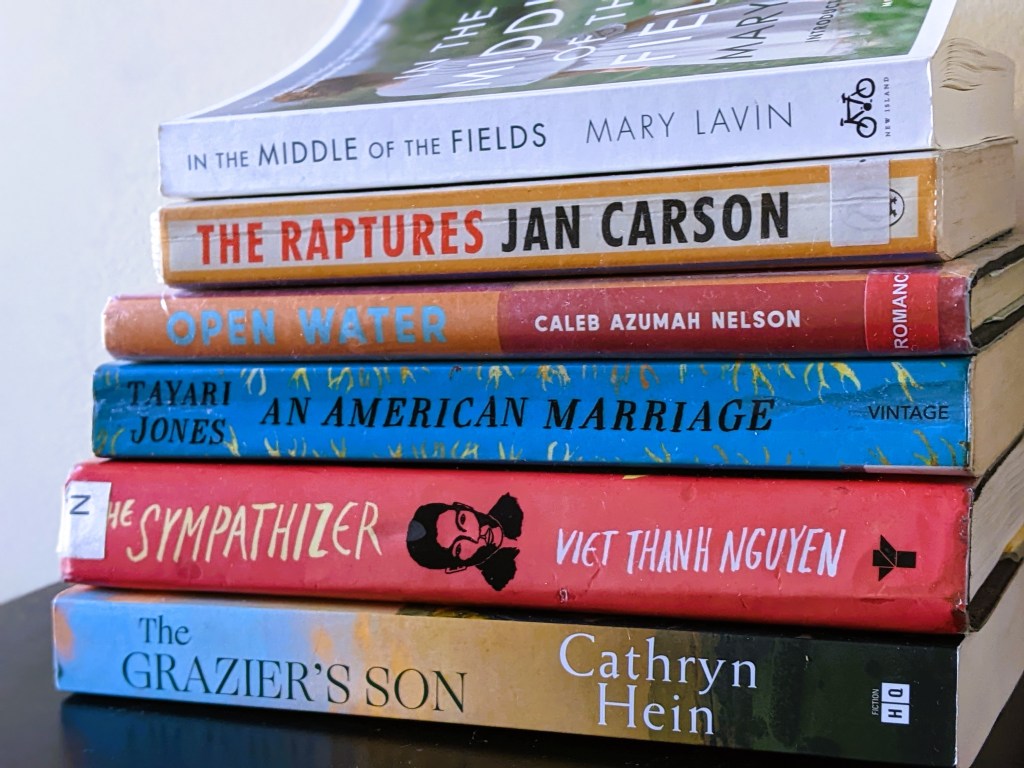
In the Middle of the Fields by Mary Lavin, New Island, 2016

Mary Lavin is known as one of Ireland’s best short story writers. Colm Toibin writes a beautiful introduction in this edition, about how she doesn’t fetishise Ireland for foreign readers (many of her stories appeared in the New Yorker). She writes more about people’s dynamics and inner life than politics or culture. Her Irish women especially, are more than the stereotype of widow, tired mother or spinster. She’s so evocative, conjuring isolation or grief or joy in a few simple sentences and then keeping it there while she moves the story ever onward.

I’m dipping in and out of this collection, having decided that gorging on an anthology like I often do is theft to the individual stories. Consuming them one after the other doesn’t let me savour them or reflect.

The Raptures by Jan Carson, Penguin, 2022

It’s early nineties Northern Ireland and the Troubles are in full swing. Every night on the telly there are stories about bombs and fighting. In the small town of Ballylack a primary school child gets sick and dies. Then another one. And another. These are Hannah’s classmates. Her family aren’t Catholic or Church of England. They’re Evangelical, so she was already an outsider before the dead kids started talking to her.

There’s communities, conflict, faith and magic realism in this book, which sound like much more of an awkward mix than they turn out to be on the page.

An American Marriage by Tayari Jones, Vintage Books 2018

Celestial and Roy have only been married 18 months when he’s accused of a crime he didn’t commit and sentenced to 12 years in prison. They remain married on paper but by the time he’s released early, they haven’t spoken in two years.

This is a big one. Like a Tolstoy tableau, one marriage plays out as a reflection of modern America with race, incarceration, inherited trauma and questions of loyalty and ownership at its heart.

Open Water by Caleb Azumah Nelson, Viking, 2021

In a South London pub a man and woman meet. Something starts between them, a connection that dodges definition. They’re both creatives, both scholarship kids who tried to fit in with their white peers, both sick of their friends matching the appearance of someone police are looking for.

This reads like stream of consciousness, a rhythmic parallel to the soundtrack of our narrator. It’s a very cerebral read and I picked it up with a flu fogged head and gave it a good go. I stayed the course for more than 100 pages but then abandoned ship. Not for me for right now.

The Grazier’s Son by Cathryn Hein, Harlequin, 2024

As mentioned, it’s been a bit of month, so it was nice that this month’s Books at the Bowlo author was rural romance writer Cathryn Hein. After hearing her talk about daydreaming along country roads, hero helicopter pilots and vintage fashion, I thought this might be just what I needed. Joining Stirling and Darcy on their bumpy road to happiness via embezzlement, infidelity, injuries and a surprise inheritance from an estranged father was just what I needed amidst my sneezing and sniffles.

The Sympathizer by Viet Thanh Nguyen, Grove Press, 2015

A communist sleeper agent narrates this story during occupied Vietnam and in America after the fall of Saigon. I haven’t finished it yet but it’s right down there in the details. His voice is so distinct, incredibly dry yet conflicted about the compromises that are made and the moral questions of what he does. The bloody mess of war is not some aerial shot in this book. It’s right up close. The body count keeps climbing but unlike the faceless and expendable lives in an action movie, these people have names and families and lives they were living.

If you enjoyed reading this and want to hear about the next bookstack, subscribe to my bi-monthly newsletter below.

Processing…
Success! You're on the list.

Sky Chase – The story of a short story

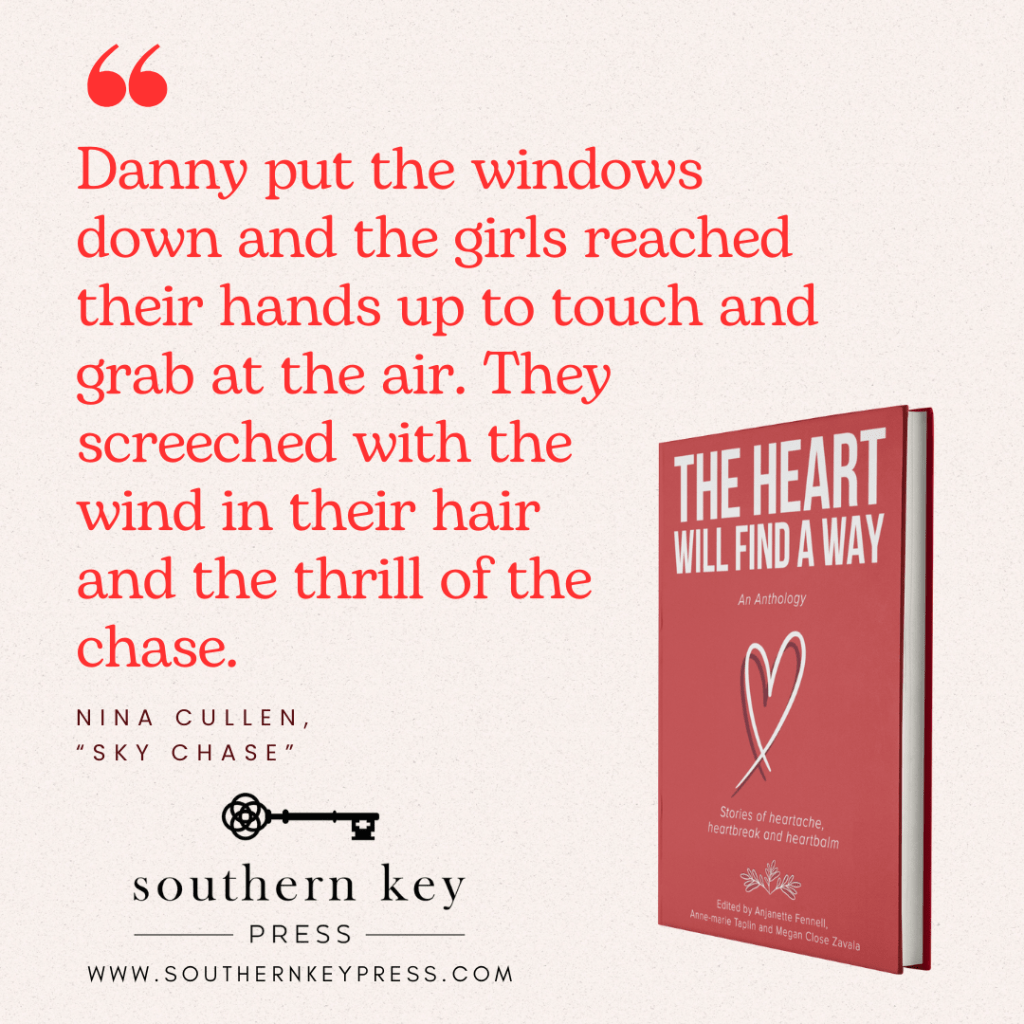
My short story Sky Chase has just been published in the anthology The Heart Will Find a Way. For the process-curious of you who like to know how the sausage is made, here is how it was for this piece.

Do you listen to the Pop Culture Parenting podcast? If you have kids or work with them, then you really should. It’s hosted by Dr Billy Garvey, a developmental paediatrician and Nick McCormack, a ‘developing parent’. These two are such great humans.  They are compassionate and curious and Dr Billy is exactly who you’d want to be your clinician. He’s such an advocate, so measured and thoughtful and reassuring but I digress.

The premise per episode is that they have a topic and pick a clip from a movie, then Billy speaks to it and the deeper dynamics going on. People can send in questions during the following week about the topic, for example resilience in kids, and he answers the questions. They also talk about their own parenting and every week they offer up a ‘Winslow’ for good parenting and a ‘Griswald’ for something they could’ve done better.

My story was inspired by one of Nick’s Winslows. He has two young daughters and one Sunday morning he gets them out of the house early so his partner can sleep. They’re in the car with no real direction and then they see some hot air balloons and just follow them wherever they go. You can listen to him tell it in Episode 25 (you’ll find it at 12 minutes 30 seconds).

My stories often start as an image. I see something and think, I want that in a story. I don’t know the hows or whys but I just need that image. I thought this image was so beautiful, the silent early-morning city, the air balloons floating and a car with three people and no direction suddenly finding one.

I keep a bit of a writing log, of what I’ve been working on, the date, how many words and how many minutes I was at it. I don’t know why. Sometimes it makes me feel good that I’m regularly sitting down. Other times it makes me feel pretty rubbish about how long it’s been since my last entry. I think it was a hangover from freelancing and logging words and minutes and working out where my hourly rate sat. It’s also interesting to see how some pieces are just pure labour and I can only squeeze out a few hundred words in an hour or two and others just flow.

According to the log, I wrote the Sky Chase draft in 3 sittings. 20 minutes – 370 words. Another 50 minutes took me to 1170 words. And 35 more minutes to finish the draft at 1670 words. So, it’s quite a short short story and was quicker to write than usual. And then I edited it in 3 40-minute sessions.

It was a lucky little piece that almost didn’t get submitted to the one call out and was then accepted.

The Heart Will Find a Way anthology is a memoir and fiction collection of 41 stories of heartache, heartbreak and heartbalm edited by Anjenette Fennell, Anne-marie Taplin and Megan Close Zavala.

I had a chat on ABC Breakfast with Jenny and Dan on Valentine’s Day about the book, my story and being a writer. You can hear the episode (pick it up around the 2 hour 4 minute mark) HERE.

If you’re in Newcastle and you’re looking for a copy, try Maclean’s Booksellers on Beaumont St, Betty Loves Books down at the Station or Harry Hartog Kotara.

For those elsewhere, you can order at your local bookstore with the ISBN (978-0-6455648-7-7) or through Amazon and Booktopia.

If you enjoyed this and want to read more posts or the next Bedside Bookstack, subscribe to my bi-monthly newsletter below.

Processing…
Success! You're on the list.

The bedside bookstack – September 2023

What’s sitting on the bedside bookstack this September.

A Swim in a Pond in the Rain by George Saunders, Vintage, 2021

What’s the next best thing to being one of the 5 or 6 students every year who nab a spot in George Saunders’ writing class at Syracuse University? Reading this book because it absolutely feels like you’re one of the 5 or 6 students in George Saunders’ nineteenth-century Russian short story in translation class!!

This one is for the readers as well as the writers. He takes 7 short stories from Chekhov, Turgenev, Tolstoy and Gogol, includes them in the book and then discusses each one. For anyone who misses the close-reading of high school or university English, this is for you. He fossicks around and asks questions and delicately takes the story apart. Then he polishes each part and by the time you finish your reading, it’s been put back together as something better and brighter. I’m loving the meticulousness of this!

Fifty-Two Stories by Anton Chekhov, Bloomsbury Publishing, 2021

I mean really, what can you say about Chekhov? That he’s timeless. That he’s nailed it. Nailed us – our dynamics and foibles and joys. He can tell a tale about an aristocrat or a farmer and it can seem like it’s about nothing but then ta-da it reveals itself to be about everything.

I feel like he’s a bit of a Helen Garner where all of life’s small moments somehow turn up on the page to be much more than the sum of their parts. This is a gem to have on the bedside table. Dip in and out. I guess the 52 is neatly suggesting a year of Chekhov. The temptation with good short stories though, is to gobble them all up.

(Incidentally, not inspired by a Swim in a Pond in the Rain. I was already reading this one)

Tell me who I am by Una Mannion, Faber, 2023

Deena Garvey has gone missing. She’s a loving mother to Ruby and a dedicated NICU nurse but a history of mental illness allows people to think that she’s done a runner. Her sister Nessa knows this isn’t the case. She thinks that Lucas, Deena’s ex-partner had something to do with it. When Lucas moves back to his childhood farm in Vermont with Ruby, he creates a new story about what happened.

Narrated over 20 years by Ruby and Nessa, this is a compelling read about family, control, loyalty and lies.

Brutus and Other Heroines by Harriet Walter, Nick Hern Books, 2016

This book was brilliant! Every so often I think it’s time I read some Shakespeare and that I really should read one of his plays I haven’t studied or seen. But time marches on and it seems too much like hard work.

Harriet Walter (who a lot of people will recognise from Succession and Ted Lasso) has appeared in productions for the Royal Shakespear Company for over 30 years. She has played every major female and male Shakespeare character and this book is a fascinating insight into the approach an individual actor and the cast as a collective take with each new production.

It’s also a great way to catch up on your unknown Shakespear’s. Instead of a plot summary, you get the close-reading and analysis of someone who needs to understand the characters well enough to embody them.

For me it was a great three-for-one. It was a refresher on plays I knew, an introduction to those I’d never read or seen and research for my novel.

Getting into Character – 7 Secrets a Novelist Can Learn From Actors by Brandilyn Collins, John Wiley & Sons, 2002

Notice the dramatic flavour that’s turning up on the pile? If you’re not interested in acting or writing, then skip to the next book. I’m doing research for my main character who is an actor and this book was a great two-for-one reading about acting as well as applying it to characterisation in your writing.

The premise is to take the seven characterisation techniques of method acting and suggest how they can be used by writers to create believable characters with depth who are able to create drama and tension.

I’ve never been much of a craft reader. I think I read a few duds early on and was arrogant enough to think there wasn’t much to learn (excuse me while I roll my eyes at youthful ego and a wasted decade or two) but I’ve just joined a Hunter Writer’s Centre Book club which only reads books on the craft of writing. Anyway, this was a crash course in method acting and tips on how to make better characters, so tick and tick.

The Pearl by John Steinbeck, Penguin, 2011

I love Steinbeck. In fact one of the few craft books I have read and loved was his Journal of a Novel.  But this was a DNF for me. It’s set up as a fable and reads as a fable with an exaggerated tone to the characters and events and I’m just expecting something way more detailed and nuanced from him.

Kino finds a pearl which he wants to sell, so his son Coyotito can go to school and have a better life than his father. But having something precious makes you a target and reveals the potential we all have for greed and violence.

For a modern reader, there’s also a white American writing about a peasant Mexican family. There is context. Steinbeck has a lot of lived experience growing up in Southern America and living for a while in Mexico. It was 1947 and he was deliberately writing about people who were invisible to his big city readership but I’m reading it in 2023 and that has context too.

If you enjoyed reading this and want to hear about the next bookstack, subscribe to my bi-monthly newsletter below.

Processing…
Success! You're on the list.

If there’s only one writing listicle you ever read…

it should be Sarah Sentilles’ 11 Things I Wish I’d Known About Writing 11 Years Ago

I seem to be caught in a bit of a rupture and repair cycle with my writing at the moment. Anyone who read ‘finding my way back to the page’ will already know that my relationship with writing has been on shaky ground. After writing that, I thought I’d found my way back to the page but I’ve since made my way off it again. I’m not writing and I’m not reading.

There’s a difficult pull as a writer where you love the writing but also want readers and if that isn’t happening, the desire to be read, published, short-listed, commended, acknowledged, anything, seems to overtake and obscure the writing itself. The fact that it’s not happening can then bleed into everything – especially the writing and things seem to get stuck from there. So, I’m impatient for something to happen but frozen and not writing a word.

Maybe it’s just me.

Anyway, I’m always on the lookout for the answer, a solution to get things moving again and keep the momentum going. The simple suggestion is to just get on with it. Put words down on the page. But that’s ignoring all the other dynamics at play. And so, on an unsuspecting Thursday, trawling through Twitter, I came upon Sarah Sentilles’ listicle 11 Things I Wish I’d Known About Writing 11 Years Ago.

Reading it was like being thrown a life line.

I think we’ve all read plenty of Top 5 writer’s tips.  A lot are just filling a content quota and saying the same old things. This one is different. She’s wise and generous and says things I haven’t read before which are so refreshing and exactly what I didn’t know I was looking for!!

I suggest reading all 11. And then printing them out. And then re-reading them. And then keeping them close, because you’ll want to go read them again, for comfort and reassurance and because good advice can change everything.

There’s no hot air in this list. All 11 have something to say but I’ll share the three that really resonated and have shaken things up for me.

Number 1. SET AN INTENTION

Sarah Sentilles credits her friend and teacher Juliana Jones-Munson for this one and says you should set an intention for every writing project.

The intention should be personal and healing, not external or dependent on other people. Your intention should remind you why you write, and it should be powerful enough that everything else – what critics say, whether you sell it – pales in comparison.”

Boom! Nothing will ever be the same again. I think this is my way back, to have intention keep me company during the writing rather than the idea of an outcome. Her intention when she was writing Stranger Care was for it to be a love letter to her foster daughter. Now that’s worth writing through the doubts.

Number 7.  YOUR STORIES CHOSE YOU

This is a nice way to excuse your doubts and tell them they aren’t welcome.

She says, “When we worry our story isn’t good enough, it’s disrespectful to the idea. Thinking we’re not good enough to write is also impolite. Our ideas come from deep within, and they come from the stars. Treat these visitors with love.”

This is a riff on some of Elizabeth Gilbert’s ideas from Big Magic. Funny that if we think it’s us, we’ll drag out the inner-critic but if we hold it as something separate, we behave better.

She also goes on to say that ideas can take time. Her book Draw Your Weapons took 10 years to write and by the end of it she was impatient and wanted to be done with it.

Her friend, the writer Alice Dark said, “Sometimes we have to become the person our books need us to be before we can finish it.”

I love it and I find it so heartening when she says, “That idea knows you have everything you need to become the writer it needs.”

Number 11. YOUR PROJECT IS WELL SUPPORTED

Again, it’s all about the internal stuff for me. The monkey-chatter is what gets me off the rails and the only way the quiet it is to have something better and louder on a loop.

She says, “We don’t write alone. We write for the generations who came before us and we write for the generations who follow.”

If that seems a little lofty and presumptuous then bring it in closer. Write for your grandmother who couldn’t or the kids you know who one day will.

PS Number 5 YOU DON’T KNOW WHAT YOU’RE WRITING UNTIL YOU HAVE A DRAFT needs a special mention for the pantsers. It’s all good. Just get it down and worry about what it is or will be later.

It’s a big claim but I’m going to say it, this listicle by Sarah Sentilles has the best writing suggestions I’ve ever read. I’m interested if it resonated for you or if you have another list you turn to when things get wobbly? If so, please share!

If you enjoyed reading this and want blog updates, subscribe to my monthly newsletter below.

Processing…
Success! You're on the list.

5 ways to find your way back to the page

Sometimes you need to hit pause on your writing relationship

Last year was a low point for me and my writing. The dynamic was starting to feel like a bad marriage. It isn’t romantic or cathartic or necessary to feel huge amounts of pain in exchange for words on a page. So, I had a trial separation. Here’s how we got back together. #writingcommunity #writerslife

At the end of last year, my relationship with writing felt like a bad marriage. Life was stalling in other ways, care of the pandemic and my tally of unsuccessful submissions, applications and pitches was getting depressing.

I wasn’t writing and I hated that I wasn’t writing but I just couldn’t seem to do it. There was no excitement. No chasing the unknown or following curiosity. No lightness or joy to it. Something that had been a life force for me had turned rotten.

It was feeding all my worst core beliefs. When I thought about writing the associations were dark and heavy; sadness and unworthiness, invisibility, despondence. It isn’t romantic or cathartic or necessary to feel huge amounts of pain in exchange for words on a page.

How can you write with those shadows at your hand? You can’t. Like all relationships, if it’s bringing you more sadness than joy, it’s worth examining if it it’s time to get out and for me it was. The idea was to have a trial separation, get some distance, have a think about it all and see if I could rekindle what we once had.

Here’s how I made it back to the page.

  1. Read if you can’t write

Someone once said that if you’re a writer who isn’t writing, then you should be reading and vice versa. Reading is sustenance, joy and escape. It’s immersion and fascination and the repeated exposure to text is also instructive. There’s a kind of osmosis occurring as you take it all in. There are styles you’ve never read before, structures you hadn’t imagined, impossibly gorgeous language and clever plotting. So, if you can’t do nothing but are finding it impossible to do something, reading is a good way to start the journey home.

2. Ban yourself from writing…or not

If the writing (or inability to do so) is causing the pain, then step away. Don’t write. Just put a ban on it for an amount of time that lets you off the hook. This isn’t wheedling yourself out of your regular writing practice or habit. This is an intervention to get you back there. You can’t make it better without a bit of distance and reflection.

And if not-writing is a not-option then….

3. Make it mean nothing

My writing had all become so loaded with the expectation of outcome. I needed to make it mean nothing so I could love it again. You can’t just turn off your desire to be published or your hopes that what you write will be ‘good’ but you can write things that aren’t meant to go beyond what they are.

Keep writing in your journal. Excavate the emotions that are setting it all off until you get a little nugget of something. Go old school and write letters to friends, birthday cards longer than they need to be, post-its with too much detail. Write notes apropos of nothing in particular, stories or poems that you don’t have any future plans for beyond the action of simply writing them. Or see number five for writing exercises that offer writing practice minus a loaded expectation of the outcome.

4. Don’t let it steal your other joys as well

Writing is a big part of my identity, so the rot I felt there started to spread through to other aspects of my life. Try and isolate it to stop the spread. Champion the healthy relationships you do have and the aspects of your life which are bringing you joy. Give them more time and attention. It’s the same advice for anyone going through any other negative thought cycle. Do some exercise. Spend time with the people you love. Do things that relax you and make you happy. Try to stay present and avoid the constant mental replay and fast-forward.

5. Learn something

This is a great time to admit humility and allow that there’s always more to learn. Read a book by a writing teacher (Writing Down the Bones by Natalie Goldberg, The Artists Way by Julia Cameron, Bird by Bird by Anne Lamott, The Emotional Craft of Fiction by Donald Maas). Read a book by a writer talking about their process and advice (On Writing by Stephen King, The Writing Life by Annie Dillard, A Writer’s Diary by Virginia Woolf, Journal of a Novel by John Steinbeck).

This is a chance to try new things and think about process rather than the outcome. Writing exercises are exactly that, exercise. They’re a great way to write without expectation and for this writer, it was the way back to the page. It was a reminder of what I love about writing, what I get out of it and why, for me, it’s a relationship worth sticking with.

If you enjoyed reading this and want blog updates, subscribe to my monthly newsletter below.

Processing…
Success! You're on the list.

Colm Toibin’s The Magician and the right to write

I’ve just finished reading Colm Toibin’s The Magician. It’s an epic that covers most of his life. Its rich layers cover politics, sexuality, history and culture and it has a certain weight to it because of that but also because you’re in such good hands with Toibin.

In the midst of international politics and repressed sexuality though, all I could think about was the practical aspects of his writing life and how enabled he was by those around him, especially his wife Katia and daughter Erika.

Every day of his adult life, he spent the four hours before lunch writing. He always had his own study and children and visitors were warned not to disturb him, or even make too much noise in the house. He had six kids.

In the afternoon he napped and read and thought. Can you imagine??!!!

He had money, which makes a difference, but he’d also decided that he was a writer early on and expected time and silence as part of that.

I wonder how much of his ideas about having a right to write and a right to make demands about it was about gender and how much about the culture of the time and his social status?

I’ve always known that I wanted to be a writer but still struggle with the idea of having a right to write. Do I dare take time for this?  There’s ‘Who am I to have something to say?’ mixed in with ‘Who am I to write when there are other obligations in the mix?’.

It was also interesting to read the gestation of his ideas and how they would build to become short fiction and novels. It all came from his life, the families he was part of, the holidays he took and the people he watched.

No one ever belittles his writing because of this. They never say his books are just glorified diaries or dismiss the content as domestic. It’s always intuited as something bigger than what it is. He has conflicting desires about men and boys and basically represses his sexuality. Even when he writes with desire and detail about young men, which definitely wasn’t socially acceptable, instead of interpreting it as his voice and his desire it’s elevated and thought of as metaphor or a clever device.

Of course it makes me think, about what woman would ever have her family observations lauded as high literature like he did or what woman would demand silence and have her husband and son shushing company and making diary arrangements so that she could get on with her writing. Every day. For at least four undisturbed hours. And then allow some napping and thinking time on top of that.

If you enjoyed reading this and want blog updates, subscribe to my monthly newsletter below.

Processing…
Success! You're on the list.

Kneel down and weed the bindis, baby

Use your hands to get out of your head.

Sometimes, the only way to dilute all the monkey chatter is to do something hands-on and finicky that needs all of your attention.

For the readers outside of Australia, let me explain. Bindis (also called bindi-eyes) are small weeds that grow in circular clumps often near clover. They’re a summertime menace. When they’re young or there’s been a lot of rain, they’re soft and harmless. But as the weather gets hotter and dries out, they get thorny. Whole swathes of gorgeous grass are off-limits to bare feet because of them. Even thick-skinned soles will feel a bindi prick.

Spraying them partially works but the only way to truly deal with them is get down on your knees and pull them out, each little clump at a time across an entire lawn or verge. Your painstaking process will pay dividends across the whole summer and give you the satisfaction of a personal win but it also offers something in the moment – a chance to get out of your head and concentrate on something else completely.

Fine finger work and attention to detail have saved me from the unmooring of heartache, the dogged cycle of rumination and the waiting, waiting, waiting that comes with writing. You can’t do nothing but you feel unable to do any kind of significant something.

Perfect, you can kneel down and weed the bindis then, or make dolmades, clean a window, fold origami, sand back an old stool. There are plenty of small tasks that never get a look-in during normal life. They’re perfect for distraction and pride offering the satisfaction of something completed or created and the reprieve of getting out of your head for a while.

If you enjoyed reading this and want blog updates, subscribe to my monthly newsletter below.

Processing…
Success! You're on the list.

The eternal waiting room of lockdown

Take away the future and it’s hard to stay ‘present’.

We’ve been in lockdown for a few weeks now. I understand the necessity. It’s not as long as Sydney or as many times as Melbourne but what most of the country, nay world, has realised by now is that any lockdown is lockdown enough.

A few weeks ago, I blogged about the idea of presence and my attempt to stop mentally scrolling backwards and forwards in time. Now I realise that to do that you need the neat bookending of both a past and future.

But time has slipped from its moorings. Lockdown, the eternal waiting room, has scrambled our sense of the future and, as I’m now realising, it’s hard to be in the present without a future.  

Waiting isn’t uncommon territory for a writer. We’re well aware of how uncomfortable it is to wait on submissions, feedback and querying. Waiting is its own kind of agony. It’s a protracted presence but one that isn’t really fixed on the moment. It has its sight set on some point in the future, when things will change or you’ll finally have your answer. With lockdown though, that future is on hold.

It feels like I’m caught in a Beckett loop except it isn’t Godot I’m waiting for. My eternal waiting is for the host to let me into the meeting, for the vaccine supply to arrive, for the daily reveal of dire digits in the press conference or for my daughter to actually start writing a sentence using her spelling words.

Some people are writing away and having a mini-renaissance with time and perspective. I’m frozen. Everything has come to a confused halt as I continue to wait.

My lockdown is stagnant in many ways but not still. Alas, not for me the baking of sourdough or learning of a new language. Between home-schooling, work and domestics, I don’t have much left in the tank, time or energy wise. I’m not reading much. I’m writing even less and I’m always at my worst when that happens.

Two characters in a Tom Stoppard play discuss the future. One says, ‘Tomorrow is another day.’ The other replies, ‘Tomorrow, in my experience is usually the same day’ and I’d have to agree.

If you enjoyed reading this and want blog updates, subscribe to my monthly newsletter below.

The presence present

Trying to be more in the moment with life and writing

I’m trying to cultivate a new habit. My usual tendency is to spend way too much time thinking about the past and the future. Thoughts about the past keep me circling round regrets and pre-occupation with the future makes me feel like I’m still ‘waiting’ for life to happen. Both of these, of course, neglect what’s going on right now in the present and I didn’t realise how exhausting all this mental time travel was until I started to suspend it.

There are plenty of traditions and modalities that talk about the benefits of being present, so I’ve decided to give it a go. The results thus far are interesting. When you intentionally stick with what you’re doing, it gets done a lot faster and with more ease. I know, nothing surprising there. Just like so many of life’s learnings, it’s as simple and as difficult as that.

In the morning, I set some intentions around presence by writing down a few sentences of how I’ll be doing it and why I want to do it. Then I check in at regular intervals during the day to see where my mind’s at – rarely in the present, it turns out. It’d be great to find that I was in the moment more but being reminded that I’m not is enough to cut the loop of whatever mental re-run I’m on.

I’ve mainly been doing it with work and general life admin but I’m wondering how it would affect my writing. I’m sorry to say that I’m not often writing in the present. You get those golden streaks of pure flow but especially before I start writing, I think a lot about the end product and whether it will be published and read, where and who by. Then I think about past pieces and what did and didn’t work.

I’m constantly scrolling backwards and forwards and deciding the future of a piece based on past experiences. It must weigh words down when they arrive with such hopes and expectation, when you want them to achieve something big before they’re even born. I wonder what it would be like to write without that? Does it read as something different when it’s freed from all that chatter and of course, is it easier to write when it’s just you and it in the moment?

I also wonder would it add more depth to my writing. The idea of tuning in to the senses is a common suggestion for finding more of a connection with the present moment, so if I’m more open to the tactile or visual or aural, would that have a flow on effect with my writing?

I’m interested in how it works for others. Maybe this is how everyone else is already writing, firmly in their now. If so, is this just how it works for you or did you cultivate a process to get you there? Or does all that past and future rumination freeze you and stop you from starting anything?

I’m going to keep trying to offer the present of presence to my words. I want to see if it’s as good for them as it is for my to-do list.

If you enjoyed reading this and want blog updates, subscribe to my monthly newsletter below.

Comparison the joy thief

Comparing yourself to others isn’t helpful but it is human.

Last week I found out that I was unsuccessful in four story submissions that I’d made for publications and competitions. I didn’t find out through the usual ‘unfortunately, this time your piece wasn’t chosen’ email, instead it was by reading declarations on Twitter from the writers who were successful.

Pop. Pop. Pop. Pop. There they went, one by one, the little bubbles of hope and possibility I have when I’m still waiting to hear back on a few submissions. Next came a slow deflating sigh and then disappointment.

For me, the disappointment usually starts me questioning and the questioning usually leads to comparing. How many stories have they had published? How many competitions have they won? Do they have an agent? Have they had published a book? How many followers do they have?

There will always be room for comparison, even when books are published, an agent is secured and followers are plentiful you can compare prize nominations, festival invitations, sales into foreign territories, options for films or bodies of work. It doesn’t matter what you have, someone else will always seem to have more.

Comparison is indeed a joy thief. Comparing yourself or your work to someone else isn’t helpful but it is human. With that in mind, I’ve gathered together some quotes and I’m hoping that reading them will help to still the spiral for when I next slip into the comparison vortex.

“How much time he gains who does not look to see what his neighbour says or does or thinks, but only at what he does himself, to make it just and holy.”
Marcus Aurelius, Meditations

“Comparison is the death of joy.” Mark Twain

“Don’t compare your life to others. There’s no comparison between the sun and the moon. They shine when it’s their time.” Unknown

“A flower does not think of competing to the flower next to it, it just blooms.” Zen Shin  

“To be yourself in a world that is constantly trying to make you something else is the greatest accomplishment.” Ralph Waldo Emerson

“You cannot envy the branch
That grows bigger
From the same seed,
And you cannot
Blame it on the sun’s direction.
But you still compare us….”
Suzy Kassem, Rise Up and Salute the Sun (2010)

“Comparison is the most poisonous element in the human heart because it destroys ingenuity and it robs peace and joy.”
Euginia Herlihy

“Don’t always be appraising yourself, wondering if you are better or worse than other writers. “I will not Reason and Compare,” said Blake; “my business is to Create.” Besides, since you are like no other being ever created since the beginning of Time, you are incomparable. ” Brenda Ueland

“There is really no use in comparing yourself to others. There will always be someone ahead and someone behind, and there will be dozens (if not hundreds) of different scales and gradients to be behind and ahead on.
To be number one is never final. It is and always will be a momentary, fleeting instant. But to be a growing version of yourself? That, you can be. You can be that every single day.” Vironika Tugaleva

If you enjoyed reading this and want blog updates, subscribe to my monthly newsletter below.