The bedside bookstack –June 2025

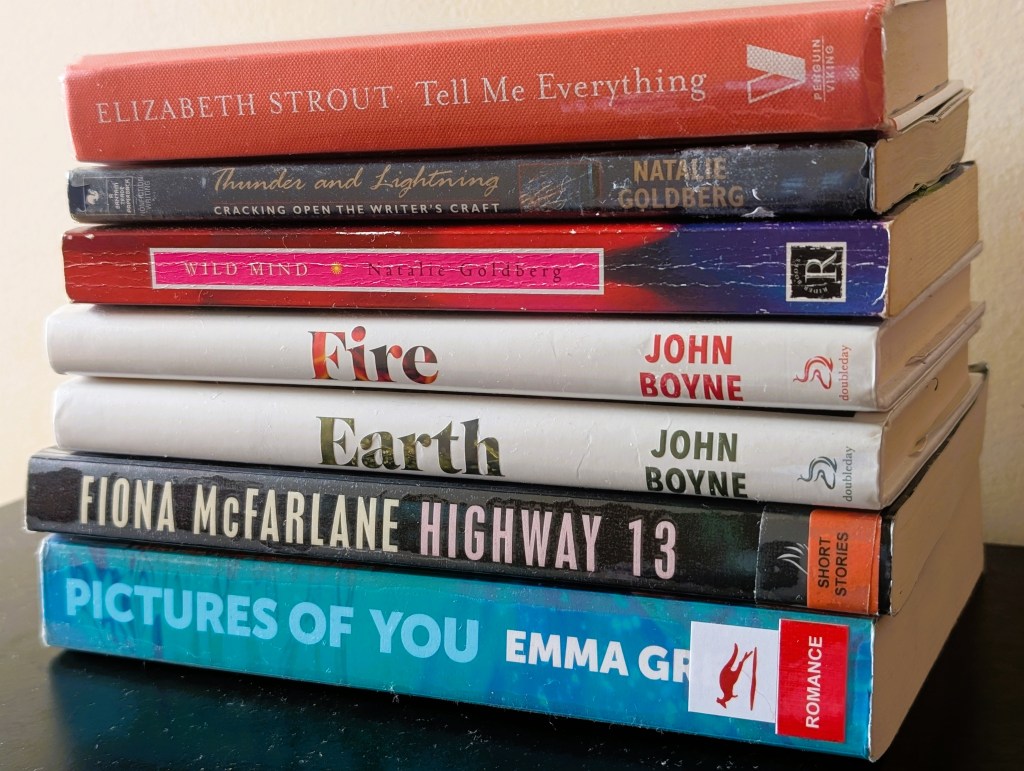
Highway 13 by Fiona McFarlane, Allen & Unwin, 2024

I avoided this for a while because the name and premise made it sound a bit true-crimesque, which isn’t really my thing. But its’ a story cycle, which is definitely my thing and it’s Fiona McFarlane who has a solid track record, so no surprises then, that it was great. The connection linking these stories is a fictionalised version of the Ivan Milat backpacker murders. Especially with the current popularity of true crime, I liked how these stories took the crime off the front page and exploded it into all of the lives, of real ordinary people, who were affected.

Tell Me Everything by Elizabeth Strout, Penguin Viking, 2024

Anyone who has read Elizbeth Strout’s Olive Kitteridge or Lucy Barton books, can just pick this right up and start reading. You know what you’re in for. If you haven’t, you should still pick it up because Elizabeth Strout is the master of small town and big lives. They are big in the sense of being rich and complex like we all are as humans.

She likes to have a central character/s moving things forward while stepping into all of these other lives along the way, reading sometimes more like a story cycle than novel – which is fine by me as you probably know by now.

Bob Burgess and Lucy Barton are good friends. They regularly take long walks together and talk for hours. Often they tell each other stories they’ve been told about people they know or knew. It sounds gossipy but it’s more philosophical.  

Fire by John Boyne, Doubleday, 2024

I can’t recommend this book. John Boyne is a master writer. His female characters are impeccable. I loved Water to bits and pieces and it was actually my doggedness to see the ever-so-slight way the books in this series (Water, Fire, Air, Earth) refer to each other that kept me reading. Otherwise, I’d have to say it was too dark for me. The trauma and revenge and cruelty was just too much, despite being so well-written.

Earth by John Boyne, Doubleday, 2024

Unbelievable. I read this thinking it was going to be lighter than Fire but it’s about a rape trial and broken people and power. There is so little love or hope to be found that once again, I should’ve just stopped and left it. And now that I’m three books in, I’m too stubborn not to read Air.

Wild Mind by Natalie Goldberg, Bantam Books, 1991

You may have heard me go on about Natalie Goldberg’s Writing Down the Bones and how it gets me fired up and back on track when me and the words have split ways. Or maybe it was the Writing Down the Bones Deck, where you pull a card every day and follow the prompt to get back into writing practice through low-stakes words on the page?

Wild Mind was written after Writing Down the Bones. It’s along the same lines but with an extra five years’ experience behind her. It’s full of practical exercises and suggestions. She’s a Zen Buddhist as well and her belief in cutting out the critic to get to the core of what we’re trying to write resonates with me, so this one is going to join my select collection of writing-book bibles, joining A Swim in Pond in the Rain by George Saunders, The Emotional Craft of Fiction by Donald Maas and Writing down the Bones.

Thunder and Lightning by Natalie Goldberg, Bantam Books, 2000

I’ve been in bed with a cold for a few days. Usually, I can’t read when I’m sick and tired but Wild Mind was so compulsive for me that I went straight to another Natalie Goldberg book. I read it but this one has left me a bit deflated and adrift.

Reading Wild Mind, I did think, ‘well all this writing practice and getting to the source of things is great but how do you then turn that into something more than 20-minute timed writing?’ What’s the secret to accessing that judgement-free flow zone when writing and editing a novel or collection of short stories or essays? I was hoping she’d have the answers. She did have some but she also had questions and seems a bit lost herself and I wasn’t ready for this person I’d decided would be my mentor to suddenly have clay-feet and the same doubts as the rest of us. She’s been writing for years, she’s a Zen Buddhist, if she’s still unsure that makes things mighty wobbly for the rest of us.

If you want to keep her a hero/mentor then leave this one and stick to Writing Down the Bones and Wild Mind.

Pictures of You by Emma Grey, Penguin, 2024

Evie Hudson has just lost her husband in a car crash. When she wakes up in hospital, she thinks she’s 16 and can’t remember that she was even married. The people who once mattered to her aren’t even in her phone anymore.

She bumps into her old best friend Drew at her husband’s funeral, not knowing who he is, she asks for a lift out of there and then for help in trying to find her parents. We find out what happened over the past 14 years between Evie and everyone, including Drew who’s torn between not saying anything or saying way too much.

I’ve been sick in bed for a couple of days and this was one of the books I was curled up with. It was the right read but could’ve been closer to a 300-page read than the 400 it was.

If you enjoyed reading this and want to hear about the next bookstack, subscribe to my bi-monthly newsletter below.


Processing…
Success! You're on the list.

The bedside bookstack – October 2024

What’s sitting on the bedside bookstack this month.

Solider Sailor by Claire Kilroy, faber, 2023

Soldier speaks this story Sailor, to her baby boy. She tells him of his birth and the early months of his life. She advises him on what to be and not to be in this world and she apologises for the backdrop to his first years when she and Sailor’s father fought and she nearly let all of them go.

She speaks like a madwoman telling all our truths and she is mad with the lack of sleep, the exhaustion, the relentless repetition of those early days of motherhood and the sudden gender division of labour. This is such a sucker punch of read – visceral and all-consuming. You feel like you’re drowning with her, so maybe one for when you’re out of the trenches and sleeping through the night again yourself.

Orbital by Samantha Harvey, Random House, 2024

Six astronauts orbit around the earth over a 24 hour period. That’s it. That’s what happens in this book but it is beautiful and poetic and slowed me down until it felt more like a meditation than a narrative.

As they go about their daily tasks, they think about their lives and their loved ones. They look down on the world as life down there wakes up and goes to sleep again. They record the growing fury of a typhoon for meteorological services back on earth and they wonder about the vast space that opens up when they look in any direction other than earth. Grand in content and contained in style, this is like the space version of a Claire Keegan book. Just gorgeous.

Sky Song by C. A. Wright, Pantera Press, 2024

CA Wright was our October Books at the Bowlo guest. It’s always a treat to read a book and then get more insight into it from both a craft and content angle.

Oriane is the Skylark. She sings the sun and a new day into being every morning. To many she is just a myth. Her father has kept her hidden in safety but as she grows so does her curiosity about what is out there beyond their isolated home in the woods. There is another myth. This one is about the Nightingale who sings forth the darkness each evening and if Oriane is real, perhaps the Nightingale is too.

This is based on a Hans Christian Anderson story. I don’t know the original but I’m always curious about what was kept and shed in the rewrite.

The Emotional Craft of Fiction by Donald Maas, Writer’s Digest Books, 2016

Boom!! That was my head exploding into smithereens while reading this book. Donald Maas is New York literary agent and after reading thousands of manuscripts he started to wonder why some brilliantly plotted and/or written books still didn’t make much of an impression on him.

His analysis is that it is the emotional impact and connection with a book which makes it stand out from others. He lays out different methods for achieving emotional engagement and includes excerpts and exercises with each. This book is a brilliant mix of theory and practice and is now in my Top 3 Writing Books. Yep. That’s saying something.

Oh, what are the other 2 you ask. George Saunders’ A Swim in the Pond in the Rain and Natalie Goldberg’s Writing Down the Bones. I just keep going back to them again and again and I can see how this will be the same.

The Writer’s Library by Nancy Pearl & Jeff Schwager, Harper One, 2020

I know, no one needs more to add to their book list but….I’m a big fan of reading about writers and certainly very happy to take their book recommendations. Each chapter is dedicated to a writer and set out in Q and A style from their early reading to reading which made them want to write, reading which influenced certain works of theirs and what they’re reading now. And instead of having to take notes and add books as you’re reading it, there’s a list at the end of each chapter for all the books which were mentioned!

Just as a warning, it’s an American book, thus US writers only which could be limiting for some readers but I picked and chose a bit and loved that my current fiction fan-girl recipient, Jennifer Egan, was featured.

Wall by Jen Craig, Puncher & Wattman, 2023

An artist returns to Australia to clear out her father’s house after his death. She has plans to turn it into an installation but the reality of a hoarder’s house and the history it holds for her make it a much more complicated task. I’ve only just started this. The stream-of-consciousness prose is densely packed, almost like the narrator’s thoughts are mirroring the clutter she stands in. She jumps from art theory to family memories to her current situation in the same way that she notices and moves on from the objects around her. Not a tired bedtime read, methinks.

If you enjoyed reading this and want to hear about the next bookstack, subscribe to my bi-monthly newsletter below.
Processing…
Success! You're on the list.

Sky Chase – The story of a short story

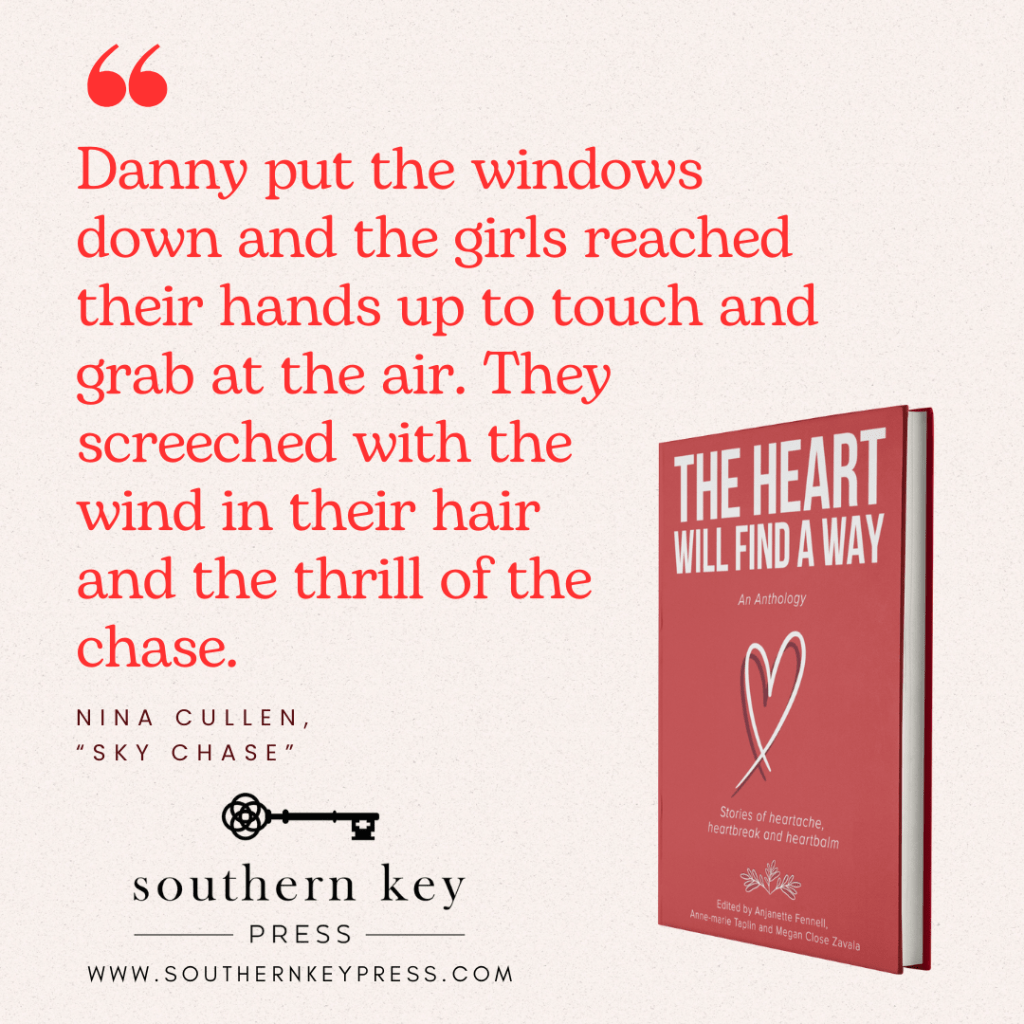
My short story Sky Chase has just been published in the anthology The Heart Will Find a Way. For the process-curious of you who like to know how the sausage is made, here is how it was for this piece.

Do you listen to the Pop Culture Parenting podcast? If you have kids or work with them, then you really should. It’s hosted by Dr Billy Garvey, a developmental paediatrician and Nick McCormack, a ‘developing parent’. These two are such great humans.  They are compassionate and curious and Dr Billy is exactly who you’d want to be your clinician. He’s such an advocate, so measured and thoughtful and reassuring but I digress.

The premise per episode is that they have a topic and pick a clip from a movie, then Billy speaks to it and the deeper dynamics going on. People can send in questions during the following week about the topic, for example resilience in kids, and he answers the questions. They also talk about their own parenting and every week they offer up a ‘Winslow’ for good parenting and a ‘Griswald’ for something they could’ve done better.

My story was inspired by one of Nick’s Winslows. He has two young daughters and one Sunday morning he gets them out of the house early so his partner can sleep. They’re in the car with no real direction and then they see some hot air balloons and just follow them wherever they go. You can listen to him tell it in Episode 25 (you’ll find it at 12 minutes 30 seconds).

My stories often start as an image. I see something and think, I want that in a story. I don’t know the hows or whys but I just need that image. I thought this image was so beautiful, the silent early-morning city, the air balloons floating and a car with three people and no direction suddenly finding one.

I keep a bit of a writing log, of what I’ve been working on, the date, how many words and how many minutes I was at it. I don’t know why. Sometimes it makes me feel good that I’m regularly sitting down. Other times it makes me feel pretty rubbish about how long it’s been since my last entry. I think it was a hangover from freelancing and logging words and minutes and working out where my hourly rate sat. It’s also interesting to see how some pieces are just pure labour and I can only squeeze out a few hundred words in an hour or two and others just flow.

According to the log, I wrote the Sky Chase draft in 3 sittings. 20 minutes – 370 words. Another 50 minutes took me to 1170 words. And 35 more minutes to finish the draft at 1670 words. So, it’s quite a short short story and was quicker to write than usual. And then I edited it in 3 40-minute sessions.

It was a lucky little piece that almost didn’t get submitted to the one call out and was then accepted.

The Heart Will Find a Way anthology is a memoir and fiction collection of 41 stories of heartache, heartbreak and heartbalm edited by Anjenette Fennell, Anne-marie Taplin and Megan Close Zavala.

I had a chat on ABC Breakfast with Jenny and Dan on Valentine’s Day about the book, my story and being a writer. You can hear the episode (pick it up around the 2 hour 4 minute mark) HERE.

If you’re in Newcastle and you’re looking for a copy, try Maclean’s Booksellers on Beaumont St, Betty Loves Books down at the Station or Harry Hartog Kotara.

For those elsewhere, you can order at your local bookstore with the ISBN (978-0-6455648-7-7) or through Amazon and Booktopia.

If you enjoyed this and want to read more posts or the next Bedside Bookstack, subscribe to my bi-monthly newsletter below.

Processing…
Success! You're on the list.

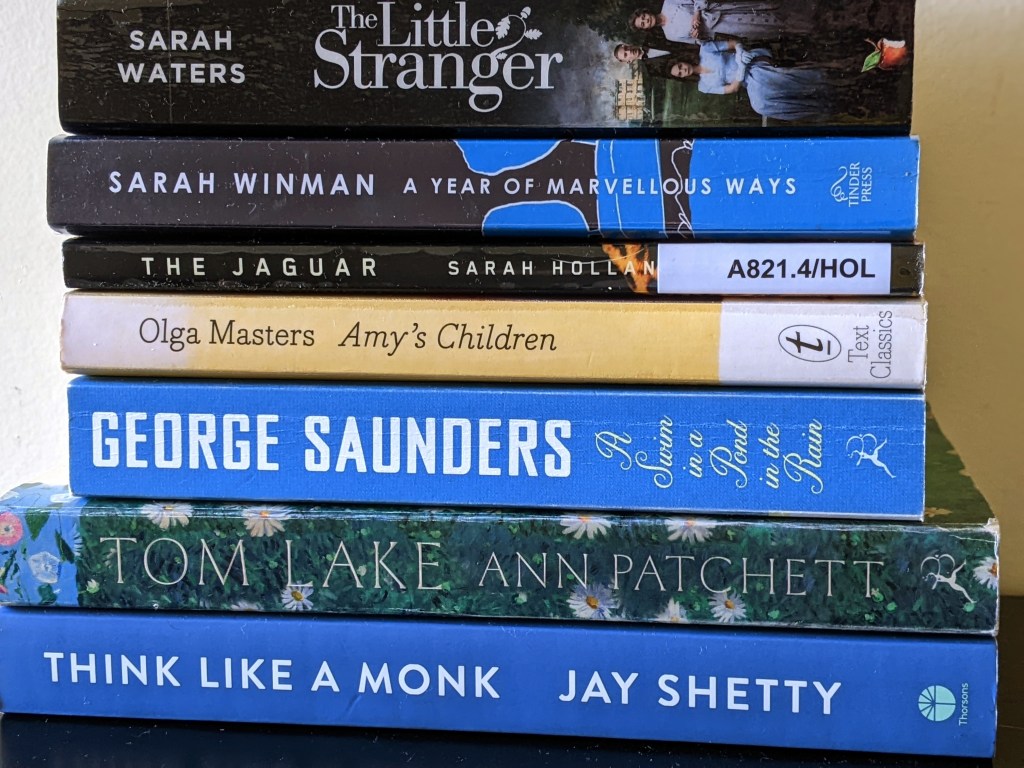
The bedside bookstack – November 2023

What’s sitting on the bedside bookstack this month.

Tom Lake By Ann Patchett, Bloomsbury Publishing, 2023

It’s lockdown and Lara’s three daughters have come back home to their cherry farm to help with the harvest. In between the picking they demand that it’s time to hear the full story about their mother’s life as an actress and the summer she spent with Peter Duke who is now a famous actor but was just starting out like the rest of them back then.

This is Ann Patchett. She knows what she’s doing and a dual narrative comes off just fine in her hands. She also knows how to get in there a play around with personal dynamics and ideas about loyalty, love, creative ability, ambition and ageing. I loved the present sibling and family narrative as much as the summer at Tom Lake. This’ll be a great summer read, settle in for some seasonal nostalgia.

The Jaguar by Sarah Holland-Blatt, UQP, 2022

Sometimes poetry makes me feel stupid. I read it and just can’t find a way in. I don’t like feeling stupid, so I don’t read a lot of poetry. But that’s a shame, because it isn’t all like that and I’m so glad that this won the 2023 Stella Prize and was on the radar enough for me to pick it up.

It doesn’t make me feel stupid. It makes me see the world with fresh eyes. It makes me even more curious about words, sounds, rhythm and pace and how I could use it to better effect in my own writing. She has a lovely way of dusting some words off as well, that have been sitting on the shelf for a long time and deserve to find themselves on a page again.

For me, this collection is at its best when she recalls her father and his 20-year deterioration with Parkinson’s Disease and subsequent death. There isn’t anywhere for poets to hide with the omnipresent ‘I’ and she’s so generous with what she shares.

A Year of Marvellous Ways by Sarah Winman, Tinder Press 2015

Sarah Winman is one of my literary heroes. I just love her to bits and pieces for bringing Still Life into the world. She has so much heart and humanity in her writing and that’s present not just in a masterpiece like Still Life but also in a quieter novel like A Year of Marvellous Ways.

Marvellous Ways is a 90-year-old woman who lives in a caravan on the sea. Francis Drake is a 28-year-old soldier who had nothing to come back to in England after the war. When their paths cross Marvellous gets a chance to relive the past and Drake finally looks to the future. If you didn’t like Still Life or you need total realism in your narrative then give this one a miss. Otherwise, savour as it’s another Sarah Winman delight.

For any Winman fangirls like me, this interview she did on The First Time Podcast confirms she’s just as warm and wonderful a human as you’d think she would be.

Amy’s Children by Olga Masters, Text Publishing, 1987

I’m ashamed to say that this is the first Olga Masters I’ve read. I feel like I owe more to an Australian female writer publishing at a time when the scene was so male. Ne’er mind. I’ll be looking up her backlist now.

Amy’s husband leaves her and her three young daughters during the Depression. Living on the family farm in rural NSW, she then leaves her daughters to try and find work in Sydney. Work is scarce but no one will hire a married woman, so she makes herself slightly younger and unmarried on any applications.

This is a fascinating insight into Depression and war-time Australia, especially society’s ideas of women and the paths open to them. It’s also a nuanced offering of a mother leaving her children and atypical mother-daughter relationships. People will come down on all sides about Amy leaving her children and pretending when her eldest daughter arrives in Sydney, that she’s actually her sister. Definitely an Australian classic!

The Little Stranger by Sarah Waters, Virago, 2009

This book opens post World War One in rural Warwickshire. You’ve got the landed gentry in their slowly crumbling Georgian manor, the two house staff they can afford, a local doctor and a family of new money just moved from London.

This is beautifully written. I feel like I’m in an episode of Downton Abbey and so obviously in good hands. However, I’m 136 pages in (of 500) and it’s starting to get creepy. There are unexplained incidents in the house and a few people are starting to admit to feeling a malevolent presence. And it’s around about now that I think I’m going to put it down. I do most of my reading at night and I still haven’t totally squared myself with the dark. I don’t love scary, so I’ve called time on it. All those who like a bit of Henry James’ spooky house spirit vibe, read on.

Think Like a Monk by Jay Shetty, Thorsons, 2020

Like many of us, I’m on a journey to get a bit more calm in my life and improve the way I deal with stress. I heard Jay Shetty on the Dear Therapist podcast (my version of voyeurism which also happen to have good life advice) and they talked about this book.

After working in finance in London, he ends up moving to India and being a monk for three years. It isn’t out of the blue – he’d been spending his summers in an ashram throughout uni but it was still a huge life change. He shares his experiences of that time and teachings mixed in with modern examples to offer suggestions to ‘train your mind for peace and purpose every day’. If you’re already interested and open to these ideas, you’ll enjoy it.

If you enjoyed reading this and want to hear about the next bookstack, subscribe to my bi-monthly newsletter below.
Processing…
Success! You're on the list.

The bedside bookstack – September 2023

What’s sitting on the bedside bookstack this September.

A Swim in a Pond in the Rain by George Saunders, Vintage, 2021

What’s the next best thing to being one of the 5 or 6 students every year who nab a spot in George Saunders’ writing class at Syracuse University? Reading this book because it absolutely feels like you’re one of the 5 or 6 students in George Saunders’ nineteenth-century Russian short story in translation class!!

This one is for the readers as well as the writers. He takes 7 short stories from Chekhov, Turgenev, Tolstoy and Gogol, includes them in the book and then discusses each one. For anyone who misses the close-reading of high school or university English, this is for you. He fossicks around and asks questions and delicately takes the story apart. Then he polishes each part and by the time you finish your reading, it’s been put back together as something better and brighter. I’m loving the meticulousness of this!

Fifty-Two Stories by Anton Chekhov, Bloomsbury Publishing, 2021

I mean really, what can you say about Chekhov? That he’s timeless. That he’s nailed it. Nailed us – our dynamics and foibles and joys. He can tell a tale about an aristocrat or a farmer and it can seem like it’s about nothing but then ta-da it reveals itself to be about everything.

I feel like he’s a bit of a Helen Garner where all of life’s small moments somehow turn up on the page to be much more than the sum of their parts. This is a gem to have on the bedside table. Dip in and out. I guess the 52 is neatly suggesting a year of Chekhov. The temptation with good short stories though, is to gobble them all up.

(Incidentally, not inspired by a Swim in a Pond in the Rain. I was already reading this one)

Tell me who I am by Una Mannion, Faber, 2023

Deena Garvey has gone missing. She’s a loving mother to Ruby and a dedicated NICU nurse but a history of mental illness allows people to think that she’s done a runner. Her sister Nessa knows this isn’t the case. She thinks that Lucas, Deena’s ex-partner had something to do with it. When Lucas moves back to his childhood farm in Vermont with Ruby, he creates a new story about what happened.

Narrated over 20 years by Ruby and Nessa, this is a compelling read about family, control, loyalty and lies.

Brutus and Other Heroines by Harriet Walter, Nick Hern Books, 2016

This book was brilliant! Every so often I think it’s time I read some Shakespeare and that I really should read one of his plays I haven’t studied or seen. But time marches on and it seems too much like hard work.

Harriet Walter (who a lot of people will recognise from Succession and Ted Lasso) has appeared in productions for the Royal Shakespear Company for over 30 years. She has played every major female and male Shakespeare character and this book is a fascinating insight into the approach an individual actor and the cast as a collective take with each new production.

It’s also a great way to catch up on your unknown Shakespear’s. Instead of a plot summary, you get the close-reading and analysis of someone who needs to understand the characters well enough to embody them.

For me it was a great three-for-one. It was a refresher on plays I knew, an introduction to those I’d never read or seen and research for my novel.

Getting into Character – 7 Secrets a Novelist Can Learn From Actors by Brandilyn Collins, John Wiley & Sons, 2002

Notice the dramatic flavour that’s turning up on the pile? If you’re not interested in acting or writing, then skip to the next book. I’m doing research for my main character who is an actor and this book was a great two-for-one reading about acting as well as applying it to characterisation in your writing.

The premise is to take the seven characterisation techniques of method acting and suggest how they can be used by writers to create believable characters with depth who are able to create drama and tension.

I’ve never been much of a craft reader. I think I read a few duds early on and was arrogant enough to think there wasn’t much to learn (excuse me while I roll my eyes at youthful ego and a wasted decade or two) but I’ve just joined a Hunter Writer’s Centre Book club which only reads books on the craft of writing. Anyway, this was a crash course in method acting and tips on how to make better characters, so tick and tick.

The Pearl by John Steinbeck, Penguin, 2011

I love Steinbeck. In fact one of the few craft books I have read and loved was his Journal of a Novel.  But this was a DNF for me. It’s set up as a fable and reads as a fable with an exaggerated tone to the characters and events and I’m just expecting something way more detailed and nuanced from him.

Kino finds a pearl which he wants to sell, so his son Coyotito can go to school and have a better life than his father. But having something precious makes you a target and reveals the potential we all have for greed and violence.

For a modern reader, there’s also a white American writing about a peasant Mexican family. There is context. Steinbeck has a lot of lived experience growing up in Southern America and living for a while in Mexico. It was 1947 and he was deliberately writing about people who were invisible to his big city readership but I’m reading it in 2023 and that has context too.

If you enjoyed reading this and want to hear about the next bookstack, subscribe to my bi-monthly newsletter below.

Processing…
Success! You're on the list.

Reading Steinbeck’s ‘Travels with Charley’

On the road with a poodle and a writer

I’m in awe of John Steinbeck as a writer. East of Eden is one of my favourite novels and Journal of a Novel is such a generous gift, exposing his process and doubts. So, it was interesting to read him as himself in Travels with Charley, not as a narrator or a writer immersed in fiction project.

It’s 1960 and Steinbeck feels like it’s been too long since he’s travelled and been with ’the people’. He feels like the success of his career has created a distance between him and them, so he kits out a truck as a motorhome (which he calls Rocinante after Don Quixote’s horse) and takes his poodle Charley with him on a road trip around the country. Travels with Charley are the recollections of that trip.

It’s Steinbeck, so his meditations are eloquent and intelligent but he’s also growing older and things have changed. It’s a different America to his youth. Like most generations, he wishes things were more the way he remembers them. He finds a sameness he wasn’t expecting in accents and interiors and food.

What I wasn’t expecting and didn’t like was his romanticism towards some aspects of masculinity and his bemoaning the disappearance of the hard drinking, brawling man. There’s an aggression and machismo to Steinbeck that I wouldn’t have guessed from reading his fiction. It’s always interesting (and sometimes disappointing) when the writer you read is revealed and you don’t love everything about them.

On his trip, he meets men. Apart from the odd roadside waitress, the strangers who cameo in these pages are men he’s met by the side of the road or in towns. Women just can’t do that. I remember, more than 15 years ago, backpacking around South East Asia and getting furious about the boys we’d meet. They’d be on their own or in pairs, riding motorbikes through the golden triangle, narrating their remote encounters and adventures. And they just didn’t get it when we said that it couldn’t be like that for us, that we couldn’t just jump on bikes and ride through the dusk or accept invitations back to strange men’s houses. 

But his language, as ever, takes you in and his meditations follow. He contemplates the racial tension he sees in the south, the politics of the Cold War and the rise of consumerism. The book is as much a narration of his journey through the nation as it is him philosophising on various topics, for example, ideas about the impossibility of objectivity and how the America he sees and interprets with the same cities and stops is completely different to someone else, or even to himself at a different time of day.

“Our morning eyes describe a different world than do our afternoon eyes, and surely our wearied evening eyes can report only a weary evening world.”

He mentioned that he doesn’t take notes as he goes. He lets it all sit for a year and then writes it down. I don’t know how he can write with such detail and richness about something which happened at least a year or more in the past. I would forget the details, the conversations, the finer parts of such a big journey.

Some of my favourite parts were the ‘uh-huh, that’s how it is for me as well’ moments.

How an intensely bad night can just disappear without a trace:

The sun was up when I awakened and the world was remade and shining. There are as many worlds as there are kinds of days and as an opal changes its colours and its fire to match the nature of a day, so do I.”

How he too has books that he’s never going to read:

“I laid in a hundred and fifty pounds of those books one hasn’t got around to reading – and of course those are the books one isn’t ever going to get around to reading.”

As a Steinbeck fan, I was happy just to hear his voice again, even though I didn’t like everything he had to say.

If you enjoyed reading this and want blog updates, subscribe to my monthly newsletter below.

Processing…
Success! You're on the list.

5 ways to find your way back to the page

Sometimes you need to hit pause on your writing relationship

Last year was a low point for me and my writing. The dynamic was starting to feel like a bad marriage. It isn’t romantic or cathartic or necessary to feel huge amounts of pain in exchange for words on a page. So, I had a trial separation. Here’s how we got back together. #writingcommunity #writerslife

At the end of last year, my relationship with writing felt like a bad marriage. Life was stalling in other ways, care of the pandemic and my tally of unsuccessful submissions, applications and pitches was getting depressing.

I wasn’t writing and I hated that I wasn’t writing but I just couldn’t seem to do it. There was no excitement. No chasing the unknown or following curiosity. No lightness or joy to it. Something that had been a life force for me had turned rotten.

It was feeding all my worst core beliefs. When I thought about writing the associations were dark and heavy; sadness and unworthiness, invisibility, despondence. It isn’t romantic or cathartic or necessary to feel huge amounts of pain in exchange for words on a page.

How can you write with those shadows at your hand? You can’t. Like all relationships, if it’s bringing you more sadness than joy, it’s worth examining if it it’s time to get out and for me it was. The idea was to have a trial separation, get some distance, have a think about it all and see if I could rekindle what we once had.

Here’s how I made it back to the page.

  1. Read if you can’t write

Someone once said that if you’re a writer who isn’t writing, then you should be reading and vice versa. Reading is sustenance, joy and escape. It’s immersion and fascination and the repeated exposure to text is also instructive. There’s a kind of osmosis occurring as you take it all in. There are styles you’ve never read before, structures you hadn’t imagined, impossibly gorgeous language and clever plotting. So, if you can’t do nothing but are finding it impossible to do something, reading is a good way to start the journey home.

2. Ban yourself from writing…or not

If the writing (or inability to do so) is causing the pain, then step away. Don’t write. Just put a ban on it for an amount of time that lets you off the hook. This isn’t wheedling yourself out of your regular writing practice or habit. This is an intervention to get you back there. You can’t make it better without a bit of distance and reflection.

And if not-writing is a not-option then….

3. Make it mean nothing

My writing had all become so loaded with the expectation of outcome. I needed to make it mean nothing so I could love it again. You can’t just turn off your desire to be published or your hopes that what you write will be ‘good’ but you can write things that aren’t meant to go beyond what they are.

Keep writing in your journal. Excavate the emotions that are setting it all off until you get a little nugget of something. Go old school and write letters to friends, birthday cards longer than they need to be, post-its with too much detail. Write notes apropos of nothing in particular, stories or poems that you don’t have any future plans for beyond the action of simply writing them. Or see number five for writing exercises that offer writing practice minus a loaded expectation of the outcome.

4. Don’t let it steal your other joys as well

Writing is a big part of my identity, so the rot I felt there started to spread through to other aspects of my life. Try and isolate it to stop the spread. Champion the healthy relationships you do have and the aspects of your life which are bringing you joy. Give them more time and attention. It’s the same advice for anyone going through any other negative thought cycle. Do some exercise. Spend time with the people you love. Do things that relax you and make you happy. Try to stay present and avoid the constant mental replay and fast-forward.

5. Learn something

This is a great time to admit humility and allow that there’s always more to learn. Read a book by a writing teacher (Writing Down the Bones by Natalie Goldberg, The Artists Way by Julia Cameron, Bird by Bird by Anne Lamott, The Emotional Craft of Fiction by Donald Maas). Read a book by a writer talking about their process and advice (On Writing by Stephen King, The Writing Life by Annie Dillard, A Writer’s Diary by Virginia Woolf, Journal of a Novel by John Steinbeck).

This is a chance to try new things and think about process rather than the outcome. Writing exercises are exactly that, exercise. They’re a great way to write without expectation and for this writer, it was the way back to the page. It was a reminder of what I love about writing, what I get out of it and why, for me, it’s a relationship worth sticking with.

If you enjoyed reading this and want blog updates, subscribe to my monthly newsletter below.

Processing…
Success! You're on the list.

The bedside bookstack – November 2021

What’s teetering on the bedside bookstack this November.

The Magician by Colm Toibin, Simon & Schuster, 2021

Ah Colm, it just all turns to gold in his hands, doesn’t it? This one’s a biggie, epic in proportions (a real door-stopper) but also in the dimensions it covers. Writing about Thomas Mann’s life he manages to cover culture, history and politics at a macro level, while getting down to the fine detail of relationships, parenthood, families, repressed sexuality, writing and a creative life.

This book spans world wars, years in exile and pivotal moments in 20th Century history and yet often, I was stuck on the space and time he had to write. I was so distracted by his bookshelves and study, rebuilt in about four different houses, and by the way that children and visitors were shooed from his door and shushed, so he could write in peace. I wrote some thoughts about this and his right to write in my previous blog.

Standard Deviation by Katherine Heiny, 4th Estate, 2017

How do we not all know who Katherine Heiny is? Why aren’t we all reading her for book club and recommending her to each other? I only found out about this book by reading a column in the Gleebooks newsletter. Always trust a bookseller, right?

Audra, who is the narrator’s second wife, is one of the best characters I’ve ever read. She’s an unfiltered extrovert with a good heart. The narrative is almost an aside to her stream-of-consciousness interactions with anyone and everyone she comes into contact with. This could be overplayed to get laughs. But it isn’t.

Read it. Read it. Read it.

I already have her latest book, Early morning riser on order.

Ghost Bird by Lisa Fuller, UQP, 2020

Stacey and Laney are twins. Laney’s the tear-away who sneaks out at night while Stacey is doing her homework. One night Laney doesn’t come home and Stacey’s dreams tell her that she’s in trouble.

There are things the Elders won’t tell Stacey and places no one is supposed to visit. Her mob isn’t supposed to talk to the Millers either but old May Miller knows what she’s been dreaming about without being told. This is a great YA read about culture, family and race.

Good Indian daughter by Ruhi Lee, Affirm Press, 2021

When Ruhi Lee finds out she’s pregnant with a girl, she freaks out. She thought she had the rest of her life to resolve issues around family, identity and her role as a ‘good Indian daughter’ but with a daughter on the way, she realises it’s time to resolve past traumas if she wants to break the cycle of gendered expectations.

This memoir is an honest journey into the difficult territory of loyalty, love and damage within the immediate family. Family is such a fundamental part of her life that her relationship with her parents is worth fighting for but redesigning the dynamics meets a lot of resistance.

Other people’s houses by Kelli Hawkins, Harper Collins, 2021

Kate is still grieving the death of her 5-year-old son. 10 years have passed. She’s taken up drinking and visiting open houses in expensive suburbs. When she visits the Harding House, she becomes obsessed with both the family and the residence.

I spent a lot of this book thinking ‘No Kate! That’s not a good idea. Please stop snooping!’. I get nervous about people being in places they shouldn’t be. I really wanted her to just stay at home and watch some TV but if she did, then we wouldn’t have a psychological thriller on our hands, would we?

Poly by Paul Dalgarno, Ventura Press, 2020

Chris hasn’t had sex with his wife for a loooong time. His solution is for their marriage to be polyamorous. The hope is that by having sex with other guys, she’ll want to sleep with him again. The reality is two people not being honest with each other and drawing other people into their vortex.  

Between his new girlfriend and his home life, seems more exhausting than erotic. He’s constantly telling his kids how much he loves them and himself that they’re the most important thing in the world to him. On their behalf, I was waiting for him to show it by making them a priority and stop palming off looking after them to everyone else.

Nancy Business by R.W.R McDonald, Allen& Unwin, 2021

I haven’t finished this one yet, but anyone who has missed Tippy and the gang, need not worry. They’re back together again trying to solve mysteries they’ve been told to stay away from. This time it’s an explosion at the local Town Hall.

For those who have no idea what I’m talking about, this is the sequel to The Nancys. 11-year-old Tippy Chan is a Nancy Drew fan. She lives in regional New Zealand and solves crime in her local town with the help of her uncle and his boyfriend. Good fun had by all, especially if you are or were a Nancy Drew fan.

For a Little While (new and selected stories) by Rick Bass, Pushkin Press, 2017

My husband found this on a list of recommended nature writing. As an Australian reader, it’s almost embarrassing that the American landscape evoked in this collection, is as familiar to me as an Australian one. It feels reminiscent of Cormac McCarthy, in the space and pace. The stories I’ve read so far are full of mountains, flat lands, cattle, small rural towns and the quiet lives therein.

If you enjoyed reading this and want blog updates, subscribe to my monthly newsletter below.

Processing…
Success! You're on the list.

Colm Toibin’s The Magician and the right to write

I’ve just finished reading Colm Toibin’s The Magician. It’s an epic that covers most of his life. Its rich layers cover politics, sexuality, history and culture and it has a certain weight to it because of that but also because you’re in such good hands with Toibin.

In the midst of international politics and repressed sexuality though, all I could think about was the practical aspects of his writing life and how enabled he was by those around him, especially his wife Katia and daughter Erika.

Every day of his adult life, he spent the four hours before lunch writing. He always had his own study and children and visitors were warned not to disturb him, or even make too much noise in the house. He had six kids.

In the afternoon he napped and read and thought. Can you imagine??!!!

He had money, which makes a difference, but he’d also decided that he was a writer early on and expected time and silence as part of that.

I wonder how much of his ideas about having a right to write and a right to make demands about it was about gender and how much about the culture of the time and his social status?

I’ve always known that I wanted to be a writer but still struggle with the idea of having a right to write. Do I dare take time for this?  There’s ‘Who am I to have something to say?’ mixed in with ‘Who am I to write when there are other obligations in the mix?’.

It was also interesting to read the gestation of his ideas and how they would build to become short fiction and novels. It all came from his life, the families he was part of, the holidays he took and the people he watched.

No one ever belittles his writing because of this. They never say his books are just glorified diaries or dismiss the content as domestic. It’s always intuited as something bigger than what it is. He has conflicting desires about men and boys and basically represses his sexuality. Even when he writes with desire and detail about young men, which definitely wasn’t socially acceptable, instead of interpreting it as his voice and his desire it’s elevated and thought of as metaphor or a clever device.

Of course it makes me think, about what woman would ever have her family observations lauded as high literature like he did or what woman would demand silence and have her husband and son shushing company and making diary arrangements so that she could get on with her writing. Every day. For at least four undisturbed hours. And then allow some napping and thinking time on top of that.

If you enjoyed reading this and want blog updates, subscribe to my monthly newsletter below.

Processing…
Success! You're on the list.

The eternal waiting room of lockdown

Take away the future and it’s hard to stay ‘present’.

We’ve been in lockdown for a few weeks now. I understand the necessity. It’s not as long as Sydney or as many times as Melbourne but what most of the country, nay world, has realised by now is that any lockdown is lockdown enough.

A few weeks ago, I blogged about the idea of presence and my attempt to stop mentally scrolling backwards and forwards in time. Now I realise that to do that you need the neat bookending of both a past and future.

But time has slipped from its moorings. Lockdown, the eternal waiting room, has scrambled our sense of the future and, as I’m now realising, it’s hard to be in the present without a future.  

Waiting isn’t uncommon territory for a writer. We’re well aware of how uncomfortable it is to wait on submissions, feedback and querying. Waiting is its own kind of agony. It’s a protracted presence but one that isn’t really fixed on the moment. It has its sight set on some point in the future, when things will change or you’ll finally have your answer. With lockdown though, that future is on hold.

It feels like I’m caught in a Beckett loop except it isn’t Godot I’m waiting for. My eternal waiting is for the host to let me into the meeting, for the vaccine supply to arrive, for the daily reveal of dire digits in the press conference or for my daughter to actually start writing a sentence using her spelling words.

Some people are writing away and having a mini-renaissance with time and perspective. I’m frozen. Everything has come to a confused halt as I continue to wait.

My lockdown is stagnant in many ways but not still. Alas, not for me the baking of sourdough or learning of a new language. Between home-schooling, work and domestics, I don’t have much left in the tank, time or energy wise. I’m not reading much. I’m writing even less and I’m always at my worst when that happens.

Two characters in a Tom Stoppard play discuss the future. One says, ‘Tomorrow is another day.’ The other replies, ‘Tomorrow, in my experience is usually the same day’ and I’d have to agree.

If you enjoyed reading this and want blog updates, subscribe to my monthly newsletter below.