The bedside bookstack – January 2022

What’s teetering on the bedside bookstack this January.

no one is talking about this by Patricia Lockwood, Bloomsbury Circus, 2021

Hear ye! Hear ye!

That’s me ringing the bell in the town square while I hold up this book for the villagers to see.

Behold something new!!

Patricia Lockwood (of Priestdaddy fame) has created something completely unique in this book. Equal parts profound and profane it slips from satire into something heartbreakingly earnest.

The narrator is increasingly living her life through ‘the portal’. She went viral asking “Can a dog be twins?” and appears around the world discussing everything portal-related. Our online lives squirm under the scrutiny and she’s writing in a connected/disconnected stream-of-consciousness that mirrors the online rabbit holes you can fall down.

The second half of the book changes tack, with the sickness of the narrator’s niece. Life is lived offline and measured out in hospital halls and hushed tones instead. This book is quite a ride, very clever and something I’m still thinking about.

Filthy Animals by Brandon Taylor, Daunt Books Originals, 2021

I have a particular weakness for collections of linked short stories but these tales get my love for more than their connection and continuation of a narrative. He is a master of the form.

Oh, he’s just done that has he? He’s just perfectly captured intimate moments of vulnerability or repeated habits of pain or the cruel spar between hurt partners? Why, yes. Yes, he has and he’s done it seamlessly across gender and race and sexuality.

The cruel machismo between brothers, friends and lovers sometimes scared me because it was hard to disbelieve in its perfect delivery. And I ached at the sense of acceptance and exile these characters felt from themselves and the people who were supposed to love them.

Signs and Wonders by Delia Falconer,Scribner, 2021

The sub-heading on the cover of this book of essays is perfect – Dispatches from a time of beauty and loss.

I’ve loved Delia Falconer ever since my first year of university when we studied her essay Colombus’ Blindness. Look it up if you can. It’s more than 20 years old now, but even back then, her writing mixed poetic eloquence with intelligent observation and meticulous research.

I’ve only just started reading the essays in Signs and Wonders but thus far they have that same beauty and elegance combined with a curiosity that stretches from literature to archaeology, geology, ornithology and beyond.

And if you think these are a gorgeous (and yes, sobering) read, then try her exquisite fiction The service of the clouds and The lost thoughts of soldiers.

Oh William! By Elizabeth Strout, Viking, 2021

Have you ever read Elizabeth Strout? She’s built a career writing beautifully about ordinary people in vignettes or interlinked short stories that combine to form much more than the sum of their parts. Writers are warned against this – both the short stories and the quiet lives. They’re told no one will publish or read them.

I have to admit that I’m only talking about Oh William!, My name is Lucy Barton, Olive Kitteridge and Olive Again.  I haven’t read her other books but what I love about these two sets is that they’re also interlinked (and you know I love em’ linked). She writes the literary version of a spin-off series.

But I digress. Oh William! comes after My name is Lucy Barton. William is Lucy Barton’s ex-husband and as usual, the recollection of someone else’s life always tells us more about the character reminiscing than they’d like to think.

The Last Woman in the World by Inga Simpson, Hachette, 2021

Rachel is a glass artist who has chosen isolation. She lives remote and off the grid, just the way she likes it. Outside world necessities are only delivered through her sister Monique or friend Mia. The same week that Mia doesn’t turn up, a young woman and her sick baby arrive on Rachel’s doorstep with news of a shadowy menace.

They are a charged presence that feed on fear and have killed off the population. First it was only happening far away but now they are here and Rachel needs to leave her sanctuary to find her sister get help for the woman and baby.

Perhaps we can only process climate destruction as a story but the burning fires, vast destruction and consumptive lifestyles of this novel are real. A prescient read about art, the environment, pandemics and our internal fears.

The Safe Place by Anna Downes, Affirm Press, 2020

Emily is an aspiring actor but her auditions aren’t leading to any work and she’s just been fired from her temp job. When she’s offered an au-pair-ish role by her ex-boss on a coastal property in France, it seems like the life line she needs.

The days are sunny, the landscape is gorgeous and the work is satisfying but some things feel a bit off. The husband is absent and cagey, the wife is friendly but unpredictable and the silent daughter’s unspecific health issues just don’t add up. This is the perfect summer page-turner.

Early Morning Riser by Katherine Heiny, 4th Estate, 2021

Jane is in love with Duncan and Duncan is ‘with’ Jane but in the extra decade and a half he has on her, he was also ‘with’ most of Boyne City.

Having Duncan in your life also means you have his ex-wife Aggie and his co-worker Jimmy. One night, an accident changes everything and the disparate sum of these people equals a new kind of family.

Written with her usual talent for getting human interaction just right, this doesn’t play for laughs as much as her earlier book Standard Deviation (which I love, love, loved) but the wit is still there and I think this one has more heart.

First Love by Gwendoline Riley, Granta, 2017

After reading and love, love loving Gwendoline Riley’s My Phantoms, I rushed to read something else by her. At first, I thought I’d picked up the same book. Here was the same bully of a father, the narcissistic mother, the narrator, Neve, trying to distance herself from a traumatic childhood in Northern England. But in place of a supportive and stable long-term partner for our narrator there is a totally toxic and abusive husband. His emotional and verbal blows are relentless and it’s lucky Riley writes short novels because it would be difficult to read much more of Neve absorbing and accommodating his tirades.

the family next door by Sally Hepworth, Pan Macmillan, 2018

This was a slow burn for me. Initially, the set-up of three neighbouring mums with their own secret felt a bit too staged but as other characters were added, the narrative found its way. There’s a lot about the tiredness and chaos of having young kids. I can certainly attest to the truth of it but this is just a warning, in case that’s not what you feel like picking up in your down time.

The Hummingbird by Sandro Veronesi, Weidenfeld & Nicholson, 2021

Marco Carrera is ‘the Hummingbird’. He is an ophthalmologist in Florence. This is the story of his life as told through letters, phone conversations with therapists, emails, conversations and good old-fashioned prose narrative.

There are a lot of accolades on the cover of this one, so my expectations were sky high. Alas, as a reader, it wasn’t for me. I gave it a good go but the lists, digressions and detail about mid-century furniture and Italian architecture in the 70s weren’t for me. I wonder what it would’ve read like in the original Italian and if it lost anything in translation.

As a writer though, it was an interesting example of non-linear narrative using multiple forms.

If you enjoyed reading this and want blog updates, subscribe to my monthly newsletter below.

Processing…
Success! You're on the list.

The bedside bookstack – December 2021

What’s teetering on the bedside bookstack this December.

When breath becomes air by Paul Kalanithi, The Bodley Head London, 2016

As I waited in hospital recently, I was told an oncologist joke – that one of the risk factors for getting cancer is being a nice person. In this case, Dr Paul Kalanithi wasn’t just nice. He was at the top of his field as a neurosurgeon, the recipient of awards, a favourite among colleagues and patients. At 36 he was diagnosed with cancer. At 37 he died.

Neurosurgery attracted me as much for its intertwining of brain and consciousness as for its intertwining of life and death.

This is the irony or more the tragedy of Paul Kalanithi’s illness. He was a seeker from the outset, using literature and philosophy to answer some of life’s biggest questions for himself, even as a young student. His search led him to pursue neurosurgery and the process and responsibility of his position was something he was always aware of.

Doctors in highly charged fields meet patients at inflected moments, the most authentic moments where life and identity were under threat; their duty included learning what made that particular patient’s life worth living and planning to save those things if possible – or to allow the peace of death if not.

This memoir is a gift. It’s a reflection on life and death and living with death. It’s one I’ve tagged and underlined, will read over and push into people’s hands I think.

My Phantoms by Gwendoline Riley, Granta, 2021

I don’t know what she’s done or how she has done it but this book is close to perfect.

As a reader, I hated putting it down and finished it in two sittings. As a writer, I’m trying to analyse what it was that had such an effect on me. It’s more vignettes than linear plotline. The prose isn’t elevated or attempting any high-wire tricks but there is something close to perfection in it. I was so emotionally drawn in by the characters from the first paragraph and that was all she needed to do. The interactions are of a strained mother-daughter relationship as well as memories of a father and awkward contact with a sister.

A question of craft is to ask what your characters internal and external motivations are. Someone needs to not get what they want to move things along. No one is getting what they want from life or from their family relationships in this book. They’ve all apparently given up but still keep meeting and going through the motions and this is where the meat is. People being people.

One of the reads of the year. It’s under my skin and chasing around and around and around. And when it all settles, I think I’ll have to pick it up again.

Ten Thousand Aftershocks by Michelle Tom, Fourth estate, 2021

Another fraught mother-daughter relationship, except this time you can’t console yourself that it’s fiction. It’s hard to believe that such a beautifully written memoir could be about such traumatic things.

How to sum up the damage and volatility of Michelle Tom’s early family life? A violent father, a manipulative and narcissistic mother, and three children left to absorb the trauma and impact of all those years.

Split with the narration of childhood, there is the adult experience of the Christchurch earthquake(s) and the fissures that opened up for her own family. I loved this and found it fascinating. I just wish she didn’t have to live through such trauma to write such a stunning book.

Repentance by Alison Gibbs, Scribe, 2021

It’s 1976 and as the rest of the country slows down for the Christmas holidays things are charged and accelerating in Repentance. Usually, a small cattle and timber community, the town has new residents. Old farms are being turned into Hippie communes and the newcomers are worried about the fate of the rainforest nearby.

Joanne Parmenter’s mum has just died of cancer. Her dad is a big man around town. He’s pro logging and anti the new hippie arrivals living up in the hills. Joanne’s sister works at the sawmill but Joanne goes to school with Melanie whose Mum is helping to organise protests. On both sides of a fight there are people with families, histories and loyalties that dictate their direction.

The heat, the beauty of the rainforest and the hum of insects beat throughout this story.

and all around the metallic screaming of cicadas, a tremulous curtain of sound rising and dissolving through the trees.

The Rabbits by Sophie Overett, Penguin Vintage, 2021

This book set in the middle of a sticky Queensland summer felt like the right thing to be reading during a mini heatwave. You can feel the sweaty limbs and relentless heat, although, to be honest, that’s the least of the Rabbit’s problems. When 16-year-old Charlie Rabbit goes missing, the dysfunction that the family has been getting along with gets blown sky-high. Older sister, Olive Rabbit is fuming, younger brother Charlie Rabbit is lost and mum Delia, whose own sister went missing as a teenager, is caught in a present which seems a lot like her past.

When things took a magic realism turn a third of the way through, it felt a bit bumpy and I wasn’t sure it would work, but I was so invested in the Rabbits that I had to keep going. I’m glad I did because, it worked when it was absorbed into the rest of the story.

Bodies of Light by Jennifer Down, Text Publishing, 2021

Before I’d read any of them, I used to get Jennifer’s mixed up – Jennifer Down, Jennifer Mills, Jennifer Egan. This is my first Jennifer Down and I’ve only just started it but she’s distinct now. I’ve already sobbed at the early trauma of Maggie’s life. But Maggie isn’t Maggie anymore. She’s put time and distance between herself and that identity. I need to keep on reading to know the whys and whens and you better believe that I will.

If you enjoyed reading this and want blog updates, subscribe to my monthly newsletter below.

Processing…
Success! You're on the list.

The bedside bookstack – November 2021

What’s teetering on the bedside bookstack this November.

The Magician by Colm Toibin, Simon & Schuster, 2021

Ah Colm, it just all turns to gold in his hands, doesn’t it? This one’s a biggie, epic in proportions (a real door-stopper) but also in the dimensions it covers. Writing about Thomas Mann’s life he manages to cover culture, history and politics at a macro level, while getting down to the fine detail of relationships, parenthood, families, repressed sexuality, writing and a creative life.

This book spans world wars, years in exile and pivotal moments in 20th Century history and yet often, I was stuck on the space and time he had to write. I was so distracted by his bookshelves and study, rebuilt in about four different houses, and by the way that children and visitors were shooed from his door and shushed, so he could write in peace. I wrote some thoughts about this and his right to write in my previous blog.

Standard Deviation by Katherine Heiny, 4th Estate, 2017

How do we not all know who Katherine Heiny is? Why aren’t we all reading her for book club and recommending her to each other? I only found out about this book by reading a column in the Gleebooks newsletter. Always trust a bookseller, right?

Audra, who is the narrator’s second wife, is one of the best characters I’ve ever read. She’s an unfiltered extrovert with a good heart. The narrative is almost an aside to her stream-of-consciousness interactions with anyone and everyone she comes into contact with. This could be overplayed to get laughs. But it isn’t.

Read it. Read it. Read it.

I already have her latest book, Early morning riser on order.

Ghost Bird by Lisa Fuller, UQP, 2020

Stacey and Laney are twins. Laney’s the tear-away who sneaks out at night while Stacey is doing her homework. One night Laney doesn’t come home and Stacey’s dreams tell her that she’s in trouble.

There are things the Elders won’t tell Stacey and places no one is supposed to visit. Her mob isn’t supposed to talk to the Millers either but old May Miller knows what she’s been dreaming about without being told. This is a great YA read about culture, family and race.

Good Indian daughter by Ruhi Lee, Affirm Press, 2021

When Ruhi Lee finds out she’s pregnant with a girl, she freaks out. She thought she had the rest of her life to resolve issues around family, identity and her role as a ‘good Indian daughter’ but with a daughter on the way, she realises it’s time to resolve past traumas if she wants to break the cycle of gendered expectations.

This memoir is an honest journey into the difficult territory of loyalty, love and damage within the immediate family. Family is such a fundamental part of her life that her relationship with her parents is worth fighting for but redesigning the dynamics meets a lot of resistance.

Other people’s houses by Kelli Hawkins, Harper Collins, 2021

Kate is still grieving the death of her 5-year-old son. 10 years have passed. She’s taken up drinking and visiting open houses in expensive suburbs. When she visits the Harding House, she becomes obsessed with both the family and the residence.

I spent a lot of this book thinking ‘No Kate! That’s not a good idea. Please stop snooping!’. I get nervous about people being in places they shouldn’t be. I really wanted her to just stay at home and watch some TV but if she did, then we wouldn’t have a psychological thriller on our hands, would we?

Poly by Paul Dalgarno, Ventura Press, 2020

Chris hasn’t had sex with his wife for a loooong time. His solution is for their marriage to be polyamorous. The hope is that by having sex with other guys, she’ll want to sleep with him again. The reality is two people not being honest with each other and drawing other people into their vortex.  

Between his new girlfriend and his home life, seems more exhausting than erotic. He’s constantly telling his kids how much he loves them and himself that they’re the most important thing in the world to him. On their behalf, I was waiting for him to show it by making them a priority and stop palming off looking after them to everyone else.

Nancy Business by R.W.R McDonald, Allen& Unwin, 2021

I haven’t finished this one yet, but anyone who has missed Tippy and the gang, need not worry. They’re back together again trying to solve mysteries they’ve been told to stay away from. This time it’s an explosion at the local Town Hall.

For those who have no idea what I’m talking about, this is the sequel to The Nancys. 11-year-old Tippy Chan is a Nancy Drew fan. She lives in regional New Zealand and solves crime in her local town with the help of her uncle and his boyfriend. Good fun had by all, especially if you are or were a Nancy Drew fan.

For a Little While (new and selected stories) by Rick Bass, Pushkin Press, 2017

My husband found this on a list of recommended nature writing. As an Australian reader, it’s almost embarrassing that the American landscape evoked in this collection, is as familiar to me as an Australian one. It feels reminiscent of Cormac McCarthy, in the space and pace. The stories I’ve read so far are full of mountains, flat lands, cattle, small rural towns and the quiet lives therein.

If you enjoyed reading this and want blog updates, subscribe to my monthly newsletter below.

Processing…
Success! You're on the list.

The bedside bookstack – October 2021

What’s teetering on the bedside bookstack this October.

Old Goriot by Honore De Balzac, Penguin Classic, 1951

This old Penguin classic has an inscription in looping copperplate on the inside cover; For Bunty, On a Special day, Love from Verna 14.2.75

I started reading this and was loving the greasy old boarding house and its residents but then our local library started to allow Click and Collect reserves and alas poor Balzac didn’t stand a chance. However, once I’ve finished gorging myself on my new library loans, I hope to get back to the gang at Rue Neuve-Saint-Marcel. I’ve been enjoying reading classics so much during lockdown that I think I’ll aim for one a month, thus not completely desert my unread bookshelf books.

Afterparties by Anthony Veasna So, Ecco, 2021

I’ll admit, I only read this because of an obituary I read about the author and the hype of its posthumous release. He was American Cambodian, gay and only 28 when he died. His identity and youth inform all of the stories in this collection. They’re about migrant parents, kids sick of hearing about the genocide, growing up in the wrong end of town, escaping but needing your ‘Cambo’ identity and distilling how a queer lifestyle might sit with all of that.

The cover quotes describe it as ‘raw’. The stories definitely crackle and fizz with a restless energy and disdain and of course you wonder, if he hadn’t died, what could’ve come next?

From where you fell by Susan Johnson, Allen & Unwin 2021

Chris and Pamela live on opposite sides of the globe and start a correspondence because of an incorrect email address. I was sceptical about how a whole novel could carry the email structure but I’d never read Susan Johnson before. Actually, the epistolatory format works perfectly because you get the drama of people’s lives delivered via their own analytical take on it. Then you get the other person’s opinion of how it stands and, in this case, Chris doesn’t hold back in telling it how it is.

They joking refer to themselves and Socrates and Plato and their philosophical dialogue on life, love, grief, divorce, being and a parent and being a child got me right in the heart. It and they are going to be with me for a while. 

New Animal by Ella Baxter, Allen & Unwin 2021

Amelia works at her family’s mortuary but when her mum dies suddenly, she can’t be there anymore. She flees to the father she barely grew up with and starts back at the beginning to make sense of how it can all end.

When I started reading this my heart sank a little and I thought it would be another story of a damaged young woman using sex as a punishment. Reader, it is not. There’s definitely sex as distraction, destruction and denial but there is also grief and love and life and an attempt to sit with mortality in the middle of it all. If you’re looking for the obliteration and visceral sucker punch that is unexpected loss, you will find a very real version of it here.

Hold your fire by Chloe Wilson, Scribner, 2021

You know I love my short story collections and this is another one that feels more solid and established somehow, than a debut. Maybe it’s that we move seamlessly from weapons engineers, to divers and entrepreneurs, perfumers and wellness gurus. Each one is a natural fit for the story and each story is a perfect offering of that world, with no trace of the research needed to render it so realistically.

The stories are all first-person and there’s a chill to the tone, of our darker instincts at play, so my suggestion is to read these on slow release, dipping in and out rather than back-to-back.

Luster by Raven Leilani, Picador, 2020

Where to start and what to say about this one? It’s about race, sex and power in modern America and it’s brutal. Edie, whose name is only used maybe twice in the whole book, is alone. Her mum and dad are both dead and no one’s been in her corner for years. Nothing is comfortable or a given in her life and as a reader, you’re never comfortable either. She starts a relationship with an older, married white guy, and you can feel the train wreck coming.

As a narrator, Edie is whip-smart, honest and doesn’t skimp on any of the details, no matter how compromising or abject.

The cover quotes say it’s a funny book. It’s clever and Edie is funny but I initially found it a tough read. I nearly left it a few times. Sex as self-punishment is too heartbreaking for lockdown reading.

But Raven Leilani is so good at what she does and I’m glad I stayed with it though, because the second half covered the more interesting territory for me, her relationship with her lover’s wife and adopted Black daughter. Worth sticking around because this time you have no idea where it’s headed.

If I’m honest, all my relationships have been like this, parsing the intent of the jaws that lock around my head. Like, is he kidding, or is he hungry? In other words, all of it, even the love, is a violence.”

You had me at hello by Mhairi McFarlane, Avon, 2021

This is a tale of Mr Right at the wrong time. Rachel and Rhys were best mates back at uni when she had a boyfriend. Ten years later, they meet by chance. He’s married and she’s just broken off her engagement. There’s unfinished business but the reality of their situation gets in the way…again.

You know what you’re going to get with Mhairi McFarlane; a likeable and funny protagonist who underrates the possibility of things working out for them, good friends, plenty of booze, and just enough complicators to keep things moving at a nice clip. She writes realist romcoms that are a pleasure to read and if you like this one, give Last Night a go.

Sweet Days of Discipline by Fleur Jaeggy, Heinemann London, 1991

You know when you’re supposed to love a book but after reading it, you’re still a little mystified about why. I always feel like I’m at fault, having missed the depths or point perhaps. That’s me and this book. People rave about it. I only know it exists because of an essay which described it as a revelatory reading experience.

The quote on the back ends with ‘reading time four hours, remembering time, as for its author; the rest of one’s life.’ Not for this reader.

This is an OK read. It’s a first-person reminiscence of time spent in a Swiss boarding school and the intense but fleeting friendships that were formed. It’s well written. It takes you into the internal and psychological preoccupations of adolescence but I didn’t experience the epiphany of other readers.

If you enjoyed reading this and want blog updates, subscribe to my monthly newsletter below.

Processing…
Success! You're on the list.

The bedside bookstack – September 2021

What’s teetering on the bedside bookstack this September.

Are you Somebody by Nuala O’Faolain, New Island, 1996

This memoir was explosive when it came out in Ireland in the 90s. She’s adamant that her story as one of nine children with an alcoholic mother and a charismatic but absent and philandering father is nothing unique. It blew the lid off unspoken trauma, misogyny, alcoholism, neglect and poverty.

I couldn’t read it without thinking of my father’s Irish Catholic family. What part of this inheritance was theirs and what could they shuck off when they migrated to Australia?

I never knew she existed and now I need to read her novels and essays too. If you don’t have time for the book, in this interview with Canadian radio she covers most of it. If you need more or want the postscript, this is the last interview she gave. Trigger warning, she is dying of late-stage cancer and grappling with the end of her life and is not shying away from the intensity of either.

Wide Sargasso Sea by Jean Rhys, Penguin, 1997

I read this 20 years ago and couldn’t remember the details but the evocation of darkness and turmoil stayed. If you don’t know the premise, it’s clever. This is the story of Rochester’s mad woman-in-the-attic wife from Jane Eyre. Set in the Windward Islands of Jamaica, Antoinette is Creole. She has inherited her mother’s beauty, reputation for madness and enough money to get Rochester, a second-born son, as a husband. The mood is post-colonial Caribbean gothic where the sensuality of both climate and landscape always has an edge and uncertainty to it.

I read introductions and end notes with more interest these days than I did when I was 20 and the general conclusion is that Jean Rhys was ahead of her time. Her understanding of mental health certainly was, not as something that simply is but as behaviour that comes from trauma, isolation, provocation and lack of support.

I’ve always been a bit suspect of the Heathcliffs, Rochesters and Darcys. It’s too convenient that they get to hurt people repeatedly and then claim passion as their defence. After reading this, Rochester definitely comes in as more a-hole than brooding.

Onegin by Alexander Pushkin, Penguin Classics, 1964

I eventually got to this book fifteen years after buying it because we’re in lockdown, the libraries are all closed and I’m actually reading my unread books. The pages are yellow, the font is crazy small and when I saw that it was a novel in verse, I nearly put it back on the shelf. Just seemed like too much hard work but it was an absolute delight.

I’m in awe that a translation can fit the intended rhyme and meter but what I really loved was how a place and age so foreign to me felt familiar because as humans, not much has changed. We’re still pining and snubbing, still loving and losing. My copy is now full with marginalia and post-its and I feel an Onegin essay brewing. I guess it’s a love story but with the infatuation only one side, can you call it that? I didn’t like Onegin, the man, at all.  You’re not supposed to I guess, as a Byronic hero. He was cold, arrogant and entitled and not even Ralph Fiennes in the movie version could change that for me.

The Lying Life of Adults by Elena Ferrante, Europa Editions, 2019

There is a distinct world that you enter in a Ferrante novel. You’re placed very specifically not just in Naples but a neighbourhood. Characters are products of family and environment and your narrator’s internal world also becomes yours. Every decision, emotion and reaction is recorded and analysed. The process of living, in this case being a female teenager is dealt with forensically. 

In the Neapolitan novels (her four-book bestselling series), the preoccupations are political and intellectual. In this book they’re more theological and moral as our narrator tries to understand the difference between what the adults in her life have taught and told her and how they are actually behaving. If you know that you like Ferrante, then definitely read this. If not, give it a go and see if she’s your style.

Bark by Lorrie Moore, Faber & Faber, 2014

She is as good as everyone says she is. Her short stories read like a fully furnished room. They’re so complete. But readers a warning, the first three stories have a pretty bleak tone going on with regards to marriage, dating and middle-age life. She’s a great writer and I usually devour my anthologies like a novel but I was reluctant to head back into another bedsit and read about characters who didn’t really like each other or people in general. Glad I did though, because they aren’t all like that.

Seventeen poisoned Englishmen by Gabriel Garcia Marquez, Penguin 2005 (first published 1968)

This pocket Penguin has three short stories. They’re pre 100 Years of Solitude and an interesting read because they have none of his signature magic realism style and inclusions. Reading them felt a bit like watching a comedian do a serious role. It gives you a glimpse of the range of their skills.

Therese Raquin by Emile Zola, Penguin Classics, 1962

This slim little volume has been sitting gathering dust on the shelf for years. It’s a green Penguin Classic with severely yellowed pages and a fraying spine. I’ve never read any Zola and if you don’t get to it during lockdown, will you ever?

If you have the idea that Classics are a hard read, which I sometimes do as you may recall from this blog, then you’ll be surprised by Therese Raquin. It’s an easy read but I won’t do it again. Therese Raquin is a young woman who is married to her sickly cousin. Her desire and will have lain dormant. When she gets a lover, everything that was subjugated is awakened. The lovers are consumed by their lust and are desperate for a way to be together. They kill her husband off, pretty early on, bide their time and then marry according to the plan they always had. But now their guilt consumes them, like their passion once did and so the rest of the book is about this inner-torment and how it translates into their physical and emotional abuse of each other – a massive trigger warning about the relentless domestic violence.

I was expecting the detailed human insight of a Chekhov or a Tolstoy but these characters are closer to caricatures. However, Zola was writing to a particular audience at a particular time and as he says in the Introduction to the second edition about Therese and Laurant “I have chosen people completely dominated by their nerves and blood, without free will, drawn to each action of their lives by the inexorable laws of their physical nature. They are human animals, nothing more…”

Feersum Endjinn by Iain M. Banks, Orbit, 1994

My husband reads a lot of science fiction and is a big Iain Banks fan. I thought it was time to get out of my usual genres and picked this one off the shelf. Talk about a ‘hard’ read. There’s a clever story buried in here but I didn’t have the patience to find it.

There are three narrators, most people have nine lives and one of the main characters is an ant. All intriguing in their own way but what I just couldn’t slog through was the phonetic narration that popped up every third chapter:

Lookth moar like a albino cro, akchooly. Well I cant thtand awound hea ol day chattin with u…..

On and on and on. Not for me.

If you enjoyed reading this and want blog updates, subscribe to my monthly newsletter below.

Processing…
Success! You're on the list.

The bedside bookstack – August 2021

What’s teetering on the bedside bookstack this August.

Hamnet by Maggie O’Farrell, Tinder Press, 2020

This divine book is a new favourite for me. The premise is the death of Shakespeare’s son Hamnet but the offering is way beyond that. It’s also about his wife and parents, his other children and extended family. This is a story about the plague, loyalty, parents and children, old lore and knowledge.

As a reader you are fully immersed. To be honest, I didn’t want to come up for air. As a writer, I was looking for clues. How is she doing this? How is she spinning this story into such a wonder? It’s one of the few present tense narrations that never felt affected. The POV was always a perfect match for the character at hand. Shakespeare actually has the least air play of everyone and in this story, that’s as it should be. This one will be a re-read for me and a re-re-read no doubt. I want an in on the alchemy at play.

After you’d gone by Maggie O’Farrell, Review 2001

I picked this straight up after finishing Hamnet and it was interesting to go from her first novel to her most recent. In between there was 20 years and another eight or so books.

She was already doing interesting things in this book, confident and assured enough to toggle back and forth in time and also from first-person to third-person without the awkwardness you might expect.

This is Alice Raikes’ story but it is also that of her mother and grandmother. One day Alice steps out into traffic. She is left in a coma and it’s uncertain whether it was intention or accident. The story circles back to where it all began and we see how the tangled threads of family history can still trip us up years later. Maggie O’Farrell is sooo good at her job.

Pachinko by Min Jin Lee, Head of Zeus, 2017

This has been sitting on the bookstack since I started the bookstack. It’s a total tome at over 500 pages and whenever I looked at it, I thought ‘too hard’. But if you don’t read a book like that in lockdown then you never will.

And it isn’t too hard at all. It was completely absorbing and exactly what I didn’t know it needed. It’s an epic that follows four generations of a Korean family in Japan from 1932 to 1989. By the end of it, you know them all so intimately. You’ve seen people scrimp and survive and you’ve seen babies grow up and have their own babies. The family offers such rich detail and dynamics but alongside that is the history and context of Korea and Japan. For Koreans in Japan, language, culture, status and identity remain a negotiation for every generation. 

Last Night by Mhairi McFarlane, Harper Collins, 2021

I’d never heard of Scottish writer Mhairi (pronounced Vah-Ree) McFarlane before but am happy to know she’s got a good-sized back catalogue cos I just devoured this book (lying in bed after my 2nd Pfizer vaccine).

Eve, Susie, Justin and Ed have been friends since high school. A sudden accident changes everything and brings old secrets and deep loss with it. Whip-smart, of the times and somehow able to orchestrate grief and a good humour without diminishing either. One of those books where I often found myself thinking, ‘Yes! Yes, that’s exactly how it is!’.

I demand that it be turned into a smart British rom-com immediately!

Car Crash by Lech Blaine, Black Inc., 2021

When Lech Blaine was 17, he survived a car crash that killed three of his friends. This memoir is about grief and depression and the toxic masculinity that disallows young men to feel them. There has always been such honesty and eloquence to his journalism and he brings this to his memoir as well.

 Before the crash he was a product of his own expectations of what sort of man he should be; I was totally beholden to a holy trinity of influences: Christianity, masculinity and capitalism.

Masculinity still hasn’t evolved as this year’s string of revelations from parliamentarians to school boys has shown. Put this on some reading lists, make it a high school text and we can hope that maybe it might.

The Spill by Imbi Neeme, Penguin, 2020

Sisters Nicole and Samantha aren’t exactly what you’d call close. Their family split a long time ago with Nicole and their Mum, Tina, on one side and Samantha, their father and whoever his current wife is on the other. No one wants it to be this way or stays civil long enough for it to be any different.

When their mum dies from liver failure, it’s finally time for the sisters to get answers from each other and the past. Spanning the decades and a fair stretch of Western Australia’s coastline this one is also good as a home grown read. Sometimes you just need to read about a climate that’s familiar and places you recognise. 

Lucky’s by Alex Pippos, Picador 2020

This is a sprawling family saga that crosses continents and generations. During what he thinks were his best years, Lucky owned a franchise of cafes all over Australia. They were usually run by Greeks, like Lucky, but the décor and menu were intentionally American. But times change, families split up and as an old man, Lucky wants to get back some of what he’s lost over the years.

At the same time Emily comes to Sydney chasing the ghost of her father and a commission for the New Yorker. She thinks that Lucky has answers for her and he hopes that her interest could be a final chance to change his luck. Like Pachinko, this is another one where you’re with the family long enough to see babies have babies and witness how the migrant dream changes with the next generation.

If you enjoyed reading this and want blog updates, subscribe to my monthly newsletter below.

Processing…
Success! You're on the list.

The bedside bookstack – Winter 2021

What I’m reading on the bedside bookstack this June and July.

The Vanishing Half by Brit Bennett, Dialogue Books 2020

This one is definitely in my Top 5 books of the year so far! It’s got that Tolstoy feeling of being a ‘big’ book where the personal and political play out over decades. The big is also for race, identity, family, belonging, secrets and the inheritance of trauma that ripples through generations.

Stella and Desiree Vignes grow up with their mother in tiny Louisiana town of Mallard where everyone is the lightest shade of brown. One night, they leave together for New Orleans. A few years later Desiree wakes up to find that Stella has left her.

The narrative is divided between Desiree, Stella and their daughters Jude and Kennedy whose lives overlap but can never quite make the family whole again.

All the murmuring bones by Angela Slatter, Titan Books, 2021

Make sure you’re warm when read this one, it’s an elemental tale where wind howls and waves crash and the forces of nature have magic in them.

Long ago the O’Malleys made a pact with the Mer. Each generation they would give a child in return for calm passage and safe seas. Miren O’Malley decides it’s time to end this promise forged in blood and saltwater but there are those who want the days of old power and prosperity to return.

This is the stuff of old legends and magic, selkies and ruskaly and saltwater creatures with all the good stuff – greed, betrayal, love, loyalty.

I absolutely loved it!     

Some said the O’Malleys had too much saltwater in their veins….

The Believer by Sarah Krasnostein, Text, 2021

When a (mainly) fiction reader loves a non-fiction book, then you know it’s good. And it is. If you’ve read The Trauma Cleaner then that will come as no surprise and if you haven’t, then you should.

Sarah Krasnostein is meticulous in her detail and eloquent in her telling. She manages empathy and curiosity, generosity and honesty.

The thread the publisher promotes is that this book is about the power of belief. I’m not so sure there are neat parallels between the people in this book but it doesn’t matter to me because they are so fascinating.

There are people grappling with death, with religion, with the paranormal and with life turning out totally differently to how they had planned. All written with her casual blend of whip-smart analysis and poetic observation. In this book truth in definitely stranger than fiction.

“I believe we are united in the emotions that drive us into the beliefs that separate us.”

The Nancys by R. W. R McDonald, Allen & Unwin, 2019

I didn’t know what I was reading when I first picked this up. Massive Nancy Drew fan Tippy Chan is our 11-year-old narrator whose dad has died in a car crash. She lives in regional New Zealand and is minded by her glamourous hairdresser uncle and his fashion designer boyfriend while her mum is on holidays. When her school teacher is murdered, the three of them form the Nancys to solve who did it.

This book is about death and grief but also family and community. It’s a fun read (note – must enjoy an adult sense of humour) and now I understand why everyone is so pumped about the recent launch of the sequel, Nancy Business. I only wish I’d read some Nancy Drew when I was younger to pick up the full vibe of what they were riffing off.

The Little House by Kyoko Nakajima (translated by Ginny Tapley Takemori), Darf Publishers, 2010

This is narrated by 90-year-old Taki who has been a maid for most of her life. She works for the Hirai family and is close to the Mistress Tokiko. This is part saga, part history and part love story as Taki writes down her memories of the years from 1930 until after World War II.

It’s interesting, as an Australian, to read about domestic, city and cultural life in pre-war and wartime Japan.

I hope that history is different now but we didn’t spend a lot of time on the ‘enemy’ as individuals when I was at school. This is a story of the little people and how life goes on in its own way even when a country is at war.

The Rest is Weight by Jennifer Mills, UQP, 2011

This is Jennifer Mills’ only collection of short stories. They play out around the globe from Central Australia to China and Russia. There’s a residue of dust and distance in these stories. And when you put the book down, you’re left with that feeling of someone being in the room a moment ago.

Singing my sister down and other stories by Margo Lanagan, Allen & Unwin, 2017

The titular story is one my Top 3 short stories. Ever. I read it years ago and it has stayed with me and partially haunted me ever since. Lanagan uses our world and associations and then tilts everything just a little off. She is subtle and nuanced and a master at atmosphere. For me, Singing my Sister down has that same (brilliant) casual terror as Shirley Jackson’s The Lottery.

The man who saw everything by Deborah Levy, Hamish Hamilton2019

I’ve never read a Deborah Levy before but I see a lot of love for her work. To be honest, I took a while to warm up to this one. Reading as a reader, I often just want a straight narrative. Reading as a writer it was more interesting. Pick this one up if you’re looking for layers that circle back and around, over the same territory.

It’s late 1988 and Saul Adler is run over by a car as he crosses Abbey Road. He’s about to head off to East Berlin but not before his girlfriend dumps him. What follows is his time in East Berlin where he meets Walter and his Beatles-fan sister, Luna.

We soon realise that Saul is an unreliable narrator. He recollections are a mash-up of past and present events as he lies in a hospital bed many years later. This is how we learn about the life he has lived, before and after his trip to Berlin.

Transcendent Kingdom by Yaa Gyasi, Viking, 2020

The first page of this book was such a cracker. I was right there with Gifty as she introduced her depressed and bed-bound mother. There again with her when she’s with an aunt in Ghana who is trying to show that the crazy of a man in the market is not the same as her mother.

Her family’s migration from Ghana to America is not the American dream and as an adult Gifty is shaped by the absence of her father, the death of her brother and her mother’s depression.

She goes on to study neuroscience and does research with mice around reward and addiction. There’s a lot about her research and also a lot of bible quotes from her years as a child in the Pentecostal church. Both of these are important elements of the story, the study as a way to grieve her brother and religion as a way to connect with her mother, but they slowed down and diverted from the narrative so much that I didn’t end up finishing this one. This was a good book at the wrong time for me.

If you enjoyed reading this and want blog updates, subscribe to my monthly newsletter below.
Processing…
Success! You're on the list.

The bedside bookstack – May 2021

What I’m reading and what’s gathering dust on the bedside bookstack this month.

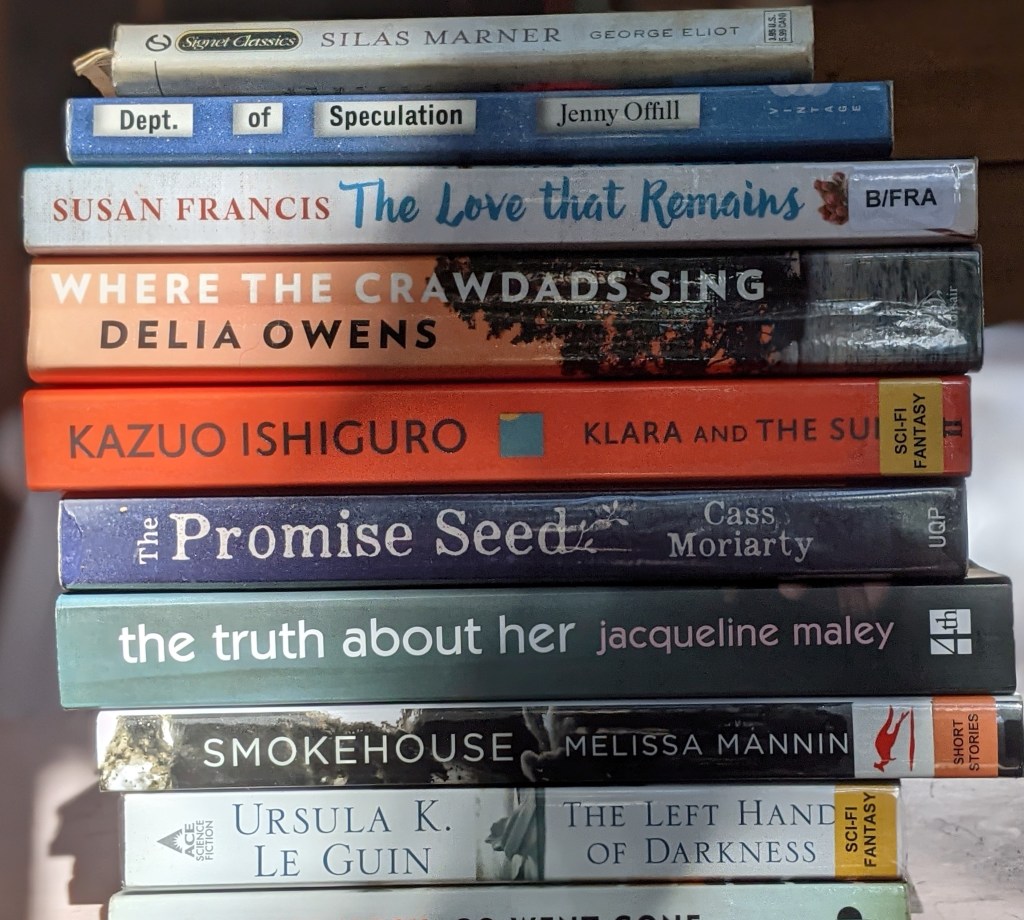
Where the crawdads sing by Delia Owens, Corsair, 2018

Long slow exhale of breath.

Now I understand the bestseller status, the brilliant reviews and the fact that it’s under the Popular 2 weeks borrowing category at my local library. This book is absolute immersion into another time and place. Place specifically.

The natural world is all the family and comfort that Kya knows. She lives in an isolated shack on marshland in North Carolina. Slowly abandoned by her mother, siblings and father, she digs mussels and smokes fish to get by. And with all the other lonely hours of the day she observes the life of the marsh; birds, shells, insects, waterways.

How’s this for an opening paragraph?

Swamp water is still and dark, having swallowed the light in its muddy throat. Even night crawlers are diurnal in this lair. There are sounds, of course, but compared to the march, the swamp is quiet because decomposition is cellular work. Life decays and reeks and returns to the rotted duff; a poignant wallow of death begetting life.

In the next paragraph, two local boys discover the body of the town’s young hero footballer. There’s a lot of gossip and Kya is named as a suspect.

I loved, loved, loved this book. Delia Owens is a zoologist so her knowledge of the environment she’s writing about is as detailed as it is poetic.

This was her debut novel which she published when she was 70. There is hope for us all!

Dept. of Speculation by Jenny Offill, Granta 2015

Imagine Helen Garner’s diaries with their conversational snippets except more specifically about motherhood, mental (un)health and a marriage going south. Then intersperse it with quotes from Rilke and some philosophers, stories of past space quests and odd bits of trivia.

That is the Dept. of Speculation. Easy to read but very hard to explain. If you need continuous linear narrative, maybe not your thing. But if you like to fill in some the gaps, and don’t mind moving on from vignette to vignette, then you’ll enjoy this.

Smokehouse by Melissa Manning, UQP, 2021

Confession – my current work-in-progress is a collection of interconnected short stories, so it’s no surprise that I’m a big fan of…. interconnected short stories. I love the progression and span you get but also the gaps that you can fill in as a reader (see Jenny Offill above). I also love that what’s background in one story can be the focus in the next.

I think this book is divine. It starts with Nora who’s just made a sea/treechange with her husband and two young daughters. They’ve bought a block in a small town south of Hobart and they’re going to build a mud brick house. But the dream is dissolving and so is her marriage. By the end of this collection relationships have come and gone, children have grown up, friendships have developed and health has failed. We know who runs the shop and works at the local school, which neighbours who talk to each other and who is nursing their own quiet grief.

Tassie also offers its own extremities to these narratives, in temperature and location. By the end of it, you’ll feel like a local too.

And if you need to hear more, check out Cass Moriarty’s review.

This Taste for Silence by Amanda O’Callaghan, UQP, 2019

Another collection of short stories. I’ve always got one or two on the go. You’re in such good hands with Amanda O’Callaghan. Just like a good actor doesn’t make you think they are acting, a good writer makes you feel like the stories aren’t ‘written’. These stories feel like you’re reading about lives that just happen to be written down.

You’re in Queensland, then Brooklyn, then London or Adelaide. There’s a mix of flash fiction and longer pieces, so you’re in and then out again, wondering what might come next.

The love that remains by Susan Francis, Allen & Unwin, 2020

Susan Francis’ memoir is testament to the fact that we never know the narrative of our life until we live it. She thinks she is defined by the fact that she’s adopted and doesn’t fit in anywhere but in her 50s, Susan meets Wayne. It’s a spectacular love story that neither of them expected. They get married and decide to sell up and move to Europe for a loved-up year of travel and life at their own pace.

It looks like this is going to be the new story about love and sex and identity and travel. But life is never so linear and neat.

This generous and beautiful book follows some of the biggest questions we ask about our ourselves. Who am I? Who is the person I love? Where do I belong? What is a good life?

Klara and the sun by Kazuo Ishiguro, Faber, 2021

The world here feels similar to his Never Let Me Go – a near future where some people have been genetically modified but not everyone. Klara is an AF (artificial friend). She wants to understand everything about the world and humans.

When human behaviour is observed and analysed by an outsider, you wonder how we think all this shit that we do is actually normal. And how is it that we don’t misunderstand each other more than we do?

Although the initial chapters move monotonously, perhaps as they would for Klara when she’s waiting in a shop for someone to buy her, it’s always a subtle journey with Ishiguro. He’s asking ethical and moral questions about machines and humans. What is it to be human? Is there something limitless inside us that can never be replicated or are we finite and knowable?

The truth about her by Jacqueline Maley, 4th Estate, 2021

This is a fresh one. It only launched mid-May and the ink on my signed-copy has barely dried. I’m a big fan of Jacqui’s column for SMH and the Age and am happy to be happy about her debut novel now too.

Suzy’s husband has left without a forwarding address. She’s holding down a fulltime journalism job, looking after her 4-year-old daughter and sleeping with two different guys. Things really start to unravel though, when a wellness influencer who she exposed, commits suicide.

I like it when characters have jobs, worry about money and still have to pick nits out of pre-school hair while their world is crumbling around them. This will keep you turning the pages and gunning for Suzy to win a trick.

The Left Hand of Darkness by Ursula le Guin, Ace (Penguin), 2010

Genry Ai has been sent as an Envoy by the Ekumen of Known Worlds, to study the Gethenians on Winter and ask them to join the Ekumen. On the planet Winter there is no gender. The Gethenians can become male or female during their mating cycle.

This book, written in 1969, wasn’t what I expected. I was thinking it would be a more obvious quest and hero’s journey. But the first half of the book is mostly politics, alliances and old lore to make more sense of the world of Winter and its inhabitants.

The second half of the book is a journey with Genry and an exiled advisor, Estraven. The relentlessness of ice, snow and cold conditions is the foe they fight and the journey is that of two beings who are alien to each other but develop a bond and understanding.

It was a slow burn for me. The real accomplishment here is the creation of another world complete with its own calendar, language, customs and history. It’s as rich as any Tolkien kingdom. But if you need character-based action and tension, you’ll be looking for it in a snowstorm.

Silas Marner by George Eliot, 1999, Signet Classics

You’ve got to be match-fit to read a classic or have the patience to give it time and let it be what it is rather than what you’re used to – more on that in my Reading the Classics post.

It feels like visiting somewhere with a rusty knowledge of the language. Everything is familiar but not immediately decipherable but then with a little more exposure it clicks and you’re off.

Silas Marner is an isolated weaver who is robbed, takes in an orphan and finds a reason to live. What you’re reading about is people being people. In this case, people are greedy and proud and lie because they think it’s for the greater good. The love and care of a child makes the world new and the loss of one is felt forever. It’s love and loyalty and families, just like it is now.

And now that I’ve got the classic cogs spinning again, I think I might try one of the Russians.

The Promise Seed by Cass Moriarty, UQP,

An old man and a young boy form an unlikely friendship. They bond over chickens, chess and a need for company.

At 72, the narrator feels like he’s just going through the motions, something that has shaped most of his life. But it’s never too late for life to have meaning and what are we without human connection?

This story is about family and the inheritance of trauma. What happens when you have a family or long for one shapes the life we live and the people we become.

If you enjoyed reading this and want blog updates, subscribe to my monthly newsletter below.

Processing…
Success! You're on the list.

The bedside bookstack – April 2021

What I’m reading and what’s gathering dust on the bedside bookstack this month.

Lucky ticket by Joey Bui, Text Publishing, 2019

This collection of short stories was one of my favourite picks of the month. I was totally absorbed by the stories and binged on them more than I usually do with an anthology. I often go in and out of anthologies reading a few at a time in between novels. This collection however, made me want to move on to the next one and then the next..

The stories move from Vietnam to Australia to America to Abu Dhabi where we meet Vietnamese locals, migrants and expats as well as a Pakistani-American professional and a Zanzabari guest worker.

Bui writes in first and third person and skips from the distant past to a familiar present. One of my favourites was Mekong Love. Set in a more traditional Vietnam, it proves that lasting love can start in many different ways.

Both ways is the only way I want it by Maile Meloy, Text Publishing 2009

Thanks to @zbradley’s tweet about how long it had taken her to discover Maile Meloy. I wouldn’t have found my way to her either and what a loss that would’ve been.

There are 11 stories in this collection and they’re all achingly beautiful. I use that word deliberately. She’s doing something and I don’t know how she’s doing it. I go into a story as one person and come out slightly changed. I had to sit for a moment after some of these and just savour that feeling before jumping straight into the next one. I also had to reread paragraphs and flip back a page or two to see if I could trace her tricks and trap what it was she did to write such a good story. That in itself is the magic, I guess.

Gather the Daughters by Jennie Melamed, Tinder Press, 2017

God bless Kinokuniya bookshop in Sydney which had a booklet printed around the time of the March for Justice about kickass women’s reads. This was on that list.

If you’re not into island-bound traditions of women forced into submission and condoned abuses of power by the patriarchy, then this may not be for you. However, for every state of slavery there is a seed of revolution and the girls of this island are starting to question just why everything has to be the way it always has been.

Kept on the island by fear of the Wastelands on the horizon, girls adhere first to their father’s will and then their husbands. This is like a Handmaid’s Tale for pre-teens. Sometimes, when adults write kids, the voice is too laboured, but these girls are nothing but themselves and I never doubted their narrations.

Earthlings by Sayaka Murata, Granta, 2020

Whoa. This one is unlike anything I’ve ever read. “Out of this world” was one of the cover quotes and it’s right on because Natsuki and her cousin believe they are from another planet. They don’t understand the rules adults make for them and earthlings are confusing.

Kids trying to makes sense of adult behaviour and rules isn’t easy. They internalise who adults say they are and make leaps of deduction in doing so. Feeling like aliens because they don’t conform is a fair-enough link for children to make. As adults, life is no less confusing as they grapple with taboos and their place in the world.

The legacy of abuse and societal expectation make for a totally original but pretty heart-breaking read. It’s uncomfortable reading and won’t be for everyone because taboo is taboo and examining them from another angle doesn’t make them any less uncomfortable.

Sayaka Murata is best known for her book Convenience Store Woman which I haven’t read yet.

The Trespassers by Meg Mundell, University of Queensland Press, 2019

How was this book not on every pandemic reading list last year? This is the plague book that came out a year before COVID and its epidemiologic jargon became part of the vernacular.

The worst scenario of a pandemic future is already playing out in this book. The UK is a disaster zone and pandemic hotspot. There are no jobs, no supplies or stability and the death rate is constantly climbing. To get away, people are willing to take a ship to Australia where they are essentially indentured labour but unlikely to get sick.

On board are Billie, a Scottish singer who has experience of the death wards in Glasgow, Cleary, a deaf boy whose mum wants to give them a chance at a better future and Tom, a teacher from a wealthy family who now has no money to his name.

Three weeks into the journey a crewman is found murdered and people start getting sick. There are rumours and dissent and no way off the boat.

This book is a great read and a timely reminder that not every harbour offers safe haven and that it isn’t a crime to seek a better life.

Skylarking by Kate Mildenhall, Black Inc. Books, 2016

Set in the 1880s on an isolated cape in Australia, this book is about best friends Kate and Harriet. Their fathers are lighthouse keepers and the girls live with their families and workers in a small settlement. Things change for them when a fisherman arrives.

This book is a great read for elemental coastlines, intense female friendships, burgeoning desire, envy and the jumble of growing up.  

There is a foreshadowing from the very first page and as Kate continues her narration, she tells of regret and final moments and times before and after everything changes. As a reader you should get to enjoy all that anticipation and tension, so I’ll say no more.

The Labyrinth by Amanda Lohrey, Text Publishing, 2020

Erica’s son has been given a life-sentence. Locked in her guilt and grief she moves to a small coastal cottage to be closer to his prison. She is a woman alone and doesn’t want company but she does want to build a labyrinth in her backyard and to do that, she needs people.

I liked the pace of this book, the wash of days into each other and the gradual revealing and healing of Erica. I also happened to walk the labyrinth at Cenntenial Park in Sydney a few weeks ago, and now understand the meditative appeal of Erica’s project more.

One of my pet peeves in novels is the description of dreams. This book had way too many. But, all good, I just skimmed forward until we got back to the narrative.

Family Life by Akhil Sharma, Faber, 2014

Ajay moves from India to America with his parents and older brother. It’s the 70s and the Indian community in New York is small. A few months after their arrival, Birju, the older brother has a swimming accident that leaves him with brain damage. He is bedbound, unable to communicate and in need of constant care.

Family Life changes to accommodate this. First, he’s in a nursing home and Ajay and his mum live close while his dad commutes. Later they move to New Jersey and bring Birju home for his care.

For a long time, Ajay feels like life is happening around but not to him. There are family friends who think they can heal Birju, the women who think his mum is a saint and the fact that his dad is drunk all the time. But time passes and as nothing changes with Birju, things slowly do for Ajay and his parents.

Pachinko by Min Jin Lee, Head of Zeus, 2017

Still in the pile. Still haven’t started it yet. Next month I say.

This tome was my only Christmas book (and it actually arrived in January). Anything over 500 pages seems to sink further down the book stack for sheer stability of the pile.

Billed as a generational family saga about Koreans in Japan, I missed the hype of this book when it came out but put it on my wish list after listening to this interview with Min Jin Lee on Conversations.

Sounds like once I get stuck in, I won’t be coming up for air for a while.

If you enjoyed reading this and want blog updates, subscribe to my monthly newsletter below.

Processing…
Success! You're on the list.

The bedside bookstack – March 2021

What I’m reading and what’s gathering dust on the bedside bookstack this month.

It’s been a bit of a restless and sleepless month. I abandoned three books and I’m not sure if that’s a reflection of my state of mind or a decision to try and stick to my idea that life is too short to read books that just aren’t doing it for you.

Ghost Wall by Sarah Moss, Granta, 2018

Silvie’s father is an Ancient Briton enthusiast. He’s brought her and her Mum along on an Iron Age re-enactment with a university professor and his students. She’s named after an ancient Briton goddess and has been walking the moors and learning about her forebears since she was a little girl.

She knows the dark history and shadows of the area too, the ritual sacrifice and the bodies offered up by the bog.

And there are shadows in her own family, power and control and violence that blend with the history they are simulating.

This is a simple tale, very well told.

This slim little volume will linger.

Trick of the Light by Laura Elvery, UQP, 2018

It’s no secret from all my rescue reading lists that I’m a big short story fan. I read them and write them and I love how the form can compress or expand a life on the page.

That’s exactly what Laura Elvery has done in her debut collection. She has taken ordinary lives and held them up for us in all their heartbreak and glory. In her hands, with her words, they’re illuminated and made into something special. A great read and if you enjoy this, check out her collection Ordinary Matter which came out last year.

The Housekeeper and the Professor by Yoko Ogawa, Vintage, 2010

This beautiful book is about maths and memory. The housekeeper is our narrator. She goes to work for the professor who is on an 80-minute memory loop. He keeps notes attached to his suit so that he can recognise people in his life and the parts of his day. Her son comes to the house after school and together, the three of them form a special relationship despite the cycle of time and memory. Another simple story, well told and another one that has stayed with me.

The Coconut Children by Vivian Pham, Vintage, 2020

This is a great read about the migrant experience, the inheritance of loss and Cabramatta in the 90s.

Sonny lives life on the sideline. She tries to keep the peace at home where she lives with her volatile mum, her dad, grandma and brother. At high school, she and her best friend sit on the edges where their talk is all theory but not much practice. When Vinnie, an old childhood friend, gets out of juvie, Sonny starts to wonder how she can live both her internal and external lives.

Vivian Pham started this as part of a novella workshop with the Sydney Story Factory. I love their programs and have volunteered with them for years, so reading it was an extra special treat. And who better to write about teen desire and dislocation than someone who isn’t yet 20? Here’s a little taste:

“Why has his history always felt so fucking mythical? Vince felt an absurd and meaningless pain. It was like digging a grave and having nothing to bury.”

what are you going through by Sigrid Nunez, Virago 2020

This is what’s referred to as an ‘interior’ novel. My interpretation is that it feels like a conversational essay with a bit of narrative moving it along. In this case it came as a belated surprise that that was fine by me.

For more details see my post about reading this book, my first Sigrid Nunez, and how I nearly didn’t finish it.

The Friend by Sigrid Nunez, Penguin, 2018

So, now I’m confused, because this is the Sigrid Nunez book which was the bestseller. It’s written before what are you going through but I read it after and for me it wasn’t the better book.

The narrator is a writer (I’m not a big fan of writer-narrators) whose best friend has just committed suicide. The narrator inherits the friend’s dog and together they grieve for owner and friend.

The rest of the book reads, as above, like a relaxed essay with some narrative on the side. This time it looks at animals, humans, the state of modern literature and grief. There are always interesting authors, books and movies being referenced. She’s great for adding to your scribble list of things to look-up-later.

As a reader, my patience was with the asides and digressions but not with the friend who is being mourned. Here he is again, the American-novelist-professor-womaniser. Why is he always getting so much air play in novels? Why is no one calling him out? In this case, the cultural tide is turning against his behaviour, but not the narrator (it’s up to us to decide if she was in love with him or not). Just like when I read Meg Worlitzer’s The Wife, my annoyance at how much these guys get away with and the fact that they’re still getting so much air-play, is what stays with me.

Before the Coffee gets cold by Toshikazu Kawaguchi, Picador 2019

I totally judged this book by its cover. A big pink Staff Pick sticker under Japanese Bestseller was what made me pick it up.

It’s set in a small basement café in Tokyo where you can go back in time. There are 5 rules; you have to sit in a certain seat, you can only stay in that seat, you can only meet someone else who has been in that café before, meeting won’t change the present and most importantly, you have to come back before the coffee gets cold.

There’s a lot of repetition with each new customer who wants to go back in time which snagged the narrative for me. I got two thirds through and realised I just wasn’t invested. It’s a subtle book that wasn’t right for me this time round.

The Bodysurfers by Robert Drewe, Penguin, 2009

Another book with a big Staff Pick sticker. The word iconic and classic are also mentioned in the blurb and I haven’t read any Robert Drewe for ages. I liked the early short stories of the Lang family but I put it down before the end.

The male protagonists had an emotional distance that kept me at bay. They were at their best with their observations as a father or failure as a husband.

It was also hard to read the story written from the point of view of a rapist. Reading it in the current climate (or any climate really), it felt like a voice was being given to the wrong side of the story.

The Paper House by Anna Spargo-Ryan, Picador, 2016

After miscarrying their first baby, Heather and Dave leave the city. Dave gets a job at the local school but Heather is sinking. She’s drowning in the loss of her child and the memories of her mother who she is also gone.

This is well written but with my restlessness and sleeplessness, I just couldn’t stay the course with Heather’s heavy grief and depression. I left her early on to tend to my own mental health.

The Book of Joe by Jonathon Tropper, Delacorte Press, 2004

Joe hasn’t been back to his hometown for 17 years. He did however write a bestseller about it that annoyed almost everyone. When he returns after his father has a stroke, the welcome is about how you’d expect it to be.

The sentences aren’t sublime and it trots around small-town-story territory (high school loves, sibling rivalry, fractured father/son relationships) but it’s very readable!

This reads like a Netflix teen movie and if anyone’s seen my streaming history, you’d know I’m pretty partial to those.

Pachinko by Min Jin Lee, Head of Zeus, 2017

Still in the pile. Still haven’t started it yet. Next month I say.

This tome was my only Christmas book (and it actually arrived in January). Anything over 500 pages seems to sink further down the book stack for sheer stability of the pile.

Billed as a generational family saga about Koreans in Japan, I missed the hype of this book when it came out but put it on my wish list after listening to this interview with Min Jin Lee on Conversations.

Sounds like once I get stuck in, I won’t be coming up for air for a while.

If you enjoyed reading this and want blog updates, subscribe to my monthly newsletter below.

Processing…
Success! You're on the list.