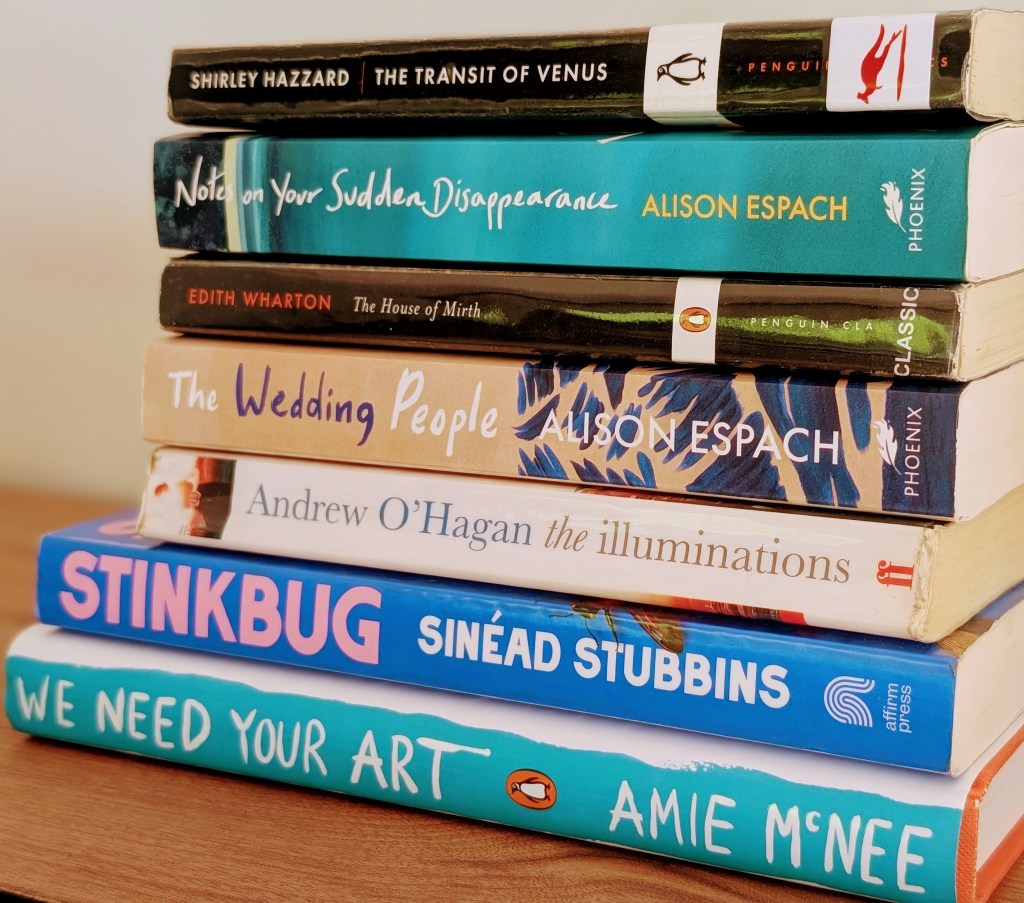
The Wedding People by Alison Espach, Phoenix, 2024
Phoebe goes to a heritage oceanside hotel in Rhode Island to kill herself. She’s been enduring life for the past two years but has nothing left to keep her going. The hotel however, has been completely booked out for the next week for Lila and Gary’s wedding.
I don’t know how she does it but depression and suicide sit respectfully next to drama and romance without either losing their shape in this book which I feel is flying way too far below the radar in Australia.
This was my read of the summer. I just loved it. It’s one of those books where again and again you think ‘Yes, that’s exactly how it is. That’s exactly what we’d say, how it feels.’ I loved it. The depth and the humour were just perfect.
Notes on Your Sudden Disappearance by Alison Espach, Phoenix, 2022
Loving The Wedding People so much, I immediately looked up Alison Espach’s back catalogue and got my hands on this one lickety split.…..it was also great. I loved it as much as The Wedding People. They’re very different books but also incredibly similar in that she’s done it again, managed to very seamlessly and respectfully blend humour and hope with the darker themes of grief and loss.
Sally’s sister Kathy dies suddenly in a car crash at 16. The novel is written in second person (not easy to pull off) with Sally telling Kathy about everything that has happened since her death.
The Book of Alchemy by Suleika Jaouad, Square Peg (Vintage) , 2025
A new book to add to my Top 5 for writers – although this one is actually for anyone. I’m always needing a reset with my relationship to writing and looking for a low stakes way back in to creating a regular habit. This book feels biblical to me at the moment, also in its achievability. I have very little free time and it only demands about 15 minutes (that’s a minimum – you could write for as long as you need/want).
This was born out of the pandemic when Suleika Jaouad needed something to tether her to the timeless days. For 100 days she got different friends/writers/creatives to post a short essay with a journalling prompt related to it. And that’s what this is, 100 mini essays divided into 10 themes with something to think about and write at the end of each one. Sitting down with this book is one of the highlights of my day. An absolute read (and write) recommendation for anyone who believes in the magic that can happen when you journal.
We Need Your Art by Amie McNee, Penguin, 2025
Another creativity call-to-action. I know that over the summer I’m never going to get much time to work on any of my writing projects, so I like to read craft and creativity books. This one was also timely for me. If you’ve been reading the Bookstack for a while, you’ll know that I lost my mum last year. There was not a lot of writing that happened and once you’re in that vortex, it can be hard to find a way back to the page.
Amie McNee’s book was written for someone like me, who is unlikely to see hours of uninterrupted writing time for years maybe. Her manifesto is simple. Firstly, give yourself permission to create. Don’t wait for gatekeepers to grant it and don’t not do it because of possibly shit outcomes. Secondly, don’t set aside precious tracts of time for it that are then so laden with expectation that anything less than perfection is possible, because of course perfection freezes things up and is a great way to not do anything. All of this was sounding very familiar to me. Her suggestion is to create daily/regularly for short amounts of time. It’s low-stakes and high output/practice and we all know that the process and doing is where the real sustenance is.
Stinkbug by Sinead Stubbins, Affirm Press, 2025
Edith and her ad agency colleagues are sent to a remote corporate team building retreat for a few days. They’re being bought by a Swedish company and no one knows if this is a way to choose who stays after the deal. This is a dark satire on workplace dynamics, corporate expectations and the intense relationships you can have with people you don’t have that much in common with.
For me, Edith was an interesting exercise in reading an unlikeable female character. She drove me mad for the first half of the book and then she started accessing more of her rage/power/sense of self which was a relief. Has made me think about our expectations of what an author is offering us in their characters and why I seem to think they shouldn’t be uncomfortable to read. I was surprised by how much she riled me up.
The Illuminations by Andrew O’Hagan, Faber & Faber, 2015
I think Andrew O’Hagan is an absolute master, so it was interesting that this book took me ages to read. I’m still trying to figure out if my late December back-to-back romance binge changed my reading ability so that I was used to quicker returns on my reading or if it’s still too soon for me to be reading an Alzheimer’s narrative when I so recently lived through one.
Anne Quirk used to be a photographer. She’s now in independent living recalling the old days of Harry, her love, and their time in Blackpool together. This is beautifully written in snippets which nicely mirror not only Anne’s memories coming and going but also the photos she took when she was younger. I like this structure, bouncing around and not beholden to strict linear progression.
There’s a parallel narrative with Anne’s grandson, Luke, who serves over in Afghanistan. As he grapples with the present, she conjures up her past and in the middle is her daughter, who knows that often memories are what you want them to be.
The Transit of Venus by Shirley Hazzard, Penguin (with intro by Lauren Groff), 2021
This one feels like a rerun of my experience with The Illuminations. I’m loving it but it’s taking me ages to read. The writing is so rich and gorgeous and clever but I feel like I’ve wrecked my brain a bit for ‘hard’ books, so when I’m tired at night, I just don’t reach for it. If I wake early and can snatch a few quiet minutes, I read it and have to re-read whole passages for how clever they are.
This is about two Australian sisters who have moved to post-war England. I’m only at Chapter 4 but especially love reading about how an antipodean experiences the northern hemisphere. It may have been written decades ago but it feels the same to live through the distinct seasons of a continental climate (with its extremes of green and the long loss of it) when you’ve only ever read about them.
Not usually big on reading introductions to books but this edition has one by Lauren Groff, so happily changed my habit.
If you enjoyed reading this and want to hear about the next bookstack, subscribe to my bi-monthly newsletter below.
 Nina Cullen